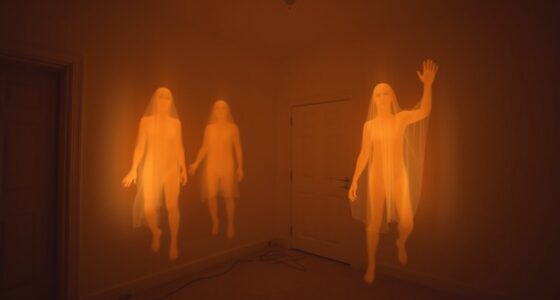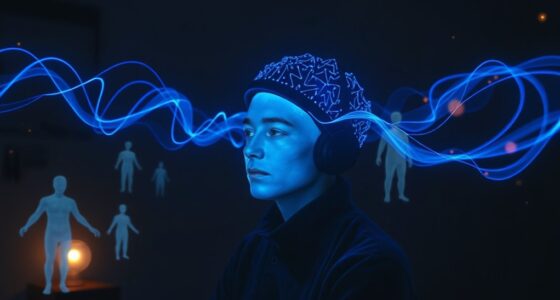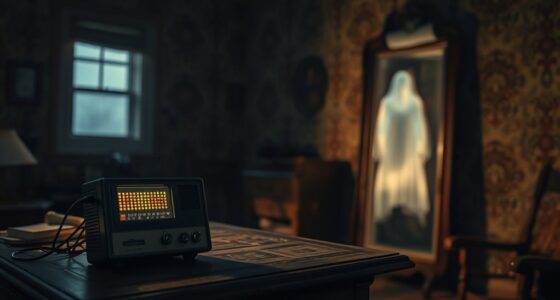
Science studies paranormal claims by using rigorous methods like forming testable hypotheses, conducting controlled experiments, and analyzing data carefully. Researchers try to reproduce results and rely on peer review to check validity. Many experiments have mixed results, often due to methodological flaws or psychological explanations like biases and perception errors. If you’re curious about how these investigations balance skepticism with curiosity, there’s a lot more to explore behind the methods and findings.
Key Takeaways
- Scientists develop testable hypotheses and design controlled experiments to evaluate paranormal claims objectively.
- Replication and peer review are essential for validating findings and ruling out false positives in paranormal research.
- Data is analyzed statistically to determine if results significantly deviate from chance, supporting or refuting claims.
- Researchers critically assess methodology, identify biases, and address reproducibility issues to ensure scientific integrity.
- Natural explanations like cognitive biases and perception errors are considered alongside experimental evidence to interpret paranormal phenomena.

UNGLINGA 150 Experiments Science Kits for Kids, S.T.E.M Educational Project Toys for Boys Girls Birthday Gifts Ideas, Volcano, Chemistry Lab Tools Scientist Set
150 EXCITING EXPERIMENTS FOR KIDS: DIY projects to get kids' minds humming, try one of these science experiments,…
As an affiliate, we earn on qualifying purchases.
As an affiliate, we earn on qualifying purchases.
Historical Perspectives on Paranormal Investigations
Throughout history, people have sought to understand unexplained phenomena by investigating claims of paranormal activity. Ancient civilizations documented strange occurrences, from ghost sightings to mysterious voices, often attributing them to spirits or divine forces. During the Middle Ages, supernatural explanations dominated, with investigations driven by religious beliefs. The 19th century saw a surge in interest with spiritualism and séances, where mediums claimed to communicate with the dead. These investigations often combined skepticism with curiosity, yet lacked scientific rigor. As the centuries progressed, some investigators aimed to bring a more systematic approach, though many claims remained rooted in anecdotal evidence. This historical context highlights humanity’s long-standing desire to explore the unknown, setting the stage for modern scientific scrutiny of paranormal claims. Additionally, the development of analytical tools and a greater understanding of natural phenomena have helped differentiate scientific explanations from supernatural ones.
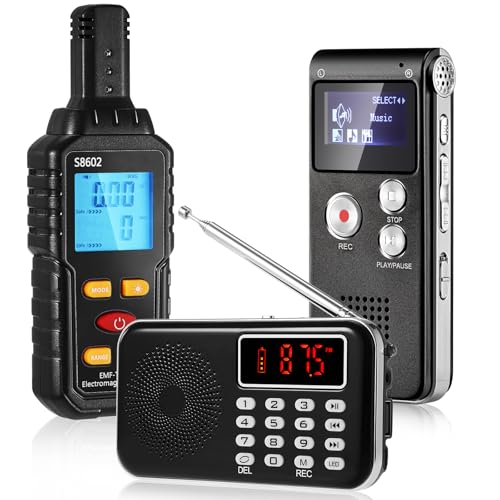
Relaxweex 3 Pcs Ghost Hunting Equipment Kit Includes 1 Pcs 8GB Audio Recorder 1 Pcs Emf Detector Emf Meter Magnetic Field Detector 1 Pcs Fm Radio EVP Recorder for Paranormal Research (Emf Meter1)
Complete Package: this ghost hunter equipment has everything you need to start your detection journey; It includes a…
As an affiliate, we earn on qualifying purchases.
As an affiliate, we earn on qualifying purchases.
Scientific Methodology in Testing Paranormal Phenomena
To scientifically evaluate paranormal phenomena, researchers rely on the principles of the scientific method to guarantee objectivity and reproducibility. You begin by forming clear, testable hypotheses based on observed claims. Next, you design controlled experiments that minimize biases and extraneous variables. Precise measurement tools are essential to gather reliable data. During testing, you record all conditions meticulously, ensuring transparency. Analysis involves statistical evaluation to determine whether results deviate markedly from chance. If findings suggest an effect, you verify by repeating experiments under similar conditions. Throughout the process, you remain open to falsification, ready to discard or modify hypotheses that don’t hold up. This rigorous approach helps distinguish genuine phenomena from illusions, biases, or errors, maintaining scientific integrity when exploring claims often dismissed as paranormal. Additionally, understanding the factors influencing alimony awards can shed light on how external variables might affect experimental outcomes in studies of paranormal claims.

Statistical Analysis of Network Data with R (Use R!)
As an affiliate, we earn on qualifying purchases.
As an affiliate, we earn on qualifying purchases.
The Role of Replicability and Peer Review
Replicability and peer review are essential to establishing the credibility of paranormal research. When you conduct studies, you need others to reproduce your results to confirm their validity. Replication helps weed out false positives or accidental findings, ensuring that claimed phenomena aren’t just flukes. Peer review acts as a gatekeeper, where experts critically evaluate your methodology, data, and conclusions before publication. This process helps catch errors, biases, or unsupported claims that might otherwise mislead the scientific community. Without these steps, paranormal studies risk being dismissed as unreliable or pseudoscientific. Additionally, ongoing cybersecurity threats emphasize the importance of rigorous security measures to protect sensitive research data. By emphasizing replicability and rigorous peer review, the scientific community can better assess whether paranormal claims hold up under scrutiny or fall apart when tested by independent researchers.

Getvow Reading Journal – Review and Track Your Reading Progress with 72 Book Reviews – Book Journal Reading Log Journal with Back Pocket, 5.8" x 8.3", Black
ORGANIZE AND TRACK YOUR READING – This reading journal allows you to easily track and review every book…
As an affiliate, we earn on qualifying purchases.
As an affiliate, we earn on qualifying purchases.
Challenges in Measuring and Reproducing Paranormal Events
Measuring paranormal events is tough because experiments often can’t be reliably replicated. You’ll find that anecdotal reports vary widely, making it hard to establish consistent evidence. These challenges raise important questions about how science can properly evaluate such claims. Additionally, the resources and tools available for investigating these phenomena are often limited, which complicates efforts to obtain conclusive results.
Replication Difficulties in Experiments
One of the main hurdles in studying paranormal claims is the difficulty researchers face when trying to replicate experiments. Paranormal phenomena often depend on subtle conditions that are hard to control or reproduce consistently. Small variations in environment, timing, or participant mindset can cause significant differences in outcomes. When you attempt to reproduce a study, you might find the results don’t match the original, raising questions about their reliability. This lack of standardized protocols makes it challenging to establish scientific credibility. Additionally, many studies lack detailed protocols or fail to document critical variables, further hindering replication efforts. As a result, even when initial findings seem promising, the inability to reproduce them casts doubt on their validity and complicates efforts to understand these phenomena scientifically.
Variability of Anecdotal Reports
A significant challenge in evaluating paranormal claims lies in the wide variability of anecdotal reports. You’ll notice that different individuals describe similar events very differently, making it hard to establish consistent patterns. Factors like personal perception, memory biases, emotional states, and environmental differences influence these accounts. Sometimes, the same person reports conflicting details about an event, complicating efforts to verify claims. This variability hampers scientific investigation because it’s difficult to determine whether reports stem from genuine phenomena or subjective interpretations. Without standardization, comparing reports across witnesses becomes nearly impossible. As a result, researchers struggle to differentiate between authentic paranormal events and misperceptions or exaggerations. The inconsistencies in anecdotal evidence pose a major obstacle to understanding and validating paranormal claims scientifically. Additionally, variability of anecdotal reports complicates efforts to establish reliable data patterns necessary for scientific validation.
Notable Experiments and Studies in the Field

You’ll find that telepathy experiments have produced intriguing, if controversial, results over the years. Remote viewing research has attempted to demonstrate the ability to perceive distant or unseen targets under controlled conditions. Exploring these studies helps you understand the scientific debates surrounding paranormal claims. Additionally, some researchers have investigated Kia Tuning techniques as a metaphor for understanding how perceptions of control and modification influence belief in paranormal phenomena.
Telepathy Experiments Overview
Telepathy experiments have long captivated researchers and skeptics alike, aiming to determine whether thoughts can be transmitted directly from one person to another without physical interaction. Over the years, studies have yielded mixed results, often marred by methodological flaws or statistical anomalies. Notable experiments include the Ganzfeld studies, which tested sensory deprivation, and the Remote Mental Influence experiments. The table below summarizes some key aspects:
| Experiment Type | Notable Findings | Criticisms |
|---|---|---|
| Ganzfeld Studies | Slightly above-chance results, inconsistent | Susceptible to sensory leakage |
| Remote Viewing | Some accurate descriptions, debated validity | Lack of replicability |
| Mental Influence | Mixed success, often anecdotal | Small sample sizes, bias |
These experiments continue to fuel debate over telepathy’s scientific legitimacy. Understanding scientific methods remains crucial when interpreting such findings.
Remote Viewing Research
Remote viewing has garnered significant attention as one of the most studied forms of paranormal perception, building on earlier experiments that sought to prove the mind’s ability to access distant or hidden information. Researchers like Harold Puthoff and Russell Targ conducted controlled laboratory studies in the 1970s, where participants attempted to describe locations or objects they couldn’t see. Some experiments reported results above chance levels, sparking ongoing debate about their validity. The Stargate Project, funded by the U.S. government, aimed to explore remote viewing’s potential for intelligence gathering during the Cold War. Despite these efforts, replication failures and methodological critiques cast doubt on consistent success. Today, remote viewing remains a controversial area, with skeptics emphasizing psychological explanations and proponents calling for further rigorous research.
Psychological and Cognitive Explanations for Paranormal Experiences
Many paranormal experiences can be explained through psychological and cognitive processes that influence how you perceive and interpret the world around you. For example, your brain often seeks patterns and meaning, even when none exist, leading to false perceptions like seeing faces in random objects or hearing voices in noise. Cognitive biases, such as confirmation bias, cause you to focus on evidence supporting paranormal beliefs while ignoring contradictory information. Memory distortions, like the tendency to recall events as more significant or accurate than they were, also play a role. Additionally, emotional states like fear or grief can heighten sensitivity to unexplained events, making them seem more extraordinary. These mental processes shape your experiences, often giving them a paranormal appearance even when rooted in ordinary psychological functions. Furthermore, the trustworthiness and vulnerabilities of AI models can influence how information about paranormal phenomena is presented and perceived, highlighting the importance of critical evaluation of sources.
The Impact of Cultural and Media Influences on Paranormal Research
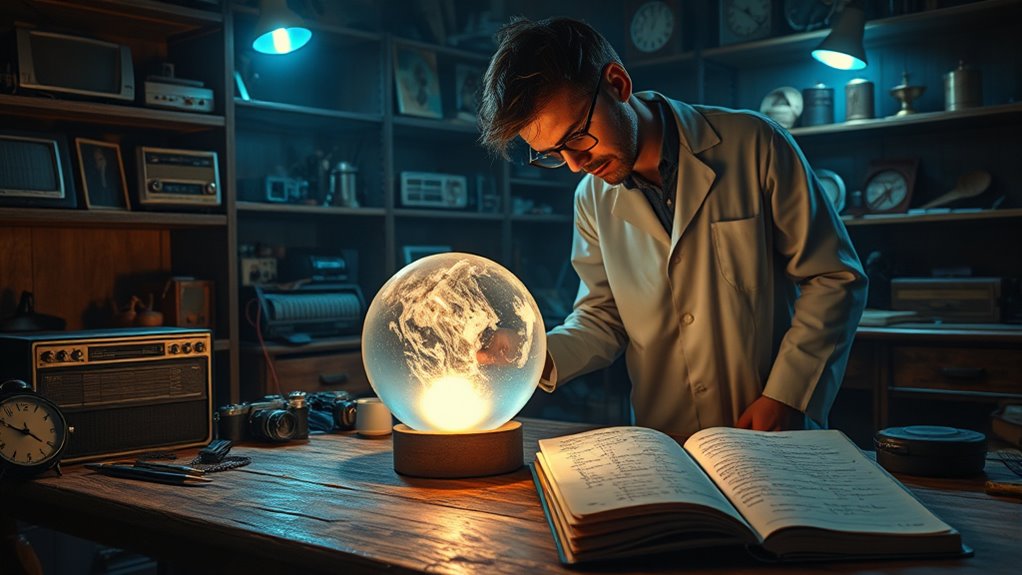
Cultural beliefs and media portrayals substantially shape how you interpret paranormal phenomena. When TV shows, movies, and books depict ghosts, UFOs, or psychic powers, they influence what you consider possible or real. These portrayals often emphasize sensationalism, making paranormal claims seem more credible and exciting. As a result, you might approach paranormal research with preconceived notions rooted in popular culture, rather than scientific skepticism. Media also reinforce cultural stereotypes, affecting who investigates these phenomena and how they do so. This environment can lead to confirmation bias, where you see what you expect to see. Additionally, media sensationalism amplifies the perception of paranormal activity, further skewing public understanding. Ultimately, cultural and media influences create a framework that guides your perceptions and expectations, shaping the way you interpret and evaluate paranormal claims.
Frequently Asked Questions
How Do Paranormal Claims Originate Across Different Cultures?
Paranormal claims originate from cultural stories, beliefs, and traditions that are passed down through generations. You might notice that different societies interpret unusual experiences through their unique worldviews, shaping their explanations for phenomena beyond scientific understanding. These claims often reflect societal values, fears, and hopes. As you explore diverse cultures, you’ll see how these beliefs evolve, blending local history, spirituality, and communal experiences into compelling narratives that persist over time.
What Technological Tools Are Used to Detect Paranormal Activity?
You use electromagnetic field meters, infrared cameras, and audio recorders to detect paranormal activity. These tools scan for unusual energy fluctuations, capture unseen movements, and record eerie sounds, creating a digital net cast into the unknown. By analyzing these signals, you seek clues that might hint at supernatural presence. Just like a detective uses different tools to solve a mystery, you rely on technology to uncover hidden phenomena lurking beyond ordinary perception.
Can Personal Beliefs Influence Scientific Investigations of the Paranormal?
Yes, your personal beliefs can influence scientific investigations of the paranormal. If you hold strong beliefs, you might unconsciously interpret data to fit those views or overlook evidence that contradicts them. Your biases can shape the questions you ask, the methods you choose, and how you analyze results. To maintain objectivity, it’s essential to recognize your beliefs and aim for impartiality throughout your investigation process.
Are There Any Undisclosed or Classified Paranormal Research Projects?
You might think classified paranormal projects are like hidden treasures buried deep, but there’s little concrete proof they exist. Governments and agencies keep many secrets, yet credible evidence of undisclosed paranormal research remains scarce. While some speculate about covert experiments, most scientific communities remain skeptical, viewing such claims as myths or misinterpretations. So, until proven otherwise, it’s safe to say that if secret projects do exist, they’re tightly locked away, out of sight.
How Do Legal and Ethical Considerations Affect Paranormal Research?
Legal and ethical considerations substantially impact your paranormal research by ensuring you respect privacy, avoid harm, and follow regulations. You must obtain proper permissions, avoid deception, and handle sensitive information responsibly. These rules protect participants and maintain scientific integrity, preventing exploitation or misinformation. By adhering to legal and ethical standards, you foster trust and credibility, making your research more valid and respected within the scientific community.
Conclusion
As you explore how science studies paranormal claims, remember that over 80% of reported phenomena lack reproducibility, highlighting the challenge of verifying these events. While skepticism remains essential, understanding psychological and cultural influences can shed light on why these experiences occur. By applying rigorous scientific methods, you can better distinguish between genuine mysteries and illusions, helping you navigate the fascinating intersection of science and the supernatural with a clearer, more critical perspective.