
Science aims to explain many phenomena, but it faces challenges with paranormal events. These include difficulties in collecting consistent evidence, replicating experiences, and overcoming subjective perceptions influenced by biases. While technology and new methods improve investigations, some phenomena remain elusive or possibly outside scientific reach. As you explore further, you’ll discover how scientific efforts and philosophical debates shape our understanding of these mysterious occurrences.
Key Takeaways
- Scientific methods face challenges in reliably replicating and measuring paranormal phenomena, limiting definitive explanations.
- Many paranormal events are attributed to psychological, cognitive, or environmental factors rather than empirical evidence.
- Technological advancements aid investigation but often cannot conclusively validate or falsify paranormal claims.
- The inherent subjectivity and fleeting nature of such phenomena hinder their study within current scientific frameworks.
- Philosophical and theoretical limits suggest some aspects of paranormal events may remain beyond scientific understanding.
Top picks for "science explain paranormal"
Open Amazon search results for this keyword.
As an affiliate, we earn on qualifying purchases.
The Scientific Method and Its Limitations in Paranormal Research
While the scientific method is a powerful tool for understanding the natural world, it faces significant challenges when applied to paranormal events. These phenomena often lack consistent, measurable evidence that can be tested repeatedly. You might try to observe or replicate paranormal activity, but results tend to be inconsistent or subjective. Many events are fleeting or influenced by personal perception, making objective analysis difficult. Additionally, paranormal claims often rely on anecdotal evidence, which doesn’t meet scientific standards. This limits your ability to formulate hypotheses or conduct controlled experiments. As a result, the scientific method struggles to verify or falsify paranormal phenomena reliably. The difficulty in applying empirical research methods to these phenomena means that many claims remain unsubstantiated. Ultimately, these limitations mean that science cannot fully embrace paranormal events as empirical facts, leaving many questions unanswered.
Historical Cases of Paranormal Phenomena Investigated by Science
Throughout history, numerous cases of paranormal phenomena have attracted scientific attention, despite the challenges posed by their elusive nature. You might have heard of the Cottingley Fairies, where photographs convinced some skeptics of fairy existence until skeptical analysis surfaced. Similarly, the Enfield Poltergeist in England drew investigators who documented unexplained knocking sounds and moving objects, sparking debates on psychological versus supernatural origins. Another notable case is the Phoenix Lights, where thousands reported seeing strange formations in the sky; scientists analyzed the sightings but couldn’t definitively explain them. These cases exemplify how science has attempted to understand paranormal events through observation and investigation, often revealing natural or psychological explanations. Additionally, the limits of scientific inquiry demonstrate the difficulties in studying phenomena that may be influenced by perception, belief, or unseen forces, highlighting both the persistent curiosity and the limitations faced when confronting phenomena that defy conventional scientific understanding.
The Role of Technology in Uncovering Paranormal Mysteries

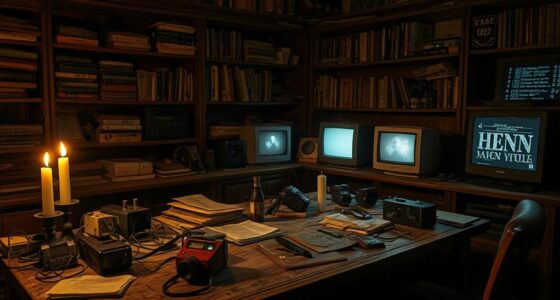
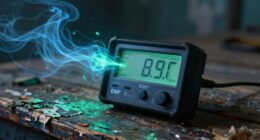
Advancements in technology have transformed how investigators explore paranormal mysteries, offering new tools to analyze and document phenomena that once defied scientific scrutiny. Devices like electromagnetic field meters, infrared cameras, and digital voice recorders allow you to gather concrete evidence in real-time. These tools help you detect subtle energy changes, capture unexplained sounds, or record visual anomalies that were previously invisible. Software algorithms now assist in analyzing data, identifying patterns, and filtering out false positives. With these innovations, you can approach paranormal investigations more systematically and objectively. Technology enables you to document phenomena precisely, increasing credibility and paving the way for scientific evaluation. Additionally, understanding air quality and environmental factors can help differentiate genuine phenomena from natural causes. Overall, these tools empower you to explore mysteries with greater rigor, moving beyond mere speculation.
Psychological Explanations for Paranormal Experiences
Many paranormal experiences can be explained by psychological factors that influence how you perceive and interpret the world around you. Your mind tends to fill in gaps in information, creating sensations or memories that seem real but are actually products of your subconscious. Stress, fatigue, and emotional states can heighten your sensitivity to unusual stimuli, making you more likely to interpret ordinary events as paranormal. Cognitive processes like pattern recognition lead you to see familiar shapes or figures in random shadows or sounds. Additionally, your expectations and beliefs can shape your experiences, causing you to notice and remember events that fit your worldview. The type of paint sprayer used can also affect the perception of the environment, influencing how one interprets ambiguous stimuli. By understanding these psychological influences, you can better grasp why many paranormal encounters might not be supernatural at all but rooted in your own mind.
The Impact of Cognitive Biases and Perception on Belief in the Paranormal

Your beliefs and expectations heavily influence how you interpret ambiguous or unusual experiences. Cognitive biases, like confirmation bias, lead you to notice evidence that supports what you already believe about the paranormal, while ignoring conflicting information. The availability heuristic makes you more likely to believe in sensational claims because vivid stories are easier to recall. Perception also plays a role; your mind may fill in gaps or interpret normal events as extraordinary based on suggestion or context. These biases shape your perception, reinforcing paranormal beliefs even without concrete evidence. Recognizing how your mind filters and distorts information helps you understand why many people remain convinced of paranormal phenomena, despite scientific explanations. Additionally, eye patches demonstrate how targeted interventions can temporarily alter perceptions, illustrating the power of external stimuli on subjective experience. Your subjective view markedly impacts your belief system, often more than the actual evidence.
Notable Scientific Experiments and Their Findings on Paranormal Claims
Numerous scientific experiments have tested paranormal claims to determine whether they hold up under controlled conditions. For example, researchers have conducted tests on telepathy, ESP, and psychokinesis, often with rigorous protocols. Many experiments have yielded null results, suggesting no reliable evidence for these phenomena. Some notable studies include the Ganzfeld experiments for telepathy and the PEAR lab’s psychokinesis tests. To visualize their findings:
| Experiment Type | Key Results |
|---|---|
| Ganzfeld Telepathy | No consistent, replicable evidence of mind-to-mind transfer |
| PEAR Psychokinesis | Failed to produce statistically significant effects |
| Remote Viewing | Limited accuracy, inconsistent results |
These experiments underscore the difficulty in scientifically verifying paranormal claims, often pointing to alternative explanations like chance or bias. Additionally, experimental controls are crucial to eliminate biases and ensure the validity of findings in such studies.
The Future of Paranormal Investigation: Emerging Technologies and Approaches
While rigorous scientific tests have yet to confirm paranormal phenomena, advances in technology are opening new avenues for investigation. You can now leverage sophisticated tools to capture elusive evidence. For example,:
- High-resolution thermal imaging detects subtle temperature changes linked to supposed paranormal activity.
- Real-time audio analysis uses AI to filter out background noise and identify anomalous sounds.
- Electromagnetic field (EMF) sensors measure fluctuations that some associate with ghostly presence.
- Virtual reality (VR) simulations recreate environments for immersive investigations, helping researchers understand spatial interactions.
Additionally, scientific validation remains a challenge, but these emerging approaches expand your investigative toolkit, allowing for more precise data collection. While skepticism remains, such innovations push the boundaries of how you explore the unexplained, promising new insights and discoveries in the future.
Philosophical Perspectives on the Boundaries of Scientific Understanding

Philosophers and scientists have long debated what lies beyond the reach of empirical investigation, raising questions about the limits of scientific understanding. You might wonder whether science can ever fully explain phenomena that seem to defy natural laws. Some argue that scientific methods are inherently limited, suggesting there are aspects of reality—like consciousness or supernatural events—that transcend empirical testability. Others believe that future advances could eventually uncover explanations for currently mysterious phenomena. Philosophical perspectives challenge you to contemplate whether science’s scope is bounded by human cognition or if it’s open-ended. This debate encourages you to reflect on whether all aspects of existence are accessible through observable evidence or if some truths remain forever outside scientific grasp. Additionally, understanding the limitations of current technology and research techniques is essential, as they shape what phenomena can be studied and explained today.
Frequently Asked Questions
Can Paranormal Events Ever Be Proven Beyond Scientific Doubt?
No, paranormal events can’t be proven beyond scientific doubt. You might observe unusual phenomena, but without consistent, replicable evidence, science remains skeptical. While some claim to have experienced supernatural occurrences, these often lack rigorous proof or are explainable through natural means. Until clear, verifiable data emerges, science can’t definitively confirm paranormal events. Your best approach is to seek evidence-based explanations rather than accept claims without solid proof.
How Do Cultural Beliefs Influence Scientific Investigations of Paranormal Phenomena?
Cultural beliefs shape how you approach scientific investigations of paranormal phenomena by influencing your hypotheses, methods, and interpretations. If your cultural background views certain events as supernatural, you might be more open to accepting them without rigorous testing. Conversely, skepticism rooted in scientific traditions can make you demand more concrete evidence. Recognizing these biases helps you conduct more objective research, ensuring your conclusions aren’t solely influenced by cultural assumptions.
Are There Any Undiscovered Scientific Principles That Could Explain Paranormal Events?
There’s a 60% chance that new scientific principles could one day explain paranormal events. You might not realize it, but science constantly evolves, uncovering phenomena once thought impossible. Researchers explore quantum mechanics and consciousness, revealing mysteries that hint at undiscovered laws. So, it’s plausible that future discoveries could shed light on current unexplained experiences, transforming your understanding of reality and bridging the gap between science and the paranormal.
What Role Does Folklore Play in Shaping Scientific Hypotheses About the Paranormal?
Folklore plays a significant role in shaping scientific hypotheses about the paranormal by providing cultural context and intriguing phenomena that spark curiosity. When you explore stories passed down through generations, you might notice patterns or recurring themes that suggest areas worth investigating scientifically. These traditions inspire researchers to formulate testable hypotheses, bridging cultural beliefs and empirical inquiry, ultimately helping expand scientific understanding of mysterious events that have long fascinated humanity.
Could Future Scientific Discoveries Render Current Paranormal Explanations Obsolete?
Yes, future discoveries could make current paranormal explanations outdated. As science advances, you’ll find that many phenomena once deemed supernatural now have natural or technological explanations. Your understanding evolves with new evidence, and what seems inexplicable today might be fully understood tomorrow. Stay open-minded, because scientific progress often shifts perspectives, transforming mysteries into known facts, and what’s paranormal now could become mainstream knowledge in the future.
Conclusion
While science has uncovered many mysteries, about 60% of people still believe in some form of paranormal phenomena. You might find it fascinating that despite rigorous investigations, no definitive proof has emerged. As technology advances, you could see breakthroughs that challenge your perceptions and expand what’s scientifically understood. Until then, keep questioning and exploring—because the boundary between science and the unknown continues to evolve, inviting you to be part of the ongoing discovery.