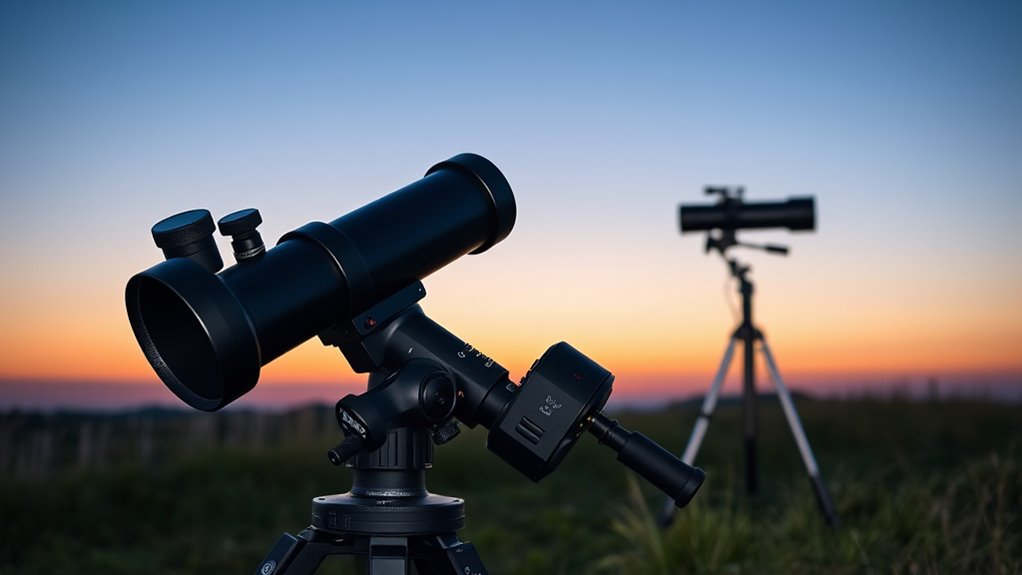

Choosing a first motorized alt-az mount is a balance between simple setup, manageable weight, and room to grow. I rank the Sky-Watcher AZ-GTi first for beginners who want a portable, app-controlled GoTo mount with a tripod; the SkyHunter is the ultralight choice for travel and tabletop observing; and the AZ-EQ6 suits buyers whose larger telescopes and future imaging plans outweigh the learning curve. Their headline payload figures do not tell the whole story: the AZ-GTi and SkyHunter each support up to 11 pounds, while the much heavier AZ-EQ6 supports 44 pounds and adds equatorial operation. The tradeoff is straightforward: portability favors the smaller mounts, while capacity and flexibility favor the AZ-EQ6.

Get movie nights delivered free with Prime
- Fast, free delivery on millions of items
- Prime Video, Amazon Music and more included
- Member-only deals all year
Key Takeaways
Best starting point: I place the AZ-GTi first because it combines GoTo control, a supplied tripod with pier extension, and a portable 8.6-pound mount.
Best for packing light: The SkyHunter weighs 2.9 pounds and supports both alt-azimuth and equatorial modes, but its tabletop format means you need a stable support.
Best for heavier equipment: The AZ-EQ6 supports a 44-pound payload and dual-telescope setups, but its 44-pound mount weight makes casual transport much harder.
Payload is not the only fit test: Leave room for accessories and check your telescope’s total load against each mount’s stated limit.
Think about control and power: AZ-GTi and SkyHunter offer WiFi control, while the SkyHunter lists an optional hand controller and the AZ-GTi can run on AA batteries or 12V input.
| Sky-Watcher AZ-GTi Portable Computerized GoTo Alt-Az Mount |  | Best Overall for Beginners | Mount type: Computerized alt-az GoTo | Mount weight: 8.6 pounds | Payload capacity: 11 pounds | VIEW ON AMAZON | See Our Full Breakdown |
| SkyHunter Portable EQ/AZ GOTO System |  | Best for Ultralight Travel | Mount type: Portable EQ/AZ GoTo | Mount weight: 2.9 pounds | Payload capacity: 11 pounds | VIEW ON AMAZON | See Our Full Breakdown |
| Sky-Watcher AZ-EQ6 Mount – Multi-Purpose GoTo SynScan Dual OTA Mount – EQ and Dual AZ Modes – 44 Pound Payload Capacity |  | Best for Large Telescopes and Long-Term Flexibility | Mount type: German equatorial, alt-azimuth, dual-OTA | Payload capacity: 44 pounds | Mount weight: 44 pounds | VIEW ON AMAZON | See Our Full Breakdown |
| motorized alt az mounts for beginner | Mount type | Mount weight | Payload capacity |
|---|---|---|---|
| Sky-Watcher AZ-GTi Portable Co | Computerized alt-az GoTo | 8.6 pounds | 11 pounds |
| SkyHunter Portable EQ/AZ GOTO | Portable EQ/AZ GoTo | 2.9 pounds | 11 pounds |
| Sky-Watcher AZ-EQ6 Mount | German equatorial, alt-azimuth, dual-OTA | 44 pounds | 44 pounds |
More Details on Our Top Picks
Sky-Watcher AZ-GTi Portable Computerized GoTo Alt-Az Mount
The AZ-GTi is my first pick for most beginners because it lands between the SkyHunter’s bare-bones portability and the AZ-EQ6’s substantial capacity and complexity. At 8.6 pounds, it is light enough to take along, yet it arrives with a tripod and pier extension rather than requiring a separate tabletop support. Its WiFi app control also lets a phone or tablet serve as the interface, a familiar entry point for someone who does not want to begin with a dedicated hand controller.
That approachable package has limits. The 11-pound payload ceiling is shared with the SkyHunter, so the AZ-GTi is not the choice for a large telescope or a heavily accessorized setup. A smartphone or tablet is required for the stated app control, and frequent use can drain batteries; the mount accepts AA batteries or a 12V external input, so planning power matters for longer sessions. The supplied tripod makes this a more self-contained beginner option than the tabletop SkyHunter, while the AZ-EQ6 is the better fit if you already know you need a much higher payload rating.
The description also mentions time-lapse and panorama use, but I would treat those as secondary capabilities rather than the main reason to buy it. For a new observer, the clearest advantage is a portable computerized mount with a complete basic support setup. Choose it when the telescope is comfortably within the payload limit and app-based control suits your routine; skip it if you need substantial capacity or prefer not to rely on a mobile device.
Pros:- Portable 8.6-pound mount with tripod and pier extension included.
- WiFi app control offers a familiar smartphone or tablet interface.
- 11-pound payload suits compact telescope setups.
- AA battery and 12V external power options provide flexibility.
Cons:- Its 11-pound capacity rules out many larger telescope setups.
- App control depends on a compatible mobile device, and frequent use may shorten battery life.
- The listed specifications do not give a full operating weight for the mount-and-tripod package.
Best for: Beginners who want a portable GoTo alt-az mount with an included tripod and are using a compact telescope within the 11-pound payload limit.
Not ideal for: Owners of larger or heavily accessorized telescopes, and anyone who does not want to operate the mount through a compatible phone or tablet.
- Mount type:Computerized alt-az GoTo
- Mount weight:8.6 pounds
- Payload capacity:11 pounds
- Control:WiFi, app controlled
- Power options:AA batteries or 12V external input
- Tripod height range:28 to 53 inches
- Gears:Brass and aluminum all-metal gears
- Included components:Mount, tripod with pier extension
Our verdict“I recommend the AZ-GTi as the most balanced beginner choice when portability, app-based GoTo control, and a supplied tripod matter more than high payload capacity.”
SkyHunter Portable EQ/AZ GOTO System
If reducing packed weight is your priority, the SkyHunter is the standout: the mount weighs just 2.9 pounds, compared with 8.6 pounds for the AZ-GTi and 44 pounds for the AZ-EQ6. It still lists an 11-pound payload capacity, matching the AZ-GTi on paper, and it can operate in both alt-azimuth and equatorial modes. That combination makes it appealing for a traveler who wants a small motorized system and values having a second operating mode available.
Its compactness changes what a beginner needs to bring. The SkyHunter is described as a tabletop mount, so the low mount weight does not mean the complete setup is ready to use without a stable surface or compatible support. By contrast, the AZ-GTi includes a tripod and pier extension. The SkyHunter offers WiFi, mobile-device control, and a hand-controller option, but that controller is optional. Buyers should check which control method and support accessories they need before treating it as an all-in-one package.
Four tracking rates—sidereal, 1X, 1/2X, and solar/lunar—give it flexibility for different observing targets, but they do not remove the 11-pound payload limit. Compared with the AZ-EQ6, the SkyHunter gives up heavy-load capability and a more substantial mount in exchange for exceptional packability. I would choose it for a compact telescope and a deliberately lightweight travel kit; I would choose the AZ-GTi instead when a supplied tripod and a simpler complete package matter more.
Pros:- Very light 2.9-pound mount for compact travel kits.
- Supports alt-azimuth and equatorial operating modes.
- Offers WiFi, mobile app control, and an optional hand controller.
- Four tracking rates include sidereal and solar/lunar options.
Cons:- Tabletop mounting calls for a stable surface or additional support.
- Hand controller is optional, so a buyer may need to rely on a compatible device.
- The 11-pound capacity limits telescope and accessory choices.
Best for: Traveling beginners with a compact telescope who can provide a sturdy tabletop or separate support and want an especially lightweight mount.
Not ideal for: Buyers who expect a tripod to be included, want a ready-to-use hand controller in the box, or plan to mount a large telescope.
- Mount type:Portable EQ/AZ GoTo
- Mount weight:2.9 pounds
- Payload capacity:11 pounds
- Mounting type:Tabletop
- Control options:WiFi, iPhone/iPad/Android, optional hand controller
- Tracking rates:Sidereal, 1X, 1/2X, solar/lunar
- Material:Stainless steel
- Warranty:1 year
Our verdict“I would choose the SkyHunter over the AZ-GTi when every pound of packed gear matters, provided a stable support and preferred control method are already accounted for.”
Sky-Watcher AZ-EQ6 Mount – Multi-Purpose GoTo SynScan Dual OTA Mount – EQ and Dual AZ Modes – 44 Pound Payload Capacity
The AZ-EQ6 is the capable, heavyweight choice here. Its 44-pound payload capacity is far beyond the 11-pound limit shared by the AZ-GTi and SkyHunter, and its EQ, alt-azimuth, and dual-OTA modes offer a broader range of configurations. For a beginner who already owns a substantial telescope—or expects to build a more demanding observing setup—this is the only mount in the lineup that makes sense to investigate first.
That capability asks more of its owner. The mount itself weighs 44 pounds, before factoring in the telescope or other gear, and its listed dimensions are 35 by 39 by 63 inches. Transport and storage are a different proposition from the AZ-GTi’s portable package or the SkyHunter’s 2.9-pound body. The AZ-EQ6 also calls for more setup and calibration for best operation, so its advanced modes are less attractive to someone seeking the simplest path to visual observing.
Features such as a belt drive, permanent periodic error correction, and dual encoders with Freedom Find support its broader use. Freedom Find allows manual movement without losing alignment, which is a practical contrast to a mount designed around a lighter app-controlled setup. Still, the high payload and imaging-oriented features do not make it an automatic beginner recommendation: the weight and setup burden are real. Compared with the AZ-GTi, choose the AZ-EQ6 only when equipment capacity and multiple operating modes justify the jump in scale.
Pros:- 44-pound payload capacity supports substantially heavier setups than either portable option.
- EQ, alt-azimuth, and dual-OTA modes add configuration flexibility.
- Belt drive and permanent periodic error correction support its imaging-oriented use.
- Freedom Find dual encoders allow manual operation without losing alignment.
Cons:- The 44-pound mount weight makes transport and storage demanding.
- Setup and calibration take more effort than the AZ-GTi or SkyHunter.
- Its advanced capacity and modes may exceed the needs of a beginner visual observer.
Best for: Beginners with a heavier telescope or a clear plan to use one mount for visual observing, dual-telescope configurations, and more advanced imaging setups.
Not ideal for: First-time observers who want a light mount for casual outings, have a compact telescope, or prefer minimal setup and calibration.
- Mount type:German equatorial, alt-azimuth, dual-OTA
- Payload capacity:44 pounds
- Mount weight:44 pounds
- Drive system:Belt drive
- Error correction:PPEC (Permanent Periodic Error Correction)
- Encoders:Dual encoders with Freedom Find technology
- Dimensions:35 inches deep x 39 inches wide x 63 inches high
Our verdict“I recommend the AZ-EQ6 only when a large payload and multi-mode flexibility are worth accepting a much heavier, more involved mount.”

How We Picked
I ranked these options for someone buying a motorized alt-az mount as a beginner, not for an experienced imager seeking a specialist rig. My priorities were how manageable the mount is to transport and set up, how clearly its control options suit a new owner, and whether its capacity matches common telescope sizes without demanding a large, complex system. I also looked at the tradeoffs each listing makes explicit: payload, weight, operating modes, power, and whether essential control or support equipment is included.
The ranking reflects different kinds of beginner fit. The AZ-GTi takes the lead because its portable design, WiFi app control, and included tripod make it the most balanced route into computerized observing. The SkyHunter comes next for compactness, but its tabletop support requirement and optional controller add planning. The AZ-EQ6 ranks third for this particular audience—not because it lacks capability, but because its weight, setup demands, and advanced EQ and dual-OTA functions can be more mount than many first-time visual observers need. I have not treated the mounts’ payload ratings as guarantees of stability with every telescope; tube length, accessories, and support all matter.
| motorized alt az mounts for beginner | Mount type |
|---|---|
| Sky-Watcher AZ-GTi Portable Co | Computerized alt-az GoTo |
| SkyHunter Portable EQ/AZ GOTO | Portable EQ/AZ GoTo |
| Sky-Watcher AZ-EQ6 Mount | German equatorial, alt-azimuth, dual-OTA |
Factors to Consider When Choosing Motorized Alt Az Mounts For Beginners
I would start with the telescope and the way you plan to observe, then select a mount around that use. Portability, support, payload, and control method separate these three models more clearly than their GoTo labels do.
Match the payload to the complete setup
Use the telescope’s weight as a starting point, not the whole calculation. Finder scopes, eyepieces, cameras, diagonals, and other accessories add load, and a long telescope can be more demanding to handle than a compact tube of similar weight. Both the AZ-GTi and SkyHunter list an 11-pound payload capacity; the AZ-EQ6 lists 44 pounds. I would leave practical room below a mount’s stated limit rather than plan a beginner setup around the maximum. If your telescope and accessories approach the smaller mounts’ limit, the AZ-EQ6 may suit the load better, but its size and setup demands need to fit your observing routine too.
Choose between tripod convenience and tabletop portability
The AZ-GTi has a clear package advantage for a new owner: its listed included components are the mount, tripod, and pier extension. The SkyHunter is lighter but tabletop-mounted, so you need an adequately stable place to set it or must account for extra support gear. That difference can matter more in practice than the mount’s own weight. The AZ-EQ6 is much larger and heavier, so I would plan how it will be transported and stored before choosing it for observing away from home.
Pick the control method you will actually use
The AZ-GTi and SkyHunter both offer WiFi and app-based control, which can be approachable if you already use a compatible phone or tablet. That choice also makes the observing session depend on the device and its battery. The SkyHunter lists an optional hand controller; do not assume it is included. The supplied AZ-GTi components list does not mention a hand controller either, so check package details if you prefer dedicated controls. Think about your comfort with app setup and power before deciding that wireless control is automatically the simplest option.
Separate visual observing from future imaging plans
For a beginner focused on finding and viewing objects, a portable alt-az GoTo system may be the more direct fit. The SkyHunter adds EQ mode, while the AZ-EQ6 offers EQ and alt-azimuth modes, dual-OTA operation, and imaging-oriented features. That flexibility can appeal to a buyer with a specific growth plan, but it comes with added weight and setup. The product descriptions mention time-lapse and panorama use for the AZ-GTi; I would not treat that as equivalent to the AZ-EQ6’s larger capacity or its listed error-correction and encoder features. Match the mount to what you want to do now, not just a possible future project.
Plan the power and support before the first session
Power and mounting details can shape how easy a computerized mount feels to use. The AZ-GTi accepts AA batteries or a 12V external input, while the SkyHunter’s listed specifications focus on its control options and tracking rates rather than a power source. Check the specific package and operating instructions for the power arrangement before buying. In either case, a stable support and a charged control device matter: lightweight does not mean self-supporting, and an app-controlled mount is less convenient if the device you rely on is unavailable.
Frequently Asked Questions
Which of these mounts is easiest for a beginner to start with?
I would start with the Sky-Watcher AZ-GTi for most beginners. It combines computerized alt-az GoTo operation, WiFi app control, and a listed tripod with pier extension, so it is a more complete portable package than the tabletop SkyHunter. Its 11-pound payload still limits it to compact telescope setups, and anyone who dislikes app-based control should check the package details for a control option that suits them.
Can I use either the AZ-GTi or SkyHunter with a large telescope?
Both the AZ-GTi and SkyHunter list an 11-pound payload capacity, so they are intended for lighter setups than the AZ-EQ6. Count accessories along with the telescope and avoid treating the maximum rating as a target. If your complete setup is heavy or bulky, the AZ-EQ6’s 44-pound capacity is the more relevant specification, though its 44-pound mount weight brings a substantial transport tradeoff.
Does the SkyHunter include a tripod?
The SkyHunter is listed as a tabletop mount, and its supplied specifications do not list a tripod among included components. I would plan on a stable table or verify compatible support equipment before purchase. By comparison, the AZ-GTi’s listing names a tripod with pier extension as included, which makes its basic support arrangement more explicit for a first-time buyer.
Which mount is most suitable for travel?
For the lightest mount body, the SkyHunter weighs 2.9 pounds, making it the easiest to pack among these three. Its tabletop design means you still need somewhere steady to use it. The AZ-GTi weighs 8.6 pounds but includes a tripod and pier extension, so it may make a more straightforward portable kit for someone who wants its support included. The 44-pound AZ-EQ6 is the least suited to casual travel.
Should a beginner buy the AZ-EQ6 for future flexibility?
I would choose the AZ-EQ6 only when its 44-pound capacity or EQ and dual-OTA modes solve a real need, such as supporting a heavier telescope or a planned multi-instrument setup. It adds belt drive, permanent periodic error correction, and Freedom Find encoders, but also weighs 44 pounds and calls for more setup and calibration. For a compact visual telescope, the AZ-GTi is a more proportionate starting point.
Conclusion
For most beginners, I recommend the Sky-Watcher AZ-GTi: it balances portable weight, app-based GoTo control, and an included tripod, provided your complete telescope setup stays within its 11-pound payload limit. Choose the SkyHunter if your priority is the lightest mount body and you are ready to supply a stable tabletop support and choose a control method. Pick the AZ-EQ6 when you already need a much higher payload rating, EQ operation, or dual-telescope flexibility—and can accommodate its weight and more involved setup. In short, I would buy for the telescope and observing habits you have, not capacity or modes you may never use.
Halloween Picks
halloween
As an affiliate, we earn on qualifying purchases.