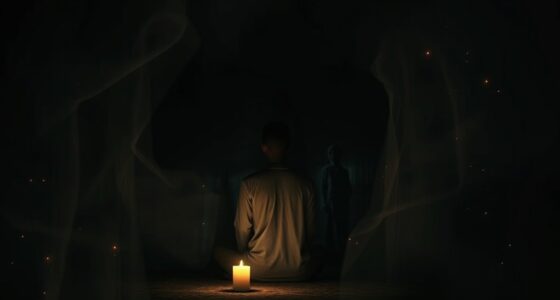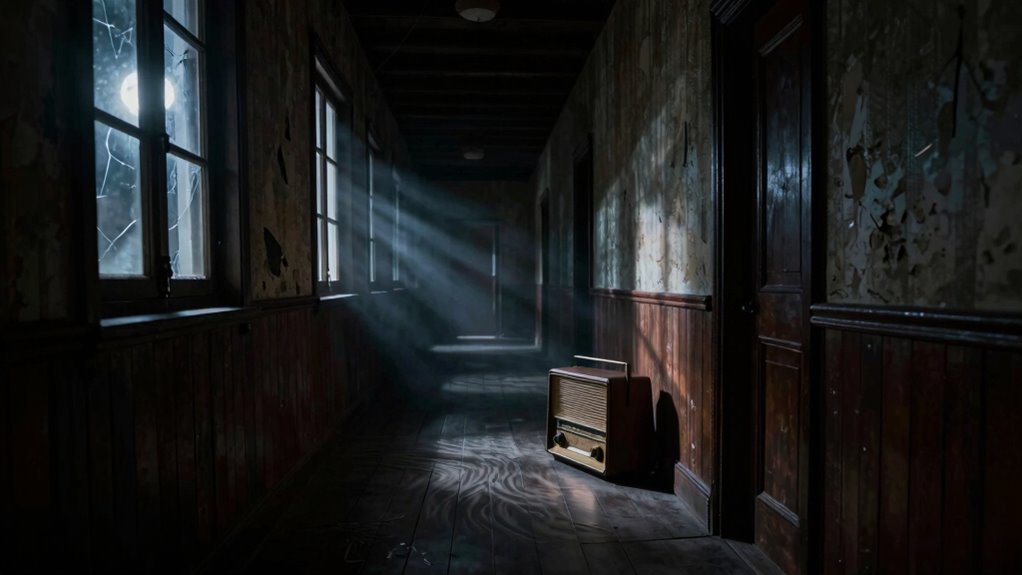
You often hear unexplained sounds before seeing anything because our minds are deeply wired to interpret ambiguous noises as supernatural, especially in eerie environments. Cultural stories and personal fears reinforce this tendency, making us more likely to believe in spirits behind strange creaks or whispers. Auditory illusions and heightened senses also play a role, as the brain seeks patterns and assigns meaning to these sounds. Keep exploring, and you’ll discover even more about why these haunting beginnings happen.
Key Takeaways
- Simple, unexplained sounds naturally trigger fear and curiosity, making them effective story initiators.
- Cultural beliefs associate unusual noises with spirits, reinforcing their supernatural significance.
- Auditory illusions and pattern recognition lead the brain to interpret sounds as ghostly voices.
- Environmental factors like creaky floors enhance the perception of paranormal activity through natural sounds.
- Psychological factors, such as fear and stress, heighten sensitivity to sounds, making them the common starting point.
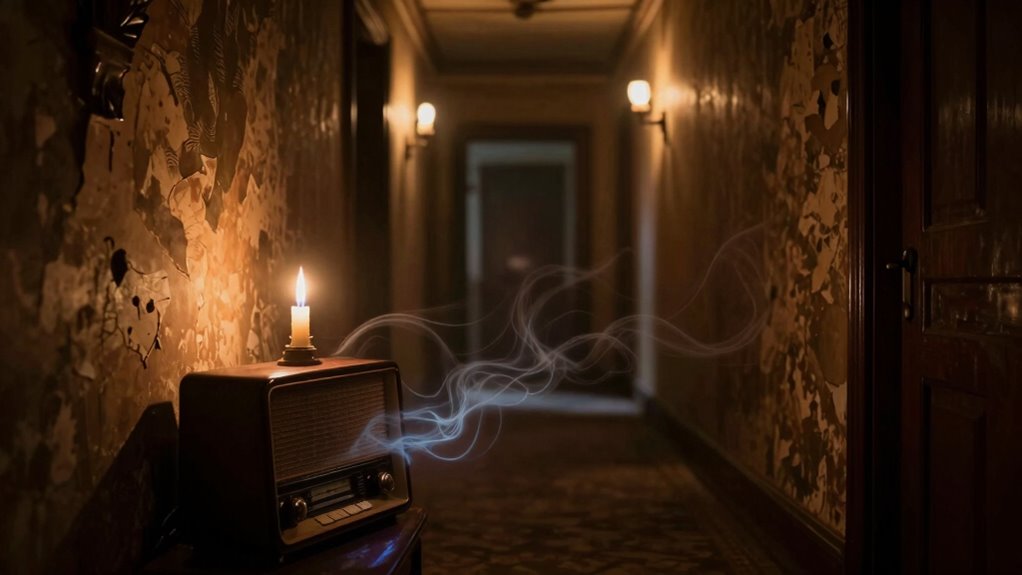
Many ghost stories begin with a simple, inexplicable sound—an eerie creak, a distant whisper, or a sudden bang—that sends shivers down your spine. These sounds often feel like the first signs of something supernatural, but they’re also deeply rooted in how our minds interpret the world around us. Paranormal assumptions play a big role here; our tendency to associate unfamiliar noises with spirits or ghostly activity makes these sounds seem more significant than they might truly be. Instead of seeing a shadowy figure, your mind might latch onto a strange noise and interpret it as a ghostly whisper or a spectral presence.
Auditory illusions are central to why these stories start with sound rather than sight. Your brain is wired to seek patterns and assign meaning, especially in ambiguous situations. When you hear an unexpected noise, your mind fills in the gaps, often imagining something more sinister. This phenomenon, known as auditory pareidolia, can make a simple creak sound like a voice or a whisper from beyond. Since hearing is a highly sensitive sense—more so than sight in some contexts—your brain becomes especially primed to interpret subtle cues as supernatural. This is why many ghost stories begin with an unsettling noise, which then spirals into a full-blown paranormal encounter in your imagination.
The power of auditory illusions also amplifies the effect of these sounds. You may hear what seems like footsteps or voices, but there’s often no real source. Your mind, influenced by cultural stories and personal fears, attributes these illusions to spirits. These assumptions are reinforced by the environment—old houses, creaky floors, or wind through the trees—which all lend themselves to making sounds seem more ghostly. The mind convinces you that these noises are not just natural or accidental, but signs of something supernatural lurking nearby. Additionally, understanding how sensory perception works can help explain why auditory cues often dominate ghost stories, emphasizing the importance of how we interpret our environment. Moreover, the brain’s pattern recognition tendencies can sometimes lead to false perceptions, making natural sounds appear paranormal. This interplay between perception and interpretation illustrates how psychological factors significantly influence ghost story narratives.
Furthermore, research into neuroscience shows that our brain’s wiring can predispose us to interpret ambiguous stimuli as supernatural, especially under stress or fear.

64GB Digital Voice Recorder – ZIPCIDE Digital Voice Activated Recorder with AI-Intelligent Noise Reduction, Voice Activated Sound Audio Tap Recorder Device for Lectures Meetings, Work, Interviews
64GB Memory Capacity & Long Battery Life – The digital voice recorder comes with a 64GB TF card…
As an affiliate, we earn on qualifying purchases.
As an affiliate, we earn on qualifying purchases.
Frequently Asked Questions
Why Do Sounds Trigger Ghost Stories More Than Visual Sightings?
You might find sounds trigger ghost stories more than sightings because, historically, folklore emphasizes auditory cues as mysterious and unsettling, often linked to acoustic anomalies. Sounds are easier to interpret as supernatural because they tap into primal fears and imagination, making them more compelling. Our brains tend to fill in gaps with stories, so when you hear unexplained noises, it’s natural to envision ghostly presences, rooted in age-old legends and acoustic mysteries.
Are Certain Sounds More Commonly Associated With Ghostly Activity?
Yes, certain sounds are more commonly linked to ghostly activity. You might notice auditory illusions or acoustic anomalies, like unexplained whispers or footsteps, that seem to come from nowhere. These sounds often evoke a stronger emotional response because they tap into your subconscious fears. You’re more likely to interpret these mysterious noises as ghostly because they’re ambiguous and hard to explain, making them perfect triggers for ghost stories.
Can Environmental Factors Influence the Perception of Ghostly Sounds?
Environmental factors can definitely shape how you perceive ghostly sounds. Ambient noise acts like a mischievous storyteller, weaving itself into your sensory perception and amplifying eerie whispers or creaks. When the environment is quiet or filled with unpredictable sounds, your mind becomes a canvas for ghostly echoes, making you more likely to interpret ordinary noises as supernatural. In this way, your surroundings play an essential role in the ghost story unfolding in your mind.
How Do Cultural Beliefs Shape the Interpretation of Ghostly Sounds?
Your cultural beliefs heavily influence how you interpret ghostly sounds. Superstitious interpretations may lead you to see mysterious noises as spirits or omens, while others might dismiss them as auditory illusions caused by environmental factors. If you come from a culture with strong ghost stories, you’re more likely to perceive strange sounds as supernatural phenomena. Conversely, skepticism can make you see these sounds as natural or psychological, rather than paranormal.
Are There Psychological Reasons Why Sounds Are More Impactful Than Sights?
Think of sounds as the whispers of your subconscious, more impactful than sights. Auditory perception taps into deep psychological triggers, stirring emotions faster and more intensely. Sounds are elusive, unpredictable, and often linked to memories or fears, making them more effective in creating suspense. Your mind fills in the gaps, amplifying the effect, which is why ghostly sounds often leave a lasting impression—more than any sight could.

Tellegloww Ghost Hunting Equipment Paranormal Equipment for Ghost Hunting Digital EVP Voice Activated Recorder Rechargeable Recorder Device with Microphone, 8GB(Purple)
Compact and Portable Design: as a paranormal ghost hunting equipment, length approx. 3.5 inches/8.9 cm, this digital voice…
As an affiliate, we earn on qualifying purchases.
As an affiliate, we earn on qualifying purchases.
Conclusion
So, next time a faint noise sends a shiver down your spine, remember—it’s often the unseen that haunts us most. What begins as a simple sound can grow into a story you’ll tell for years. Ironically, it’s the whispers we can’t see that leave the deepest scars. You might seek sight for reassurance, but sometimes, it’s the unseen echoes that truly linger, reminding us that the eeriest stories are often born from silence.

Creepy Sound Effects for Haunted Houses
As an affiliate, we earn on qualifying purchases.
As an affiliate, we earn on qualifying purchases.
Tellegloww Ghost Hunting Equipment Paranormal Equipment for Ghost Hunting Digital EVP Voice Activated Recorder Rechargeable Recorder Device with Microphone, 8GB(Purple)
Compact and Portable Design: as a paranormal ghost hunting equipment, length approx. 3.5 inches/8.9 cm, this digital voice…
As an affiliate, we earn on qualifying purchases.
As an affiliate, we earn on qualifying purchases.