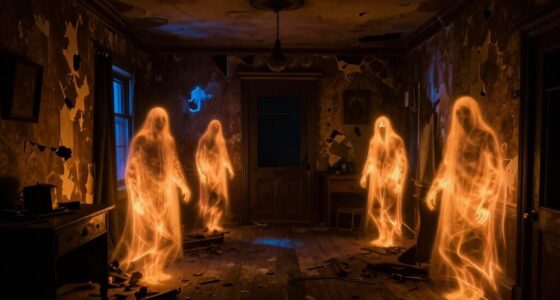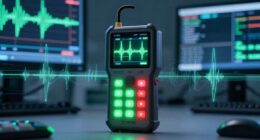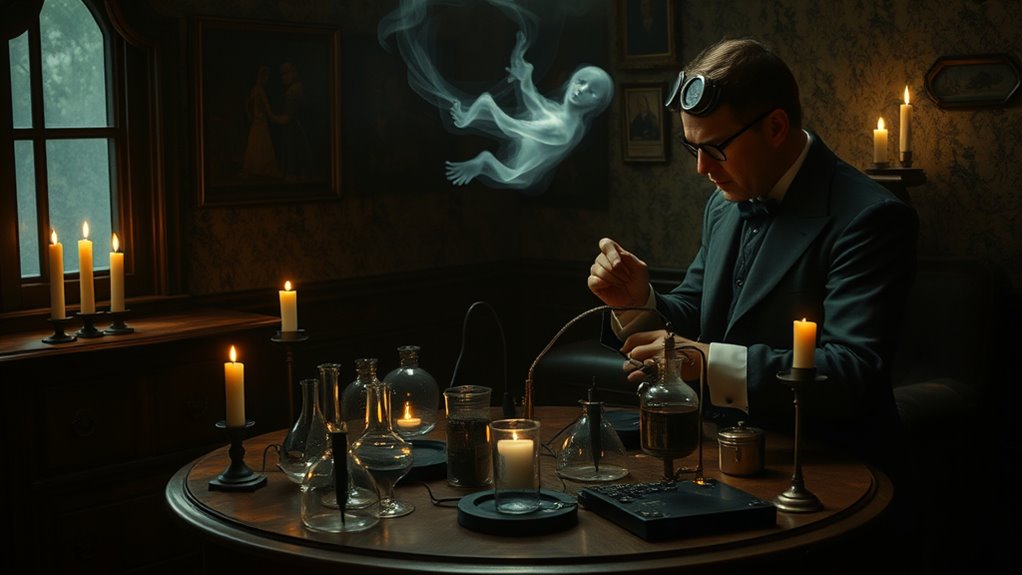
In a séance room, applying scientific experiments helps you approach spirits with objectivity and clarity. Using controlled setups, you can minimize bias by standardizing conditions and employing tools like electromagnetic meters or audio/video recordings. By carefully measuring environmental factors and controlling variables, you transform superstition into testable phenomena. This method not only enhances credibility but also bridges belief and proof, offering insights into the supernatural. If you continue exploring, you’ll discover how science can illuminate the mysteries of spirits.
Key Takeaways
- Controlled experiments with scientific tools aim to objectively assess paranormal phenomena during séances.
- Using double-blind protocols prevents bias and enhances the credibility of séance investigations.
- Environmental measurements (e.g., electromagnetism, temperature) help identify physical causes of claimed supernatural events.
- Reproducible testing transforms subjective séance reports into verifiable scientific data.
- Applying empirical methods bridges the gap between belief and evidence in paranormal research.
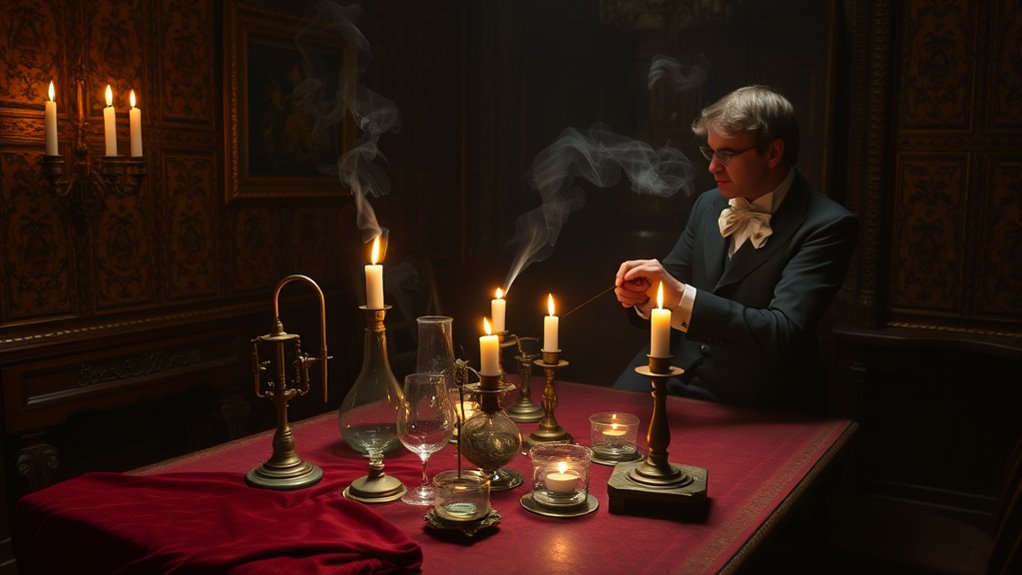
Have you ever wondered how science and séance rooms intersect? It’s a fascinating question that pushes us to contemplate whether the supernatural can be examined through a scientific lens. Paranormal investigation aims to uncover the truth behind phenomena reported during séances, but it often struggles with credibility due to a lack of rigorous methodology. That’s where experimental methodology comes into play. By applying controlled experiments, researchers attempt to eliminate bias, isolate variables, and test claims systematically. This approach transforms what might seem like mere superstition into a testable hypothesis, bringing a level of objectivity to an arena historically dominated by anecdote and speculation.
Using scientific methods to explore séances transforms superstition into testable, objective investigation.
In the context of a séance room, implementing experimental methodology involves setting up experiments that can be repeated and verified by others. For instance, if a group claims to see or hear spirits, scientists might use electromagnetic field meters, temperature sensors, or audio and video recordings to document any anomalies during the session. These tools help establish whether the phenomena have a physical basis or if they could be attributed to environmental factors, psychological effects, or even trickery. The goal isn’t to dismiss the experiences outright but to understand what’s happening through empirical evidence. When you approach séances as a form of paranormal investigation, you’re fundamentally trying to bridge the gap between belief and proof, using science as a tool rather than just skepticism.
Applying experimental methodology also means controlling variables that could influence the outcome. Darkness, for example, can foster suggestibility, so experiments are often conducted under standardized conditions. Researchers may also introduce blind or double-blind procedures to prevent bias from influencing the results. For example, if a séance involves a medium claiming to communicate with spirits, the observer’s expectations are minimized by using a double-blind setup where neither the medium nor the experimenter knows key details in advance. This rigorous approach is common in scientific experiments, and adapting it to the séance room helps to distinguish genuine phenomena from illusions or deception. Additionally, understanding the role of subconscious power during sleep can shed light on how dreams and perceptions might influence paranormal experiences. Furthermore, employing scientific tools and measurements enhances the credibility of findings and allows for more detailed analysis.
Ultimately, integrating scientific methods into paranormal investigation isn’t about dismissing spiritual experiences but about seeking clarity. It’s about asking questions, designing experiments, and analyzing results objectively. When you look at séances through this lens, you realize that the pursuit of understanding spirits isn’t necessarily incompatible with science. Instead, it’s an extension of the same curiosity that drives all investigation—using systematic, controlled, and reproducible methods to explore the unknown. This blend of science and séance room practices paves the way for more credible exploration of phenomena that have long fascinated humanity.
Top picks for "science ance room"
Open Amazon search results for this keyword.
As an affiliate, we earn on qualifying purchases.
Frequently Asked Questions
How Do Scientists Ensure Unbiased Results in Spirit Experiments?
You guarantee unbiased results by using double-blind testing, where neither you nor the participants know who receives the real spirit exposure. Additionally, you incorporate placebo controls to compare reactions against fake stimuli. These methods eliminate expectations and personal biases, making your experiments more reliable. By carefully designing your tests with these controls, you increase the chances of obtaining objective, credible data on spirits without influence from preconceived notions.
What Equipment Is Most Effective in Detecting Spirits?
When detecting spirits, you should consider using electromagnetic sensors and infrared cameras. Electromagnetic sensors can pick up subtle changes in energy that might indicate paranormal activity, while infrared cameras help you see temperature fluctuations and unseen movements. Combining these tools enhances your chances of capturing evidence. Remember, consistent methodology and proper calibration are key to ensuring your equipment provides reliable, unbiased results during your investigations.
Can Controlled Experiments Prove the Existence of Spirits Definitively?
You might wonder if controlled experiments can definitively prove spirits’ existence. While quantitative analysis and experimental controls help eliminate false positives, they can’t guarantee proof of spirits. These methods improve reliability but can’t fully account for the unknown or supernatural. So, even with rigorous testing, you’ll find that controlled experiments can support, but not conclusively establish, the existence of spirits.
How Do Researchers Differentiate Between Natural and Paranormal Phenomena?
You might think it’s simple to spot natural from paranormal phenomena, but psychic interference and atmospheric anomalies often blur the lines. Researchers look for consistency, repeatability, and natural explanations first—like drafts or electrical interference. When these are ruled out, only then do they consider paranormal causes. Ironically, the more controlled the environment, the more elusive true spirits become, making differentiation a tricky dance between science and the supernatural.
What Are the Ethical Considerations in Conducting Spirit Experiments?
When conducting spirit experiments, you must prioritize paranormal ethics by ensuring spiritual consent from all participants. Respect their emotional and spiritual boundaries, and avoid manipulating or misleading them. Be transparent about your intentions and potential risks. By doing so, you honor ethical standards, foster trust, and minimize harm. Remember, safeguarding participants’ well-being and respecting spiritual boundaries are vital in maintaining integrity during such sensitive investigations.
Conclusion
As you step back into the quiet darkness of the séance room, you realize that blending science with the unknown transforms ghostly whispers into testable mysteries. The flicker of candlelight dances across carefully arranged instruments, turning shadows into clues. With each controlled experiment, you peel back layers of mystery, revealing a world where curiosity guides your hand and evidence lights the way through the misty veil between worlds. It’s a journey of discovery, alive with possibility.