
Data logging EMF detectors help you identify recurring electromagnetic patterns by recording data over extended periods. They automatically track fluctuations, making it easy to spot repeating spikes or dips at specific times or conditions. With continuous data collection, you can analyze long-term trends and pinpoint sources of interference. This process improves your understanding of your environment’s EMF activity, and if you keep exploring, you’ll discover more ways these tools can help manage electromagnetic issues effectively.

Get movie nights delivered free with Prime
- Fast, free delivery on millions of items
- Prime Video, Amazon Music and more included
- Member-only deals all year
Key Takeaways
- They record electromagnetic activity over time, revealing recurring patterns and spikes.
- Automated logging enables easy identification of daily or periodic electromagnetic fluctuations.
- Data analysis highlights consistent interference sources or environmental factors causing repeating events.
- Regular calibration ensures accurate detection of subtle or repetitive EMF disturbances.
- Pattern recognition helps in implementing targeted strategies to reduce or control recurring electromagnetic interference.
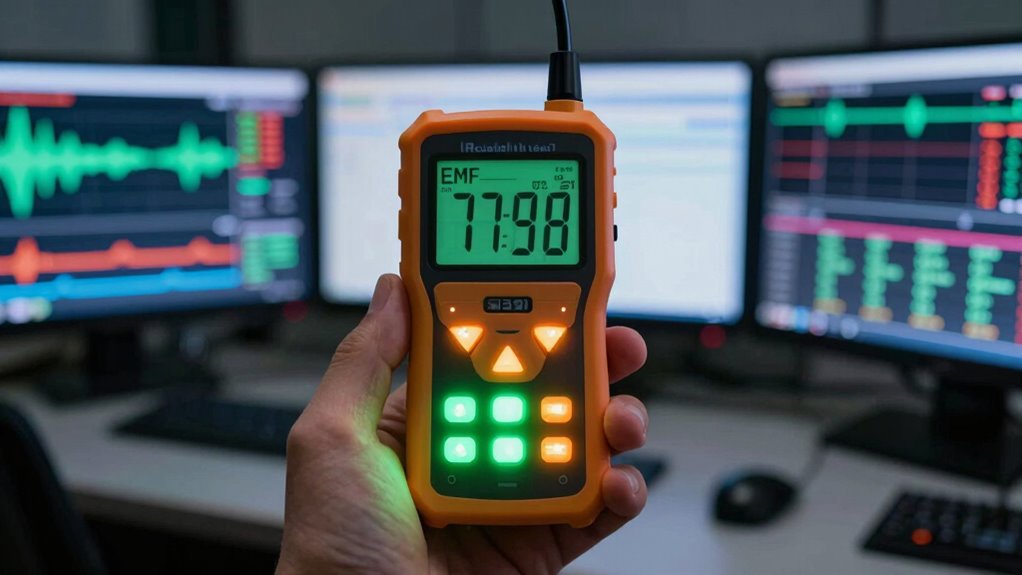
One of the key advantages of using data logging EMF detectors is their ability to provide a historical record of electromagnetic activity. Unlike momentary measurements, these devices store data over extended periods, allowing you to observe long-term trends. If you notice a recurring event, such as a spike every evening at 8 PM, you can investigate what device or activity might be causing it. This insight is vital for troubleshooting issues related to electromagnetic interference affecting your health, electronics, or work environment. Additionally, many modern detectors are equipped with features that facilitate device calibration, ensuring your measurements stay accurate over time. Proper calibration is essential because even slight inaccuracies can lead to misinterpretation of data, especially when tracking subtle or repetitive EMF events. Accurate calibration helps maintain the integrity of your data, ensuring consistent and reliable measurements. Moreover, understanding electromagnetic interference patterns can help you implement effective mitigation strategies to reduce exposure or interference. Recognizing and analyzing these patterns can also help in identifying sources of interference, enabling targeted actions to improve overall indoor air quality and electromagnetic safety. Performing regular data reviews can also help detect measurement inconsistencies, alerting you to potential device issues or environmental changes affecting your readings.
Using a data logging EMF detector also streamlines your analysis process. Instead of manually recording readings at different times, the device automatically logs data, which you can review later on a computer or mobile device. This saves time and reduces errors that often occur with manual recording. When reviewing the data, you can identify patterns, frequency, and intensity of electromagnetic disturbances, helping you understand the sources better. If you notice irregularities, you can recalibrate your device to confirm that your readings remain accurate, ensuring your observations are reliable. Proper calibration not only maintains measurement precision but also enhances data consistency and allows you to compare data over different periods or between different devices.
As an affiliate, we earn on qualifying purchases.
Frequently Asked Questions
Can EMF Detectors Differentiate Between Natural and Artificial Electromagnetic Fields?
Yes, EMF detectors can differentiate between natural interference and artificial sources. You’ll notice natural interference, like Earth’s magnetic field, produces consistent, low-level readings. In contrast, artificial sources such as electronics or power lines create more variable, often stronger signals. By analyzing these patterns, your detector helps identify whether the EMF is from natural interference or artificial sources, aiding in accurate tracking of electromagnetic activity and potential anomalies.
What Is the Typical Battery Life for Portable Data Logging EMF Detectors?
You’ll typically get around 20 to 40 hours of battery life from portable data logging EMF detectors, depending on their battery type and power consumption. Higher power consumption models may drain batteries faster, while energy-efficient devices extend battery longevity. To guarantee continuous operation during long-term monitoring, it’s wise to carry spare batteries or opt for models with longer-lasting power sources, so you don’t miss any important electromagnetic events.
How Accurate Are EMF Detectors in Detecting Low-Level Electromagnetic Fluctuations?
You might wonder how accurate EMF detectors are with low-level fluctuations, but calibration challenges and signal interference can impact their precision. While they’re generally reliable, environmental factors can cause slight inaccuracies. To improve detection, guarantee proper calibration and minimize interference sources. Recognizing these limitations helps you interpret readings better, understanding that even high-quality detectors can face challenges in capturing subtle electromagnetic changes.
Are There Specific Environments Where EMF Data Logging Is Less Effective?
Yes, EMF data logging is less effective in environments with industrial interference or urban electromagnetic noise. These areas have high levels of electromagnetic activity that can mask or distort the subtle fluctuations you’re trying to detect. As a result, your detector might struggle to identify specific repeating events. To improve accuracy, consider shielding your equipment or choosing locations with lower electromagnetic interference for better data collection.
How Do Weather Conditions Impact EMF Readings and Data Logging Accuracy?
Weather variability can impact your EMF readings and data logging accuracy, as changes in humidity, temperature, or precipitation may cause fluctuating signals. Additionally, weather-related signal interference, like lightning or storm activity, can distort the data or create false readings. To maintain accuracy, you should monitor weather conditions during data collection, and consider postponing measurements during extreme weather to minimize interference and guarantee more reliable results.
electromagnetic field monitor with data logging
As an affiliate, we earn on qualifying purchases.
As an affiliate, we earn on qualifying purchases.
Conclusion
By now, you see how data logging EMF detectors are invaluable in tracking repeating events. They give you the power to catch even the faintest signals and spot patterns that might otherwise go unnoticed. With this tool in your hands, you’re better equipped to uncover the truth, no matter how elusive. Remember, understanding these signals can be a game-changer—so don’t let the grass grow under your feet when it comes to exploring the unseen.
long-term EMF measurement device
As an affiliate, we earn on qualifying purchases.
As an affiliate, we earn on qualifying purchases.
EMF interference pattern analyzer
As an affiliate, we earn on qualifying purchases.
As an affiliate, we earn on qualifying purchases.
Halloween Picks
halloween
As an affiliate, we earn on qualifying purchases.