
During the Cold War, the U.S. launched secret programs like the Stargate Project to explore psychic espionage techniques such as remote viewing, aiming to gather intelligence on enemies like the Soviets. These efforts involved structured experiments, skilled agents, and high-stakes missions. Despite skepticism and scientific criticism, government acknowledgment and declassified documents reveal some of their activities. If you keep exploring, you’ll uncover more about this intriguing chapter of covert Cold War history.
Key Takeaways
- The Stargate Project was a secret U.S. Cold War initiative exploring psychic phenomena for military intelligence.
- It utilized remote viewing techniques to gather intelligence on Soviet military sites and activities.
- Notable agents like Ingo Swann and Joseph McMoneagle contributed high-accuracy psychic reports.
- Scientific scrutiny found little conclusive evidence, and results often lacked reproducibility, fueling skepticism.
- Declassified documents confirmed government research into psychic espionage, leaving a controversial legacy.
Origins and Development of the Stargate Program
The Stargate Program began during the Cold War as a secret initiative by the U.S. government to explore the potential of psychic phenomena for military intelligence. It originated in the early 1970s, driven by concerns that adversaries might develop psychic espionage capabilities. The CIA and military agencies collaborated with researchers to investigate remote viewing—gaining information from a distance without physical contact. Initial experiments showed promise, leading to increased funding and official support. Over time, the program evolved from clandestine research into a classified project aimed at harnessing psychic abilities for intelligence gathering. Despite skepticism and mixed results, the program persisted through the 1980s, reflecting the era’s intense desire for unconventional intelligence methods during the Cold War.
Techniques and Methods Employed in Psychic Espionage

You’ll find that psychic espionage relies on specific techniques like remote viewing protocols, which guide individuals to perceive distant locations. Sensory enhancement techniques are used to sharpen focus and heighten awareness during these sessions. Controlled imagination exercises help participants access information by quieting the mind and channeling their mental energy effectively.
Remote Viewing Protocols
Remote viewing protocols encompass a set of structured techniques designed to harness psychic abilities for espionage purposes. You begin by clearing your mind and entering a focused, relaxed state, often using meditation or breathing exercises. You then receive a specific target, which could be a location, object, or event, without prior knowledge. Using a controlled process, you describe impressions, images, or feelings that emerge, recording everything without judgment. The protocol emphasizes maintaining objectivity, avoiding conscious analysis, and trusting intuitive insights. Sometimes, you use a standardized set of stages, such as target selection, feedback, and analysis. These methods aim to minimize biases, improve accuracy, and ensure the psychic data is as precise and reliable as possible for intelligence gathering. structured techniques are crucial in ensuring consistency and reducing errors in remote viewing sessions.
Sensory Enhancement Techniques
Building on structured remote viewing protocols, psychic operatives often employ sensory enhancement techniques to sharpen their perception and gather more detailed intelligence. These methods include intense focus exercises, such as meditation or breath control, to quiet mental noise. Operatives might also use sensory deprivation, like blindfolds or isolation chambers, to heighten other senses and reduce distractions. Some techniques involve visualization, where you imagine amplifying sensory inputs—sounds, smells, textures—to create a more vivid mental environment. Additionally, certain practices rely on physical stimuli, such as holding objects or listening to specific frequencies, to trigger heightened awareness. These techniques aim to emancipate deeper sensory channels, enabling operatives to perceive subtle details and gather critical intelligence beyond normal sensory limits. Engaging in sensory training can further enhance these capabilities by systematically developing each sense to detect nuances often overlooked.
Controlled Imagination Exercises
Controlled imagination exercises form the core of many psychic espionage techniques, allowing operatives to consciously craft mental scenarios that access hidden information. You learn to visualize specific locations, objects, or people with vivid detail, creating a mental “scene” that guides your subconscious. This process involves focused concentration, often using meditation or deep breathing to quiet the mind. You may imagine a “mental window” through which you observe distant targets or events, or employ symbolic imagery to decode encrypted data. Repetition strengthens these mental pathways, making your impressions clearer and more reliable. These exercises aim to bypass conscious filters, allowing your subconscious to reveal information that’s otherwise inaccessible. Mastery of controlled imagination enhances your ability to gather intelligence covertly and accurately. Developing psychic sensitivity through consistent practice can further improve accuracy and detail in your impressions.
Notable Experiments and Cases Within the Program
Throughout the program, some psychic agents gained notoriety for their extraordinary abilities, often taking on high-stakes missions. These cases showcase how certain individuals were tasked with gathering intelligence or influencing events from afar. Exploring these notable experiments reveals both the potential and the mystery surrounding psychic espionage during the Cold War. The use of secure storage for sensitive information was crucial in protecting the integrity of these operations.
Notable Psychic Agents
Have you ever heard of the agents whose extraordinary abilities made them key figures in Cold War psychic research? These individuals demonstrated remarkable talents that fueled speculation and controversy. Consider these notable agents:
- Ingo Swann – Credited with pioneering remote viewing, Swann’s sessions laid the groundwork for the program’s early successes.
- Joseph McMoneagle – Known for his detailed remote viewing reports, he claimed to have seen distant targets with high accuracy.
- Pat Price – A former police officer, Price’s psychic insights reportedly helped gather intelligence on enemy facilities.
Their abilities captured the imagination of researchers and skeptics alike, shaping the program’s focus and fueling ongoing debates about psychic potential during the Cold War. Color accuracy played a significant role in the success of some experiments by ensuring clear and precise visual data.
High-Profile Missions
What were some of the most daring and secretive missions conducted by Cold War psychic programs? One notable case involved attempting to locate Soviet nuclear missiles using remote viewing. Agents were tasked with pinpointing missile sites from thousands of miles away, often with limited success but intense secrecy. Another high-profile mission aimed to gather intelligence on foreign military installations, providing strategic advantages during tense moments of the Cold War. Some experiments sought to influence or disrupt enemy operations through psychic means, although results remained inconclusive. The Stargate Project also explored whether psychics could aid in hostage negotiations or locate missing persons. These missions exemplify the Cold War’s extreme measures to leverage unconventional methods, often operating under strict secrecy and high stakes. Additionally, efforts to develop psychic espionage techniques reflected the era’s willingness to explore unorthodox and clandestine intelligence gathering strategies.
Public Exposure and Government Acknowledgment

Did the government ever truly admit to its psychic spy programs during the Cold War? Officially, no. However, declassified documents and public statements gradually revealed the extent of these efforts. You might find it surprising that:
- The CIA acknowledged the Stargate Project’s existence in the 1990s.
- Government reports confirmed ongoing research into psychic phenomena.
- Public disclosures followed years of secrecy, sparking widespread speculation.
- Declassified documents provided concrete evidence of these covert operations.
These admissions transformed the narrative from conspiracy theory to acknowledged government activity. While full details remained classified, the acknowledgment validated suspicions that the government actively explored psychic espionage. Your understanding of Cold War covert operations shifts as you see how much was concealed and later revealed.
Scientific Scrutiny and Criticism of Psychic Abilities
Despite the government’s secretive efforts to develop psychic espionage during the Cold War, scientific scrutiny has consistently cast doubt on the legitimacy of psychic abilities. Researchers have subjected claims of extrasensory perception and telepathy to rigorous testing, often finding results that are statistically insignificant or attributable to chance, bias, or flawed methodology. Reproducibility, a cornerstone of scientific validation, has rarely been achieved in experiments related to psychic phenomena. Critics argue that many so-called successes can be explained by psychological factors like confirmation bias or the placebo effect. Overall, mainstream science remains skeptical, emphasizing that no credible evidence reliably demonstrates psychic abilities. This skepticism persists despite occasional sensational claims, keeping scientific consensus firmly rooted in empirical evidence rather than speculation. Security concerns also play a role in scrutinizing claims of psychic espionage, as credible evidence has yet to support their effectiveness or reliability.
Legacy and Impact on Intelligence Operations
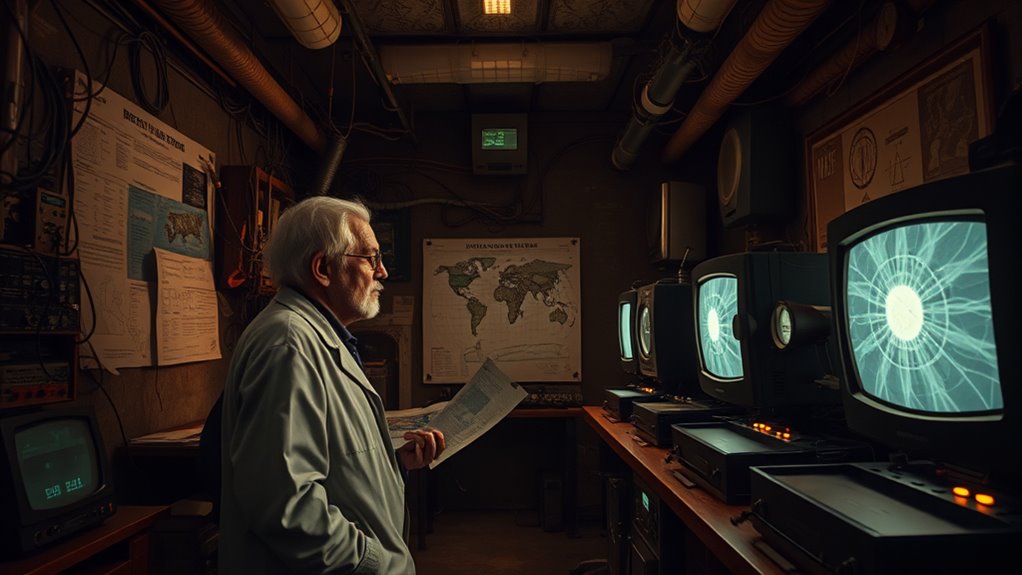
The legacy of Cold War psychic spy programs has left a complex imprint on intelligence operations, shaping both strategic thinking and technological development. These programs pushed agencies to explore unconventional methods, influencing modern intelligence tactics. You should note three key impacts:
- They spurred advancements in remote viewing technology, which, despite skepticism, contributed to data collection techniques.
- They fostered a culture of innovation, encouraging agencies to test fringe ideas for potential intelligence gains.
- They highlighted the importance of psychological and human factors in intelligence, leading to increased focus on behavioral analysis.
- These initiatives also popularized the use of specialized tools, such as unique sensors and equipment, to support unconventional research.
While many aspects remain controversial, these programs demonstrated that exploring unorthodox approaches could expand the boundaries of intelligence work, even if results were often inconclusive.
Frequently Asked Questions
Were Any Successful Intelligence Breakthroughs Achieved Through the Stargate Program?
You might be surprised to learn that the Stargate Program reportedly achieved some successes, like providing useful intelligence in certain cases. However, these breakthroughs were often inconclusive or difficult to verify. While some claims suggest it helped locate missing persons or gather strategic info, no definitive, proven breakthroughs emerged that profoundly impacted Cold War espionage. Overall, the program’s effectiveness remains debated and unconfirmed by solid evidence.
How Did the Program Influence Later Covert Operations and Espionage Techniques?
The program shaped modern covert operations by highlighting the potential of unconventional methods, like psychological and remote viewing techniques. You see, it pushed agencies to explore new intelligence-gathering tools beyond traditional espionage, influencing how they approach sensitive missions. While some techniques proved limited, the program’s focus on mind-based strategies encouraged innovation in surveillance, interrogation, and intelligence analysis, leaving a lasting mark on espionage tactics used today.
What Were the Internal Debates Within the Government Regarding the Program’s Legitimacy?
You might find that government officials debated the program’s legitimacy fiercely, questioning whether psychic spying was scientifically valid or merely a waste of resources. Some believed it could give a strategic edge, while others dismissed it as pseudoscience. These debates often reflected broader tensions between scientific skepticism and national security priorities, leading to ongoing scrutiny, funding cuts, and eventual disbandment of the program.
Did the Program Involve Collaborations With Foreign Intelligence Agencies?
You might be surprised to learn that some reports suggest the Stargate Project did involve limited collaborations with foreign intelligence agencies, especially during the 1980s. While concrete details remain classified, it’s believed that the U.S. shared certain psychic research findings with allies like the UK and Canada to enhance joint espionage efforts. This secret cooperation aimed to leverage psychic phenomena for intelligence, though the extent of such partnerships remains speculative.
Are There Any Remaining Classified Psychic Programs Beyond Stargate?
There are no publicly confirmed classified psychic programs beyond Stargate. While government agencies may still keep some intelligence activities secret, there’s no solid evidence suggesting ongoing psychic research or operations. If such programs do exist, they’re likely highly covert and undisclosed. You should stay informed through credible sources, but don’t expect to find concrete proof of any current psychic espionage efforts.
Conclusion
You’ve uncovered the fascinating world of the Stargate Program, revealing how the Cold War fueled its rise and how it pushed the boundaries of science and espionage. While skeptics call it a shot in the dark, it left a lasting mark on intelligence history. Whether real or just smoke and mirrors, it shows that sometimes, you’ve got to think outside the box to stay ahead — or risk being left in the dust.