

The Enlightenment shifted your view of the supernatural by replacing faith and superstition with reason and scientific methods. People began questioning traditional beliefs, relying on evidence and observation instead of divine signs or miracles. Thinkers like Newton and Galileo challenged mystical explanations, leading society to see natural laws and empirical proof as more trustworthy. This change laid the groundwork for modern skepticism of supernatural claims, and if you explore further, you’ll discover how these ideas still influence your world today.

Get movie nights delivered free with Prime
- Fast, free delivery on millions of items
- Prime Video, Amazon Music and more included
- Member-only deals all year
Key Takeaways
- The Enlightenment promoted empirical evidence and scientific methods, reducing reliance on supernatural explanations.
- Rational inquiry challenged traditional mystical beliefs, leading to skepticism of divine intervention and miracles.
- Society shifted from viewing divine forces as controlling natural events to understanding natural laws through reason.
- Thinkers like Newton and Descartes emphasized observation and reason, diminishing the influence of superstition.
- The scientific worldview fostered a secular perspective, placing human reason above supernatural or mystical beliefs.
Popular right now

Hisense 85 U6 Pro Series Mini-LED ULED 4K UHD HDR Gaming AI Smart Fire TV (85U6SF Pro)

TCL 85 Designer Series QD-Mini LED TV (Model 85A400U) with Google Smart TV

iRobot Roomba 105 Vac Robot Vacuum
As an affiliate, we earn on qualifying purchases.
The Pre-Enlightenment Beliefs in the Supernatural

Before the Enlightenment challenged them, many people believed that supernatural forces directly influenced everyday life. You might have thought that spirits, gods, or demons controlled events, health, and natural phenomena. People often turned to priests, shamans, oracles, and other spiritual figures for guidance, believing these beings could intervene in human affairs. Miracles and omens were seen as signs from the divine, confirming that supernatural powers shaped reality. Many accepted that storms, crop failures, or illnesses had spiritual causes, requiring rituals or sacrifices to appease higher powers. This worldview reinforced the idea that the universe was governed by unseen forces beyond human understanding, and that these forces could be manipulated through faith, prayer, or superstition. Additionally, reliance on custodian services for managing spiritual or supernatural assets reflected the importance placed on safeguarding these beliefs within a structured framework.
The Rise of Rational Thought and Empiricism

You begin to see how the focus shifted to evidence and observation during the Enlightenment. People started adopting the scientific method to understand the world around them. As a result, superstitions lost ground, replaced by rational explanations. This emphasis on empirical evidence helped to further diminish reliance on supernatural beliefs.
Emphasis on Evidence
The Enlightenment marked a shift toward valuing evidence over superstition, as thinkers began to prioritize observable facts and logical reasoning. You start to see a move away from relying on divine or mystical explanations, instead demanding proof before accepting claims about the supernatural. Thinkers encourage you to question traditional beliefs, emphasizing that knowledge should be rooted in tangible evidence rather than hearsay or tradition. This new focus leads you to scrutinize stories of miracles or spirits critically, demanding scientific proof. As a result, you become more skeptical of supernatural claims, recognizing that belief without evidence weakens understanding and progress. The emphasis on evidence transforms your approach to knowledge, encouraging a rational, fact-based view of the world rather than accepting supernatural explanations at face value. Additionally, the development of tools like the scientific method provides a systematic way to test claims and verify facts, further supporting rational inquiry.
Scientific Method Adoption
How did thinkers during the Enlightenment begin to understand the natural world more reliably? They adopted the scientific method, emphasizing observation, experimentation, and evidence over tradition or superstition. You start by asking questions about how things work, then gather data through careful observation. Instead of accepting claims without proof, you test hypotheses through experiments that can be repeated and verified. This approach shifts understanding from relying on authorities or supernatural explanations to evidence-based reasoning. Thinkers like Bacon and Descartes promoted systematic inquiry, encouraging people to question assumptions and seek natural causes. As you use the scientific method, you build a more accurate, reliable view of the universe, fostering a spirit of rationalism that challenged long-held superstitions and paved the way for modern science. Additionally, the emphasis on empiricism helped solidify the importance of evidence derived from sensory experience in understanding the natural world.
Decline of Superstitions
As thinkers embraced the scientific method and prioritized evidence over tradition, beliefs rooted in superstition began to lose their hold on society. People started questioning old tales about omens, magic, and divine intervention. Scientific discoveries challenged the idea that supernatural forces control events, leading to a shift toward rational explanations. Superstitions that once influenced daily life—such as lucky charms or fear of astrology—became less trusted. Education played a pivotal role, spreading new ideas that emphasized reason and empirical evidence. Over time, superstition’s power diminished as society grew more skeptical of claims that couldn’t be tested or verified. This decline marked a significant move toward a worldview grounded in logic, observation, and scientific understanding, transforming how people interpret the world around them. Sound design techniques, such as accurate ambient sounds and realistic effects, exemplify the application of empirical principles in recreating authentic auditory experiences.
Influential Thinkers Challenging Superstitions

You see how influential thinkers used reason and evidence to question long-held superstitions. They demonstrated that scientific inquiry can replace superstition with understanding. Their work shows how rational thought ultimately triumphs over irrational beliefs.
Rational Inquiry Triumphs
During the Enlightenment, a wave of rational inquiry challenged long-held superstitions and paved the way for scientific thinking. You see, thinkers like Descartes and Newton emphasized reason and evidence over superstition and folklore. They questioned traditional beliefs, insisting that understanding the natural world required logical investigation, not blind faith. These intellectuals promoted experiments and observation as tools to uncover truth, dismissing supernatural explanations. Their work inspired others to think critically about accepted ideas, encouraging a shift toward empirical evidence. As a result, superstition lost ground, making room for reason and science to flourish. Additionally, the development of educational toys during this era helped promote critical thinking and curiosity among children, laying the groundwork for future scientific inquiry. You can recognize how their pursuit of rational inquiry laid the foundation for modern scientific methods, transforming society’s approach to knowledge and belief.
Science Over Superstition
The Enlightenment’s emphasis on reason and evidence led thinkers to question superstitions more directly, sparking a movement where science challenged long-standing beliefs. You see this in the work of scientists like Galileo and Newton, who used observation and experimentation to explain natural phenomena. They demonstrated that phenomena attributed to spirits or divine intervention could be understood through natural laws. As scientific methods gained prominence, superstitions lost credibility, and superstition-based explanations for health, weather, and luck were replaced by empirical evidence. You’re encouraged to think critically about claims that lack proof, fostering a mindset that values inquiry and skepticism. This shift laid the groundwork for modern science, fundamentally transforming how society approaches the supernatural and emphasizing rational understanding over superstition. The development of scientific inquiry further solidified this transition by systematically investigating natural phenomena.
The Shift From Mysticism to Scientific Inquiry

As curiosity about the natural world grew, thinkers began to challenge traditional mystical explanations and seek empirical evidence. You start to see a shift where natural phenomena are no longer attributed to divine or supernatural forces, but to observable causes. Scientific methods replace reliance on mysticism, emphasizing experimentation and reason. Thinkers like Newton and Galileo apply mathematics and observation to understand the universe, diminishing the influence of superstition. You realize that explanations grounded in faith give way to those based on evidence, fostering a more rational approach. This progression fuels the development of modern science, encouraging inquiry rooted in skepticism and verification. The focus shifts from seeking mystical answers to uncovering natural laws, transforming how humans explore and understand their world. Additionally, the rise of data analysis techniques supports this shift by enabling scientists to interpret complex natural phenomena through empirical data.
Impact on Society’s Perception of the Divine and the Mystical

The shift from mysticism to scientific inquiry profoundly altered how society perceives the divine and the mystical. You begin to see religion and spiritual beliefs less as literal truths and more as symbolic or cultural expressions. The idea that divine forces operate outside human understanding gains ground, leading many to view mystical experiences with skepticism. As science explains natural phenomena, you’re less likely to see miracles or supernatural events as proof of divine intervention. Instead, you’re encouraged to seek rational explanations. This change fosters a more secular outlook, reducing the influence of religious authorities on daily life. Overall, society’s perception shifts from a worldview rooted in divine mystery to one grounded in reason, shaping modern attitudes toward spirituality and the supernatural. Recognizing the role of scientific inquiry has been essential in redefining beliefs about the supernatural and the divine.
The Legacy of the Enlightenment on Modern Skepticism
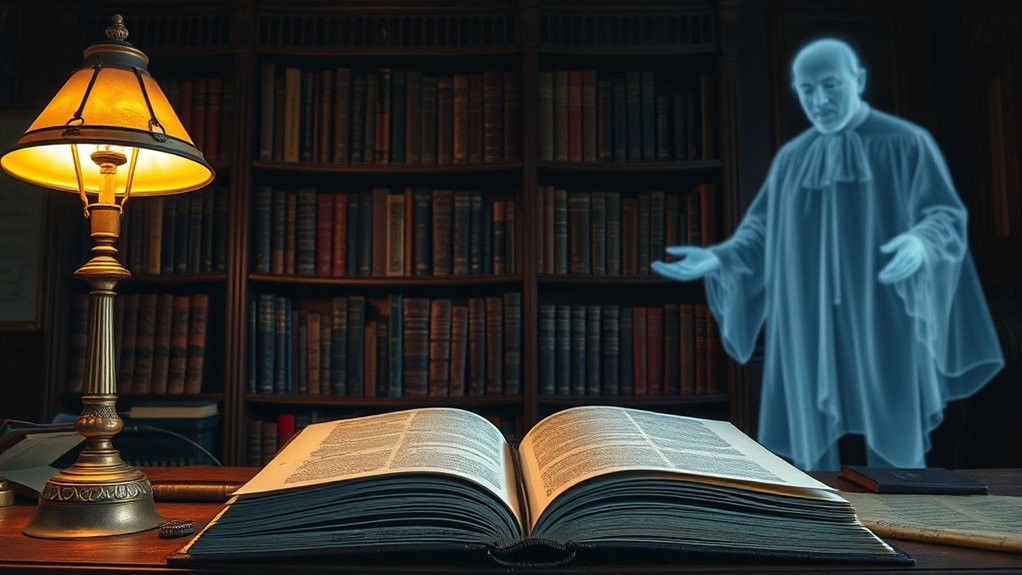
The Enlightenment’s emphasis on reason and empirical evidence has left a lasting mark on modern skepticism. You now question claims that lack scientific support and prioritize logical reasoning. This legacy encourages you to seek evidence before accepting supernatural ideas. Skepticism has become a cornerstone of scientific inquiry and critical thinking. To visualize this influence, consider the following:
| Approach | Key Feature | Result |
|---|---|---|
| Empiricism | Evidence-based validation | Reduced acceptance of supernatural claims |
| Rationalism | Logical reasoning | Increased suspicion of miracles |
| Scientific Method | Test and repeat findings | Fewer beliefs in unverified phenomena |
| Critical Thinking | Question assumptions | Promotes evidence over tradition |
This framework shapes your worldview, fostering a rational approach to understanding reality.
Frequently Asked Questions
How Did Religious Institutions React to Changing Beliefs During the Enlightenment?
Religious institutions mostly resisted the changing beliefs during the Enlightenment, feeling their authority threatened. You might see them dismissing new ideas, emphasizing tradition, and condemning scientific discoveries that challenged dogma. Some leaders tried to adapt, but many clung to old doctrines, fearing loss of influence. Overall, their reaction was a mix of opposition and cautious engagement, as they struggled to maintain relevance in a rapidly evolving intellectual landscape.
Did All Societies Experience the Same Shift in Supernatural Perceptions?
Not all societies experienced the same shift in supernatural perceptions. You’ll find that some cultures, especially those with strong traditions, resisted change, maintaining their beliefs despite Enlightenment ideas. Others embraced rational thought quickly, reducing supernatural explanations. Factors like religion, politics, and social structure influenced how people responded. So, while many shifted toward skepticism, others held onto their supernatural views, showing that the Enlightenment’s impact varied widely across different societies.
What Role Did Literature and Art Play in Changing Views on the Supernatural?
You see, literature and art played a pivotal role in shifting your perspective on the supernatural. Writers and artists began to challenge traditional beliefs, using new ideas to explore human reason and scientific understanding. As you encounter these works, they encourage you to question supernatural explanations, emphasizing rationality and empirical evidence. This cultural shift influences how society perceives mysteries and supernatural phenomena, moving toward a more skeptical, enlightened view.
How Did Non-Western Cultures Respond to Enlightenment Ideas About the Supernatural?
You see that non-western cultures often responded to Enlightenment ideas with a mix of curiosity and resistance. Many embraced scientific reasoning, questioning traditional supernatural beliefs, but they also maintained local spiritual practices. You might find that some cultures integrated new ideas into their worldview, while others strongly preserved their ancestral beliefs. Overall, their responses reflect a dynamic balance between adopting new perspectives and respecting long-standing cultural and spiritual traditions.
Are Modern Supernatural Beliefs Influenced by Enlightenment Principles?
Sure, your supernatural beliefs today are practically Enlightenment-approved, aren’t they? You’ve traded blind faith for scientific explanations, but still cling to ghost stories and mystical charms like a kid hugging a security blanket. Enlightenment principles nudged you to question, analyze, and rationalize, yet somehow, the supernatural remains a cozy corner of your world. It’s like trying to swap out a favorite song—despite progress, some things just refuse to change.
Conclusion
Now that you understand how the Enlightenment revolutionized your view of the supernatural, it’s clear that your perspective shifted from blind faith to reason and evidence. This intellectual upheaval reshaped society, making skepticism your new best friend. Without this era, you might still be trapped in a world of endless superstitions. The Enlightenment’s impact is so monumental, it’s practically the blueprint for your modern pursuit of truth—an unstoppable force that changed everything forever.