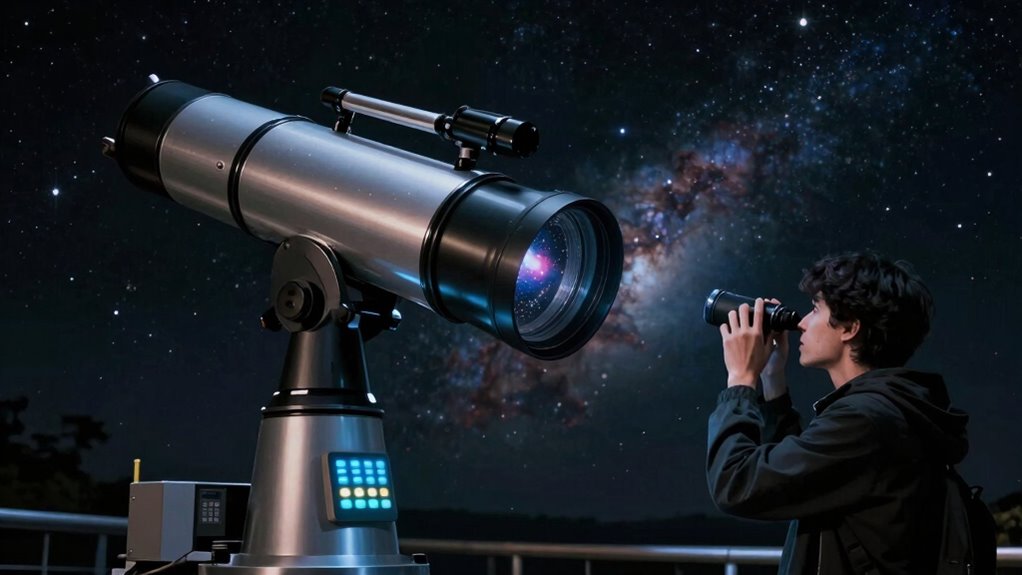

Computerized telescopes are excellent for exploring celestial objects, but they’re not designed to satisfy paranormal curiosity. They focus on observable phenomena like stars, planets, and distant galaxies, not supernatural energies or hauntings. These devices lack the sensitivity needed to detect paranormal events, which are often subjective and outside measurable ranges. If you want to uncover more about what science can and can’t do in this area, there’s plenty more to discover ahead.

Get movie nights delivered free with Prime
- Fast, free delivery on millions of items
- Prime Video, Amazon Music and more included
- Member-only deals all year
Key Takeaways
- Computerized telescopes are designed for observing physical celestial phenomena, not paranormal energies or supernatural activity.
- They lack the spectral sensitivity and specialized sensors needed to detect or interpret paranormal phenomena.
- Paranormal experiences are subjective and not measurable with conventional astronomical instruments.
- Environmental factors and calibration issues further limit telescopes’ ability to investigate supernatural claims.
- Overall, their technological scope is confined to observable, scientific phenomena, not satisfying paranormal curiosity.
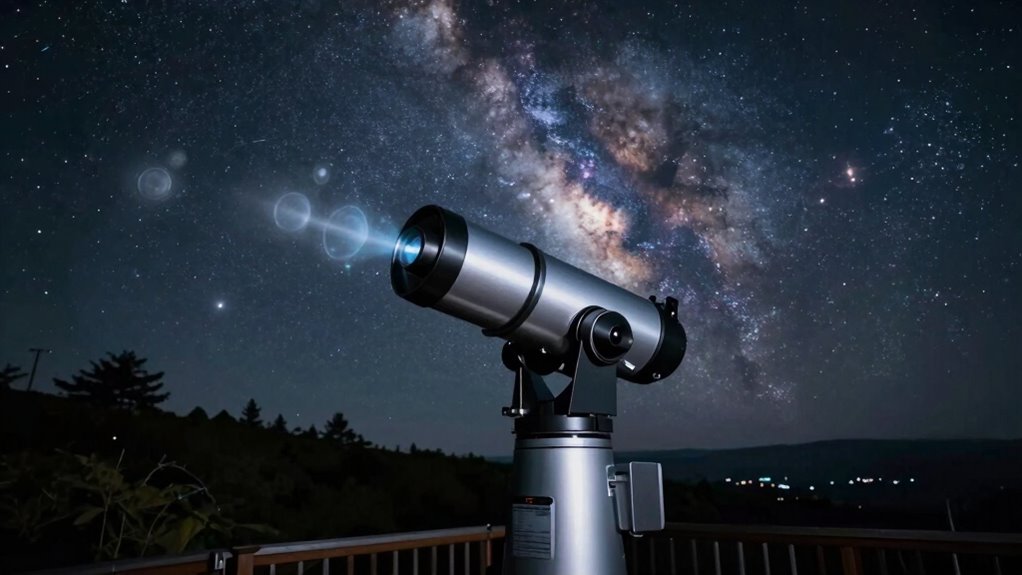
As technology advances, computerized telescopes have become powerful tools not only for exploring the cosmos but also for satisfying our curiosity about the paranormal. These sophisticated devices, equipped with digital controls and extensive databases, can help you observe distant celestial objects with remarkable detail. But when it comes to paranormal phenomena, the question arises: can these telescopes truly uncover or validate the supernatural? To understand their potential, it’s important to contemplate the technological limitations and the historical context of their development.
Historically, telescopes were designed solely for astronomical observation, with early models dating back centuries. As technology evolved, so did these instruments. The introduction of computerized systems in the late 20th century allowed for precise control, automated tracking, and access to vast digital star catalogs. These advancements made stargazing more accessible and accurate. However, despite their sophistication, these telescopes are still limited by their core purpose—studying physical, observable phenomena. They lack the sensitivity and spectral capabilities needed to detect or interpret paranormal activity, which often defies current scientific understanding. Additionally, the technological scope of these devices is inherently restricted to observable phenomena, making them less effective for paranormal investigations.
Modern computerized telescopes excel at observing physical phenomena but are limited in detecting paranormal or supernatural activity.
From a technological standpoint, computerized telescopes excel at capturing visible light and some infrared or radio waves. But paranormal phenomena, such as apparitions or energy anomalies, often fall outside the scope of what these devices can detect. They are typically rooted in subjective experiences or claims of unexplained sightings, which cannot be reliably captured through conventional telescopic imaging. Additionally, environmental factors like light pollution, atmospheric disturbances, and equipment calibration issues can hinder even astronomical observations, let alone paranormal investigations. Moreover, the development of scientific observation tools has focused on studying tangible phenomena, further emphasizing the gap between technological capabilities and paranormal exploration. This demonstrates that current scientific instruments are inherently limited in their ability to detect or analyze supernatural energies or entities. This highlights that while these tools are incredibly advanced, their scientific scope remains limited to observable, measurable phenomena.
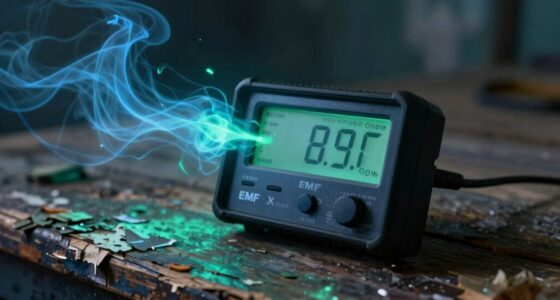
Furthermore, the historical context reveals that the human desire to explore the unknown has always pushed technology forward. Yet, the tools developed are fundamentally designed to observe physical reality—stars, planets, nebulae—rather than ghostly presences or supernatural energies. While some paranormal enthusiasts have tried to adapt high-tech devices, like night-vision cameras or electromagnetic field meters, to capture evidence, telescopes themselves aren’t inherently suited for these purposes. They serve as powerful instruments for celestial exploration, but their ability to satisfy paranormal curiosity remains limited by their original design and scientific scope.
digital astronomical telescope for celestial observation
As an affiliate, we earn on qualifying purchases.
As an affiliate, we earn on qualifying purchases.
Frequently Asked Questions
Can Computerized Telescopes Detect Ghostly or Paranormal Phenomena?
Computerized telescopes can’t detect ghostly or paranormal phenomena directly, as these aren’t scientifically measurable. However, you can use spectral analysis and electromagnetic sensors with them to observe unusual electromagnetic activity or spectral anomalies. While these tools might help identify strange signals or energy patterns, they don’t confirm paranormal entities. So, your telescope equipped with these sensors can aid in exploring mysterious phenomena, but it won’t prove ghosts exist.
Are There Specific Features in Telescopes for Paranormal Investigations?
Yes, there are specific features in telescopes for paranormal investigations. You should look for astronomical imaging capabilities that can capture detailed, high-resolution images of mysterious phenomena. Optical enhancements like infrared or ultraviolet filters help detect energies beyond visible light, potentially revealing ghostly presences. These features enable you to analyze strange occurrences more effectively, making your investigations more insightful and increasing your chances of uncovering paranormal activity.
How Accurate Are Computerized Telescopes in Identifying Celestial Objects?
Ever wonder how reliable computerized telescopes are at identifying celestial objects? They’re quite accurate, but their astronomical accuracy depends heavily on proper telescope calibration. When calibrated well, these telescopes can pinpoint stars, planets, and galaxies with impressive precision. However, slight miscalibrations can lead to errors. So, if you want the best results, make certain your telescope is correctly calibrated, and you’ll get accurate, detailed views of the night sky.
Can Paranormal Readers Use Telescopes to Communicate With Spirits?
You can’t use telescopes to communicate with spirits, as quantum mechanics and psychic phenomena lack scientific backing for such interactions. Telescopes are designed to observe celestial bodies, not bridge the spiritual domain. While some believe in psychic phenomena, current technology doesn’t support spirits communicating through electromagnetic signals or any physical means. Instead, focus on scientific methods to explore the universe, keeping an open mind but grounded in evidence.
Do Any Telescopes Have Built-In Paranormal Detection Technology?
No, no telescopes have built-in paranormal detection technology. You might think that modern equipment could detect spirits, but historical misconceptions often lead people astray. Scientific limitations prevent telescopes from sensing supernatural entities; they’re designed for astronomical observations, not paranormal phenomena. So, while it’s tempting to believe technology can bridge the gap, it’s essential to recognize that current science doesn’t support paranormal detection through telescopes.
infrared and radio telescopes for astronomy
As an affiliate, we earn on qualifying purchases.
As an affiliate, we earn on qualifying purchases.
Conclusion
So, as you peer through a computerized telescope, you’re not just gazing at distant stars—you’re opening a portal to endless mysteries. These high-tech eyes can quench your curiosity, revealing secrets once hidden in the darkness. With every click and zoom, you’re dancing on the edge of the unknown, turning the universe into your personal storybook. Embrace the magic of technology, and let your wonder soar beyond the stars into domains yet unseen.
advanced computerized telescope with star catalog
As an affiliate, we earn on qualifying purchases.
As an affiliate, we earn on qualifying purchases.
As an affiliate, we earn on qualifying purchases.
Halloween Picks
halloween
As an affiliate, we earn on qualifying purchases.