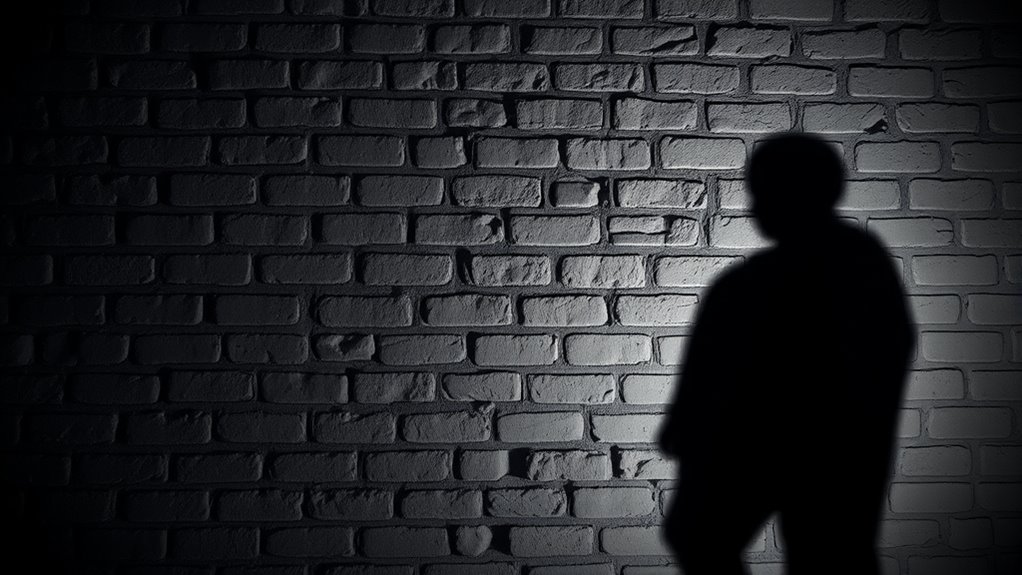

Shadow figure illusions work because your brain interprets ambiguous shadows by relying on visual perception, pattern recognition, and lighting cues. Changes in shadow shape, sharpness, and position influenced by light angles trick your mind into seeing familiar or threatening figures. Your perception is also shaped by psychological factors like expectations and anxiety. Continuing will reveal how your mind and senses collaborate to create these fascinating and sometimes eerie illusions.
Key Takeaways
- Shadows distort object shapes, prompting the brain to fill gaps based on context and prior experiences, creating illusion effects.
- Lighting angle, intensity, and shadow sharpness influence perception, making flat surfaces appear three-dimensional or eerie.
- Shadows guide depth perception through positioning and perspective cues, tricking the brain into perceiving volume and spatial relationships.
- Neural processes analyze shadow shapes and contrast, with top-down expectations and memories shaping illusion strength and vividness.
- Visual biases, pattern recognition, and emotional states like anxiety enhance susceptibility to interpreting ambiguous shadows as shadow figures.
Anatomy and Perspective: The Fundamentals of Figure Drawing
As an affiliate, we earn on qualifying purchases.
As an affiliate, we earn on qualifying purchases.
The Role of Visual Perception in Shadow Illusions

Understanding how your brain interprets shadows is key to grasping shadow figure illusions. Your visual perception doesn’t just see shapes; it actively interprets what they might represent. When you look at a shadow, your brain rapidly assesses context, lighting, and prior experiences to assign meaning. Shadows can distort the true shape of objects, leading your mind to fill in gaps or see figures that aren’t really there. This process relies on your brain’s ability to make quick judgments based on limited information, often resulting in illusions. Your perception is influenced by contrast, edge detection, and spatial relationships, which can create ambiguous images. Additionally, your brain’s tendency to fill in missing details contributes to the creation of these compelling illusions. By understanding these processes, you gain insight into why shadows can evoke such strong, sometimes eerie, visual impressions.

DE'LANCI Neon Eyeshadow Palette Glow in the Dark, Aurora Glow Eyeshadow Pallets Stage, Halloween Christmas Makeup Kit UV Blacklight Matte and Glitter Fluorescent Eye Shadows Highly Pigment
DE'LANCI Aurora Glow Eyeshadow For Eye,Face, Body, Hair and most surfaces. 24 COLOR bright eyeshadow including 5 pentagram…
As an affiliate, we earn on qualifying purchases.
As an affiliate, we earn on qualifying purchases.
How the Brain Interprets Ambiguous Shapes

Your brain constantly uses pattern recognition to make sense of ambiguous shapes in shadow illusions. Gestalt principles, like grouping and continuity, guide how you perceive these confusing images as coherent objects. Understanding these processes reveals how your mind fills in gaps and interprets shadows in unexpected ways. Additionally, research into visual perception shows that the brain’s collagen production influences how textures and depth are perceived, further affecting shadow interpretation.
Pattern Recognition Processes
When your brain encounters ambiguous shapes, it actively works to assign meaning by recognizing patterns based on previous experiences and contextual cues. You don’t see shapes in isolation; instead, your brain compares what it observes to familiar patterns stored in memory. This process helps you interpret complex shadows or unclear outlines, often filling in gaps with likely assumptions. For example, if a shadow resembles a human figure, your brain quickly matches it to past encounters with people, even if the shape is incomplete. This pattern recognition enables rapid interpretation, which is essential for survival and daily functioning. Additionally, visual processing mechanisms play a crucial role in how these patterns are identified and interpreted. However, it also makes you susceptible to illusions, as your brain sometimes prioritizes familiar patterns over actual visual data, leading to misperceptions like shadow figure illusions.
Gestalt Principles in Action
The brain doesn’t just recognize patterns; it actively organizes visual information based on principles known as Gestalt principles. These rules help your mind interpret ambiguous shapes, like shadow figures, by grouping elements, filling in gaps, and simplifying complex scenes. For example, the principle of closure prompts you to see a complete shape even when parts are missing. Proximity causes you to perceive nearby objects as related, while similarity guides you to group similar features. These principles work together to create a coherent image from uncertain or incomplete data, allowing you to quickly identify figures in shadows. An understanding of visual perception mechanisms reveals how your brain constructs meaningful interpretations from ambiguous shapes, revealing how your perception is both automatic and remarkably adaptable.

SET Enterprises SET – The Family Card Game of Visual Perception – Race to Find The Matches, For Ages 8+,81 Cards, Rules included
CARD GAMES FOR FAMILIES: The award-winning SET party game has been loved for years by fans of adult…
As an affiliate, we earn on qualifying purchases.
As an affiliate, we earn on qualifying purchases.
The Influence of Lighting and Shadows

Have you ever noticed how a simple change in lighting can transform a flat image into a haunting illusion? Lighting plays a vital role in creating shadow figure illusions because it shapes how you perceive objects and their shadows. When light comes from a specific angle, it casts shadows that can obscure or distort features, making familiar shapes appear strange or even eerie. The intensity and direction of the light determine the sharpness and length of shadows, influencing your perception of depth and form. Subtle shifts in light can make a shadow seem to move or change shape, tricking your brain into seeing figures that aren’t really there. By understanding how lighting manipulates shadows, you can better appreciate the deceptive power of shadow figure illusions. Additionally, awareness of light requirements, such as the need for consistent and adequate illumination, can help you analyze and create more convincing illusions.

XEBKOR Sunset Lamp Projector Multicolor Changing LED Projection Lamp,Switch Button and APP Control 360 Degree Rotation Sunlight Lamp for Bedroom, Photography, Party, Tiktok Live, Room Decor
【Endless Color RGB Sunset Lamps】 – This upgraded sunset projection lamp features high-refraction lenses , farther distance ,wider…
As an affiliate, we earn on qualifying purchases.
As an affiliate, we earn on qualifying purchases.
Perspective and Depth Cues in Shadow Figures
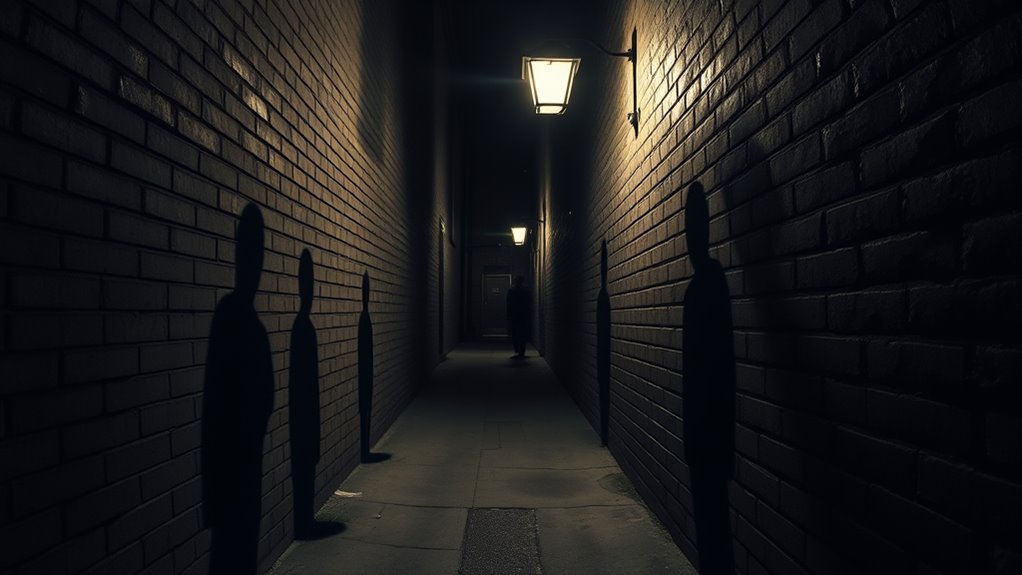
You notice how the position of shadows can change the way you perceive an object’s depth. Shadow positioning tricks trick your eyes into seeing spatial relationships differently. Understanding these depth cues helps explain how shadow figures create illusions that seem almost real. These cues, such as light contrast, play a crucial role in our perception of three-dimensional space.
Shadow Positioning Tricks
Shadow positioning tricks rely heavily on perspective and depth cues to create the illusion of three-dimensionality. By carefully placing shadows relative to the light source, you can make flat surfaces appear to have depth and volume. For example, shifting a shadow slightly higher or lower can suggest spatial relationships, guiding the viewer’s eye to interpret the figure as closer or farther away. The angle and length of shadows also influence perceived shape and size, reinforcing the illusion of form. When you position shadows strategically, you help the brain interpret the scene as three-dimensional, even though it’s flat. This manipulation of shadow placement is a powerful tool in creating convincing illusions that trick your perception into seeing depth where there is none. Additionally, understanding how regional legal resources vary by location can help in applying these principles more effectively in different environments.
Depth Perception Cues
Depth perception cues play a crucial role in how we interpret shadow figures, as our brains rely on visual signals like perspective and spatial relationships to judge distance and form. You subconsciously analyze cues such as size differences, shadows, and relative positioning to determine what’s real or an illusion. These cues help your brain interpret ambiguous shapes as either nearby or distant objects.
| Cue | How It Affects Shadow Figures |
|---|---|
| Perspective | Larger shadows seem closer, smaller ones appear farther |
| Shadow Length | Longer shadows suggest objects are closer to the light source |
| Overlap | Overlapping shapes indicate depth and layering |
| Relative Size | Size comparisons help judge object position in space |
Pattern Recognition and Familiarity Biases

Pattern recognition is a fundamental aspect of how our brains interpret visual information, often leading us to see familiar shapes or figures where none actually exist. This tendency influences how you perceive shadow figure illusions, as your brain automatically seeks patterns based on past experiences. When faced with ambiguous shadows, you might:
- Mistakenly interpret shadows as familiar objects or figures, even if they’re not present.
- Rely on prior knowledge to fill in gaps, creating a false sense of certainty.
- Experience biases that make certain shapes more likely to be recognized, skewing your perception.
These processes can cause you to see what your brain expects rather than what’s actually there. Recognizing this bias helps you understand why shadow illusions can seem so convincing and why your perception isn’t always objective. Additionally, Mazda Tuning techniques often leverage similar psychological principles to enhance the appeal and personalization of vehicles, illustrating how perception influences our preferences.
Optical Principles Underlying Shadow Effects

Understanding the optical principles behind shadow effects reveals how light interacts with objects to produce illusions. When light strikes an object, it creates a shadow that depends on the light source’s angle, intensity, and the object’s shape. Shadows can distort perception, making flat surfaces appear three-dimensional or altering the perceived size and position of objects. The contrast between light and shadow helps your brain interpret depth and spatial relationships. Variations in shadow intensity and sharpness influence how you perceive boundaries and contours. Changes in lighting conditions, such as diffuse versus direct light, can enhance or diminish shadow effects. Recognizing these principles helps explain why shadows can deceive your eyes, creating illusions that challenge your perception of reality.
Neural Mechanisms Behind Illusion Formation
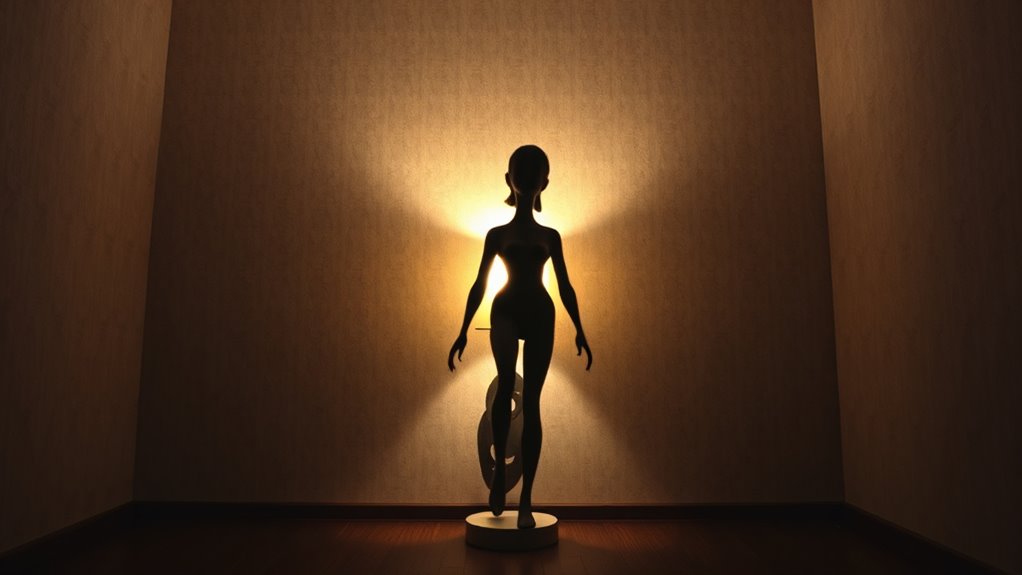
When your eyes interpret shadows created by light interacting with objects, your brain processes complex neural signals to construct your perception of reality. This involves several key mechanisms:
- Visual cortex activation, where your brain analyzes shape, contrast, and movement to identify shadow patterns.
- Pattern recognition pathways that compare shadows to stored memories, helping distinguish between real objects and illusions.
- Top-down processing, where your expectations influence how you interpret ambiguous shadows, sometimes leading to misperceptions.
These neural processes work together rapidly, enabling you to interpret shadow figure illusions in real time. Your brain’s ability to integrate visual information with prior knowledge and expectations shapes how illusions appear, often creating vivid, convincing shadow figures that challenge your perception of reality.
Psychological Factors Contributing to Shadow Perception
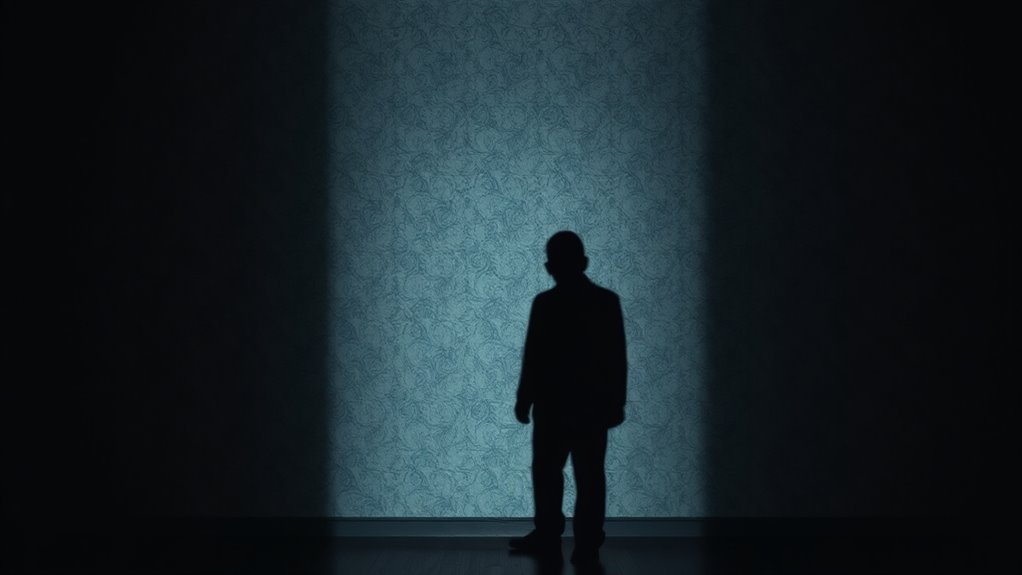
Psychological factors play a significant role in how you perceive shadow figures, often shaping your interpretation before your eyes even process the visual details. Your mind fills gaps based on past experiences, expectations, and emotions, influencing what you see. For example, fear or anxiety can heighten your sensitivity to shadows, making them appear more threatening or mysterious. Confirmation bias may lead you to interpret ambiguous shapes as shadow figures because you expect to see them. Here’s a quick visual summary:
| Factor | Effect |
|---|---|
| Past Experiences | Shapes shadow perception based on familiarity |
| Emotional State | Anxiety heightens shadow detection |
| Expectations | Leads to seeing shadow figures where none exist |
Additionally, individual differences such as visual perception can affect how shadows are interpreted, making some people more prone to seeing shadow figures than others.
Common Types of Shadow Figure Illusions
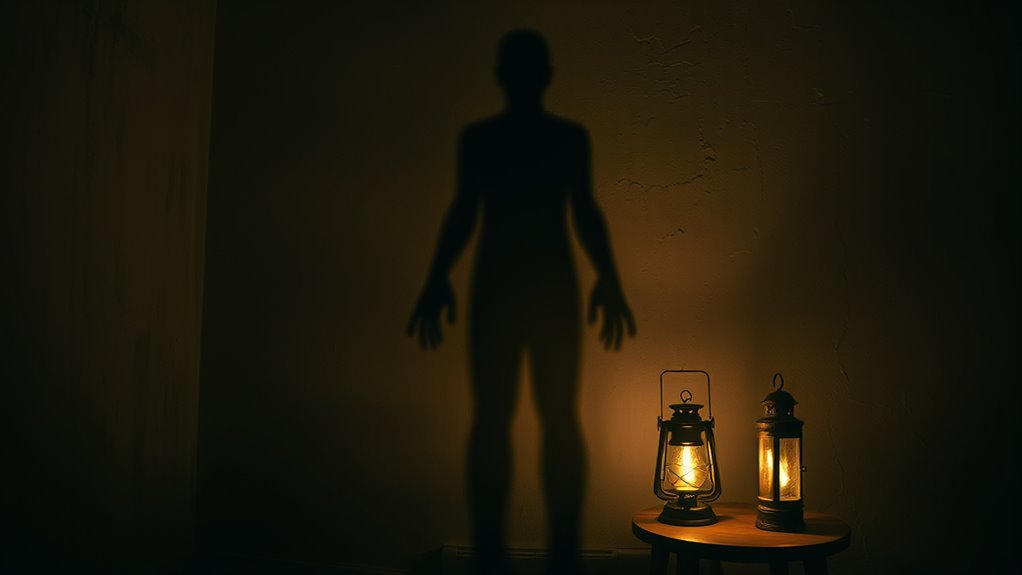
Many shadow figure illusions arise from specific visual tricks or ambiguous shapes that play with your perception. These illusions often fall into common types that challenge how you interpret shadows. First, silhouette illusions use dark outlines against bright backgrounds, making objects or figures appear as shadowy figures. Second, double images involve images that can be seen in two ways depending on how you focus, like a shadow resembling a different object or creature. Third, camouflage illusions blend shadows into their surroundings, making it hard to distinguish the figure from its environment. These types exploit your brain’s tendency to fill in gaps or interpret ambiguous shapes, creating compelling shadow figures that seem to come alive. Additionally, understanding how visual perception works can help you recognize when shadows are manipulated or illusions are at play. Recognizing these patterns helps you understand how perception can be manipulated.
Implications for Understanding Human Perception
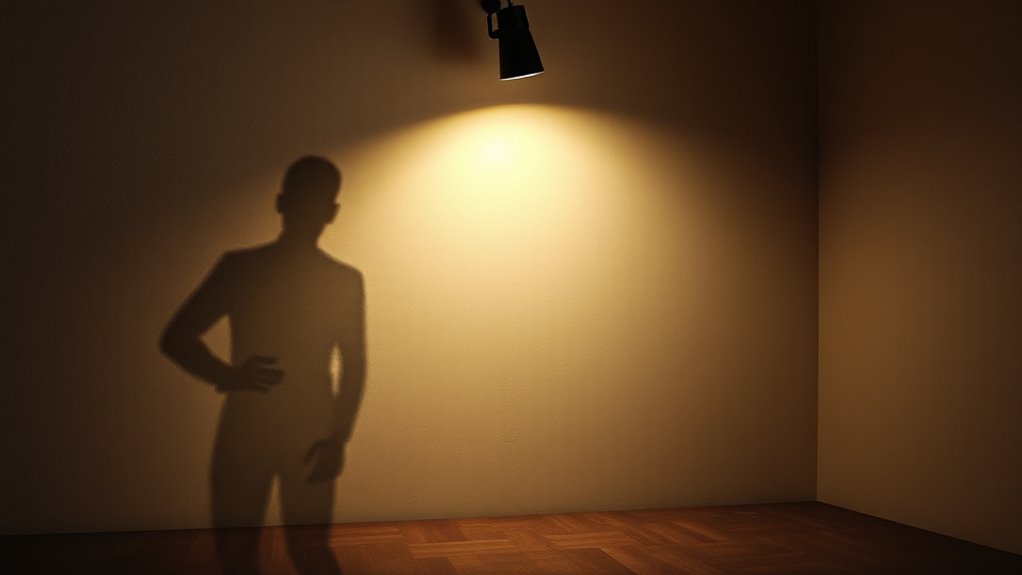
Shadow figure illusions reveal how easily our perception can be deceived, highlighting the brain’s reliance on visual cues to interpret the world around us. These illusions show that your mind often fills in gaps or interprets ambiguous shapes as familiar objects or figures, even when they’re not there. This illustrates that perception isn’t purely about what’s external but also about how your brain processes and predicts sensory information. Recognizing this helps you understand that your senses can be tricked, and perceptions are subjective, shaped by prior experiences and expectations. Such illusions reveal the limits of your visual system, emphasizing the importance of critical thinking and awareness in recognizing when your perceptions might be misleading. They remind you that perception is an active, interpretive process, not just passive reception of reality.
Frequently Asked Questions
How Do Individual Differences Affect Shadow Illusion Perception?
Your perception of shadow figure illusions varies based on individual differences like age, visual acuity, and psychological state. If you’re more anxious or have heightened sensitivity to dark or ambiguous images, you’re more likely to see shadow figures. Additionally, your past experiences and expectations influence how your brain interprets shadows, making some people more prone to illusions. Ultimately, your unique sensory and psychological makeup shapes how you perceive these intriguing shadow figures.
Can Shadow Illusions Be Used in Psychological Therapy?
Yes, shadow illusions can be used in psychological therapy to help clients confront fears and improve perception. You might experience shadow figures in controlled settings, which can trigger anxiety or other emotions. Through guided exposure, you learn to manage these reactions and reassess your perceptions. Therapists use these illusions to facilitate discussions about perception, reality, and fears, ultimately promoting emotional resilience and cognitive flexibility.
Are Shadow Figure Illusions Unique to Humans or Shared With Other Animals?
Shadow figure illusions are primarily a human phenomenon, thanks to our complex visual perception and cognitive processing. While some animals can recognize shapes and shadows, they don’t experience illusions the way humans do. You might observe animals reacting to shadows, but they don’t interpret them as illusions or figures like humans do. Your ability to perceive these illusions stems from advanced visual and psychological mechanisms unique to humans.
How Do Cultural Backgrounds Influence Shadow Illusion Interpretation?
You know what they say, “Beauty is in the eye of the beholder.” Your cultural background shapes how you interpret shadow illusions, influencing whether you see fear, mystery, or imagination. If you grow up in a culture that emphasizes spirits or supernatural tales, you’re more likely to see a shadow figure as something otherworldly. Conversely, a scientific or skeptical background might lead you to view it as a trick of light or perception.
What Are Recent Technological Advancements in Studying Shadow Illusions?
Recent technological advances include high-resolution 3D scanning, virtual reality, and eye-tracking devices that let you explore shadow illusions more precisely. Researchers now use advanced imaging to analyze how your brain perceives shadows and depth. These tools help you understand illusions better, revealing how your visual system processes ambiguous shadows. By using these technologies, you can actively participate in experiments, gaining deeper insights into your perception and the science behind shadow illusions.
Conclusion
Understanding shadow figure illusions reveals how your brain interprets ambiguous shapes, often filling in details based on familiarity. Did you know that over 70% of people report seeing shadow figures in certain illusions? This shows how perception is shaped by both visual cues and psychological factors. By exploring these illusions, you gain insight into your own mind’s fascinating processes, reminding you that what you see isn’t always the complete reality—it’s a remarkable interplay of perception and interpretation.