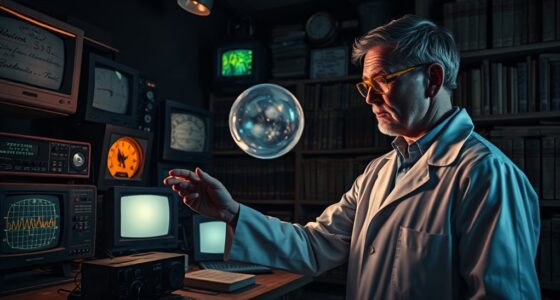
In the 1970s, researchers created the Philip Experiment to see if a ghost could be invented through focused imagination and suggestion. They devised a detailed fictional character, Philip, and had a group concentrate on his backstory, hoping mental focus alone could produce paranormal effects. Their systematic approach suggested that collective belief and intent might influence perceptions and experiences, blurring the line between imagination and reality. If you want to uncover the surprising outcomes of this experiment, keep exploring.
Key Takeaways
- The Philip Experiment was a 1970s Canadian study where researchers created a fictional ghost to test if collective thought could produce paranormal effects.
- They designed a detailed backstory for Philip to focus mental visualization and shared concentration over several weeks.
- The experiment aimed to see if focused mental suggestion alone could manifest perceived ghostly phenomena.
- Results suggested that belief and mental focus could influence perception, blurring lines between psychological expectation and paranormal activity.
- It demonstrated how scientific rigor and psychological insight can explore the influence of collective imagination on perceived reality.

Have you ever wondered if a ghost can be summoned through deliberate thought and suggestion? The Philip Experiment offers a fascinating glimpse into this possibility. Conducted in the 1970s by a group of Canadian researchers, the experiment aimed to explore whether a spirit could be created entirely through the power of collective imagination. They approached this goal using the principles of paranormal research, blending a scientific mindset with an open mind about supernatural phenomena. Their objective was clear: could they produce a convincing ghostly manifestation without any external paranormal triggers, relying solely on mental suggestion and focused intent? To achieve this, they designed a meticulous experimental methodology that prioritized control, repeatability, and logical analysis.
The researchers began by inventing a fictional character named Philip, complete with a detailed backstory, personality traits, and history. They documented everything about him, creating an extensive profile to ensure consistency in their mental visualization. Over several weeks, the group focused intensely on this shared image, attempting to bring Philip into existence through their collective thoughts. They used techniques such as visualization, affirmation, and group concentration, all grounded in the belief that mental focus could influence reality. Throughout the process, they kept detailed records, ensuring that their approach was systematic rather than haphazard. This disciplined method was essential in paranormal research, where subjective impressions can easily cloud results. Interestingly, the experiment also highlights how psychological factors such as expectation and belief can shape perceptions during paranormal investigations.
The results of the Philip Experiment opened intriguing questions about the nature of consciousness, belief, and the possibility that human minds could influence their environment in subtle ways. It challenged traditional notions of ghostly apparitions being purely external phenomena and suggested that mental constructs, when shared and focused upon, might generate tangible effects. For you, the experiment underscores how strong intent, combined with rigorous scientific investigation, can blur the lines between belief and reality. Ultimately, it serves as a compelling example of how paranormal research can blend psychological insight with experimental discipline, pushing us to reconsider what’s possible when we harness the power of suggestion and collective thought. Additionally, the experiment demonstrates how research methodology plays a crucial role in uncovering the potential influence of focused collective imagination. This study also reminds us of the importance of mental focus techniques in shaping perception and experience during such investigations.
Top picks for "philip experiment researcher"
Open Amazon search results for this keyword.
As an affiliate, we earn on qualifying purchases.
Frequently Asked Questions
Did the Philip Experiment Successfully Communicate With Spirits?
You wonder if the Philip Experiment successfully achieved spirit communication. While some believe it demonstrated that spirits could be conjured through mental focus, scientific skepticism remains strong. The experiment mainly showed how belief and suggestion influence results, making it hard to confirm genuine spirit contact. So, despite its intriguing nature, it doesn’t definitively prove that spirit communication can be reliably achieved through such methods.
What Scientific Evidence Supports or Refutes the Experiment’s Findings?
You wonder if scientific evidence backs or refutes the experiment’s findings. Paranormal skepticism remains strong because there’s no conclusive scientific validity supporting claims of communication with spirits. Critics argue that the results can be explained by psychological factors like suggestion or the ideomotor effect. Without rigorous, reproducible evidence, the scientific community remains doubtful, emphasizing that the experiment doesn’t provide solid proof of supernatural phenomena.
How Did the Experiment Influence Modern Paranormal Research?
You see, this experiment influenced modern paranormal research by highlighting how psychological effects can shape perceptions of ghostly phenomena. It also underscored the importance of rigorous experimental design to test claims scientifically. Researchers now use controlled methods to explore paranormal claims, understanding that belief and suggestion play significant roles. This shift encourages more systematic investigations, making paranormal research more credible and grounded in scientific principles.
Were There Any Ethical Concerns Regarding the Experiment’s Methods?
You might wonder if there were ethical concerns about the experiment’s methods. It raises questions about consent issues, as participants weren’t fully aware of the true purpose. Deception concerns also come into play because researchers intentionally misled participants to achieve results. These ethical issues highlight the importance of transparency in research, reminding you that respecting participants’ rights is vital, even in paranormal studies.
Has the Philip Experiment Been Replicated or Mimicked Elsewhere?
You might wonder if the Philip Experiment has been replicated or mimicked elsewhere, especially in ghost hoaxes or paranormal myths. While some groups attempt to recreate its methods, genuine replication remains rare, and many claim the results are inconclusive. You should remain cautious, as these efforts often blur the line between scientific inquiry and sensationalism, fueling ghost hoaxes and perpetuating paranormal myths without solid evidence or consistent outcomes.
Conclusion
So, next time you ponder the mysteries beyond our understanding, remember the Philip Experiment. It’s a haunting reminder that sometimes, the mind can conjure what it wishes to see, blurring the lines between reality and illusion. Are spirits truly out there, or are we simply masters of our own creation? In the end, the most chilling ghost might just be the one we’ve summoned from within ourselves, waiting silently to be awakened.