Your brain naturally seeks familiar patterns, especially faces, even in random shapes or shadows. When lighting is low or shadows form vague figures, your mind fills in the gaps, creating ghostly images through a phenomenon called pareidolia. This automatic pattern recognition helps you identify potential threats or familiar figures quickly, but it can also lead to seeing faces or ghosts where none exist. Keep exploring to uncover more about why your mind tricks you during these moments.
Key Takeaways
- Pareidolia causes the brain to interpret ambiguous shadows as familiar, often ghost-like, figures due to pattern recognition tendencies.
- Shadowy areas and low lighting enhance the likelihood of perceiving ghostly shapes through pareidolia.
- The brain’s facial recognition regions activate even without real faces, leading to ghostly face perceptions in shadows.
- Emotional states and cultural beliefs can influence whether shadow shapes are seen as threatening or supernatural.
- Pattern detection helps humans interpret vague stimuli quickly, sometimes resulting in ghostly illusions in shadows.
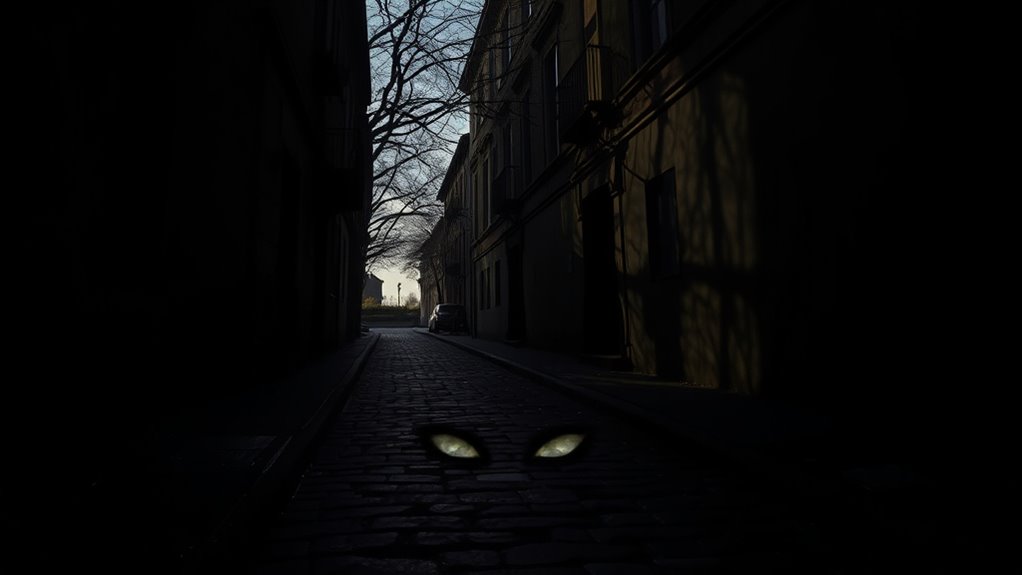
Pareidolia is the psychological phenomenon where your mind perceives familiar patterns, such as faces or objects, in random stimuli like clouds, shadows, or textured surfaces. When you spot a face in a coffee stain or a shadow that looks like a ghost, your brain is engaging in pattern perception—an innate ability to identify familiar shapes in chaos. This process is driven by your brain’s natural tendency toward facial recognition, a essential skill for social interaction and survival. Your brain has specialized regions, like the fusiform face area, dedicated to recognizing faces quickly and efficiently. That’s why, when you see a face in the shadows, your mind automatically activates these regions, even if there’s no actual face there.
Your pattern perception is incredibly sensitive, allowing you to detect faces and objects with minimal cues. This sensitivity is useful in everyday life; it helps you recognize loved ones and interpret social cues. But it also leads to the uncanny experiences associated with pareidolia, especially in low-light or ambiguous conditions. When shadows form vague shapes, your brain tries to make sense of them, often filling in gaps with familiar images—sometimes of ghosts or spirits. This tendency can be heightened by your emotional state or cultural beliefs, making those shadowy figures seem more real or threatening. Additionally, your brain’s facial recognition mechanisms are constantly active, even in ambiguous situations, which increases the likelihood of perceiving faces in shadows.
Furthermore, environmental factors like lighting conditions can influence the frequency and intensity of pareidolia experiences, making them more common in certain settings. Interestingly, your facial recognition skills aren’t limited to actual faces. Your brain can interpret abstract patterns as faces even when they aren’t intended to be one. For example, the pattern of a tree’s bark might resemble a face, or a random cluster of rocks could look like a pair of eyes. This tendency to see faces in random objects is a hallmark of pareidolia, driven by your brain’s constant search for meaningful patterns. It’s as if your mind’s default setting is to find faces because they’re so essential for social connection.
This pattern perception isn’t just about seeing faces; it’s also about making sense of your environment. When you see shadowy figures or shapes in the dark, your brain is actively trying to interpret those stimuli based on past experiences and expectations. It’s a survival mechanism, helping you quickly identify potential threats or familiar figures. The brain’s pattern recognition capabilities play a crucial role in this process. Your brain’s ability to process visual cues rapidly is supported by the neural pathways that facilitate quick recognition of familiar shapes. So, while pareidolia can sometimes lead to spooky illusions or false alarms, it’s ultimately a reflection of your brain’s incredible ability to find order amid chaos, especially through facial recognition and pattern perception.
Top picks for "pareidolia ghost shadow"
Open Amazon search results for this keyword.
As an affiliate, we earn on qualifying purchases.
Frequently Asked Questions
Can Pareidolia Be Linked to Mental Health Conditions?
You might wonder if pareidolia relates to mental health conditions. It can, as cognitive biases influence how you interpret ambiguous images or sounds, sometimes leading to false perceptions. Cultural influences also shape what you see or hear, reinforcing certain beliefs or fears. If these perceptions become frequent or distressing, it could signal underlying mental health concerns. Recognizing this connection helps you understand how your mind processes ambiguous stimuli.
How Does Pareidolia Differ From Hallucinations?
You might wonder how pareidolia differs from hallucinations. In visual perception, pareidolia occurs when your cognitive processes interpret ambiguous images, like seeing faces in shadows, as familiar objects. Hallucinations, however, are false sensory experiences that happen without real stimuli, often linked to mental health conditions. Unlike hallucinations, pareidolia is a normal, common phenomenon rooted in your brain’s pattern recognition, helping you find meaning in ambiguous visuals.
Are Children More Prone to Seeing Pareidolia?
Imagine a foggy morning, where shapes softly emerge from the mist; children’s childhood perception is much like that. Developmental psychology shows kids are more prone to pareidolia because their brains are still learning to interpret visual cues. This natural curiosity often makes them see familiar forms in shadows or clouds more easily than adults, as their minds are more open to playful interpretations and pattern recognition during early years.
Can Pareidolia Help in Psychological Therapy?
You might wonder if pareidolia can aid psychological therapy. It can, because understanding visual perception and cognitive biases helps you recognize how your mind interprets ambiguous images. By exploring these patterns, you learn to question automatic assumptions, reducing anxiety or distortions. This awareness fosters self-reflection and emotional regulation, making pareidolia a useful tool in therapy to improve mental health and develop healthier thought patterns.
Is Pareidolia a Sign of Supernatural Activity?
You might wonder if pareidolia signals supernatural activity. It’s actually a type of perception illusion rooted in our pattern recognition abilities, where your brain interprets random images as familiar objects, like faces in shadows. This isn’t evidence of ghosts, but a natural cognitive process. Your mind seeks patterns, especially in ambiguous stimuli, which can make shadows or vague shapes seem like supernatural signs when, in reality, it’s just your perception at work.
Conclusion
So, next time you glimpse a face in the shadows or see shapes in the clouds, remember it’s your mind’s way of turning the ordinary into the extraordinary. Pareidolia is like a playful trickster, whispering stories from your subconscious. It’s a reminder that our brains are wired to seek meaning, even in darkness. Embrace the mystery, knowing that sometimes, what you see is just a fascinating dance of perception, not ghosts lurking in the night.