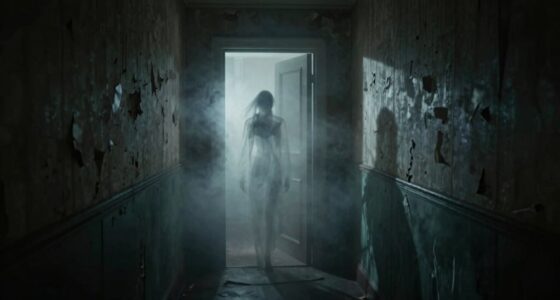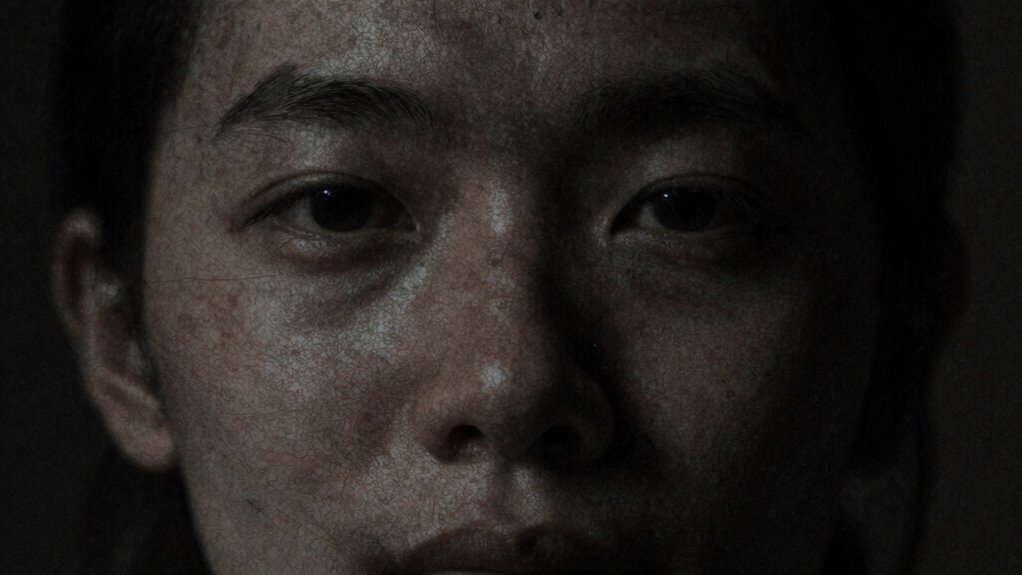

Your brain is wired to find familiar shapes in ambiguous images, so you naturally see faces in darkness and patterns in noise. Specialized neural pathways dedicated to face recognition activate even when no faces are present, helping you quickly pick up social cues or threats. Cognitive biases like pareidolia lead you to interpret vague visuals as familiar objects. If you keep exploring, you’ll discover more about how your perception is shaped by both biology and environment.

Get movie nights delivered free with Prime
- Fast, free delivery on millions of items
- Prime Video, Amazon Music and more included
- Member-only deals all year
Key Takeaways
- The brain’s pattern recognition system is wired to identify familiar shapes, including faces, even in ambiguous stimuli like darkness or noise.
- Specialized neural pathways dedicated to face recognition activate automatically, prompting the perception of faces in shadows or textured surfaces.
- Cognitive biases such as pareidolia cause the brain to interpret vague patterns or random noise as meaningful images, like faces.
- Low-light and noisy environments increase reliance on perceptual fill-ins, leading to the perception of familiar shapes in incomplete visual data.
- External stimuli manipulation or environmental factors can amplify these tendencies, making faces and patterns more readily apparent in noise.

Have you ever looked into the darkness and suddenly seen faces or patterns that weren’t really there? It’s a common experience, and it highlights how your brain’s visual perception is wired to find familiar shapes even when none exist. Your mind is constantly trying to make sense of ambiguous stimuli, which explains why you might perceive faces in shadows or see objects in random noise. This tendency isn’t random; it’s rooted in your brain’s design to recognize patterns swiftly, a process that helps with survival but can also lead to false positives. When your eyes observe dim or chaotic visuals, your brain fills in the gaps, often projecting familiar forms like faces or objects. This automatic pattern recognition is a feature, but it also makes you susceptible to illusions and hallucinations in low-light or noisy environments. The brain’s innate ability to detect patterns is influenced by neural pathways specifically dedicated to face recognition, which are highly sensitive even in the absence of actual faces. Your tendency to see faces or patterns is strongly influenced by cognitive biases—mental shortcuts your brain uses to process information quickly. One such bias is pareidolia, the tendency to interpret vague stimuli as meaningful images, especially faces. Your brain has a special set of neural pathways dedicated to recognizing faces, which are highly sensitive and active even when there’s no real face present. This sensitivity makes it easier for your mind to pick out faces in the shadows or in textured surfaces, because your brain is wired to prioritize social information. It’s a survival trait that helps you identify friends or threats rapidly, but it also causes you to see faces where none exist. In low-light conditions or when listening to noisy sounds, your visual perception works overtime to find order in chaos. Your brain tries to create coherence from fragmented or random data, which can lead to seeing patterns or figures in static or noise. This process is accelerated by cognitive biases, which bias your perception toward familiar or meaningful shapes. The brain’s pattern-finding drive is so strong that you might even see faces or objects in the irregular specks of a starry sky or in the static of a television screen. These illusions are a testament to how your mind’s natural inclination to find structure and familiarity can sometimes deceive you. Additionally, the use of visual perception in various technological devices, such as projectors or cameras, can influence how we interpret ambiguous images or noise. Recognizing these tendencies can also provide insight into how neural pathways influence perception and our susceptibility to illusions. Moreover, understanding the brain’s pattern recognition mechanisms can help in developing better visual aids and artificial intelligence systems that mimic human perception. Research into these perceptual biases reveals how easily our perceptions can be manipulated by external stimuli. Furthermore, the way your brain processes ambiguous stimuli is closely connected to cognitive processes involved in pattern recognition and perception. Ultimately, what you experience when you see faces in darkness or patterns in noise reveals the remarkable, sometimes fallible, power of your visual perception. It shows how your brain is built to interpret ambiguous stimuli rapidly but also how cognitive biases can lead you to perceive what isn’t really there. In a way, these illusions are windows into the workings of your mind, illustrating its constant effort to find meaning—even in the shadows and noise.
As an affiliate, we earn on qualifying purchases.
Frequently Asked Questions
How Does the Brain Differentiate Real Faces From Illusions?
You differentiate real faces from illusions through perception illusions and neural processing. Your brain actively analyzes visual cues like shape, context, and movement, comparing them to stored memories of actual faces. Neural processing filters out false patterns, focusing on familiar facial features. When something resembles a face, your brain’s pattern recognition kicks in, creating the illusion. This complex process helps you distinguish real faces from mere visual tricks.
Can Seeing Faces in Darkness Indicate Psychological Issues?
Seeing faces in darkness can be like shadows dancing in your mind’s theater, but it doesn’t necessarily signal psychological issues. While occasional illusions are part of normal psychological perception, persistent or distressing visions might hint at underlying mental health concerns. If this experience bothers you or worsens, it’s wise to consult a mental health professional. Your mind’s theater is complex, but support can help you navigate its shadows more clearly.
Why Do Some People See More Patterns Than Others?
You see more patterns than others because your visual perception is highly sensitive, and your brain actively seeks meaning in chaos. Cognitive biases can lead you to interpret random noise as familiar shapes or images, like faces or patterns. Your brain’s tendency to find order and significance in randomness varies from person to person, making some more prone to perceiving patterns, especially when your mind is primed or focused on finding connections.
Are Cultural Backgrounds Linked to Pattern Recognition Tendencies?
Your cultural background can influence your pattern recognition tendencies through cultural influences on visual perception. Different cultures emphasize varied visual cues and symbols, shaping how you interpret patterns and shapes. For instance, some cultures focus more on holistic perception, while others favor detail-oriented viewing. This variation affects how you detect and interpret patterns in noise or darkness, making your cultural experiences a key factor in your visual perception and pattern recognition skills.
How Does Age Affect the Ability to See Faces or Patterns?
As you age, your visual perception and developmental changes influence how easily you see faces or patterns. Children are like sponge-like scanners, quickly identifying familiar shapes, while adults may become more selective, sometimes missing subtle details. With age, your brain adapts, and your ability to recognize patterns or faces can decline or improve, depending on experience and health. Overall, age shapes your perception, like a river carving new paths over time.
noise pattern recognition puzzle
As an affiliate, we earn on qualifying purchases.
As an affiliate, we earn on qualifying purchases.
Conclusion
You’ve probably experienced seeing faces in shadows or patterns in random noise before. It’s a fascinating quirk of our brain, which constantly seeks familiar shapes to make sense of the chaos around us. Did you know that studies show our brains are wired to recognize faces within 100 milliseconds? This quick recognition highlights how deeply ingrained this tendency is, helping us stay alert and interpret our environment efficiently—even when it’s just in our imagination.
As an affiliate, we earn on qualifying purchases.
As an affiliate, we earn on qualifying purchases.
Halloween Picks
halloween
As an affiliate, we earn on qualifying purchases.