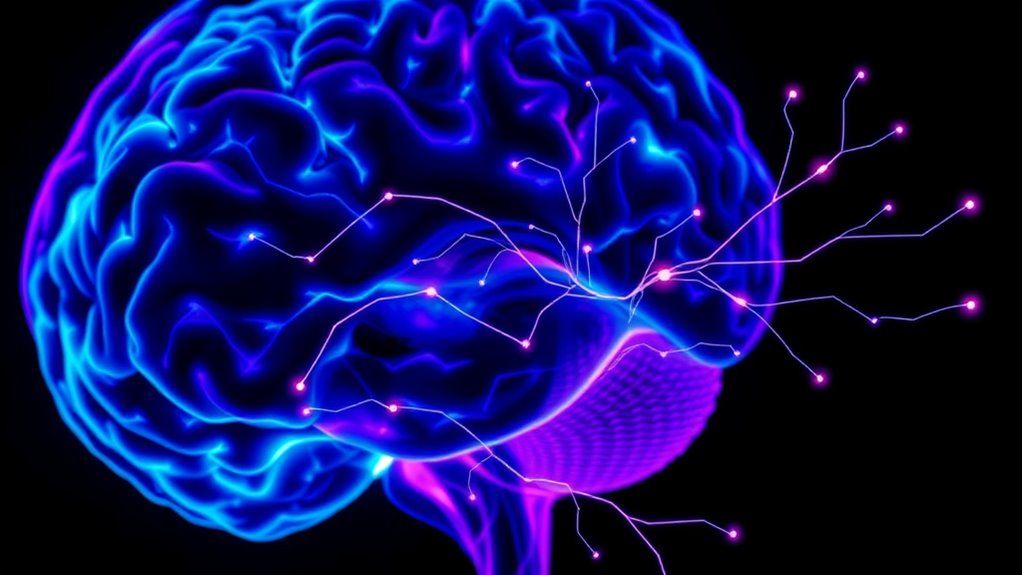

Neuroscience shows that spiritual and religious experiences involve specific brain regions like the prefrontal cortex, limbic system, and temporoparietal junction, which process emotions, self-awareness, and social connection. Practices such as meditation and prayer modulate these areas, often decreasing activity in the default mode network and increasing neurotransmitters like serotonin and dopamine, which enhance feelings of transcendence and peace. To understand how these neural processes create profound spiritual states, continue exploring the fascinating science behind them.
Key Takeaways
- Brain regions such as the prefrontal cortex, limbic system, and temporoparietal junction are involved in spiritual and religious experiences.
- Meditation and prayer modulate the Default Mode Network, influencing self-awareness and perceptions of transcendence.
- Neurotransmitters like serotonin and dopamine contribute to mystical feelings, emotional states, and reinforcement of spiritual practices.
- Regular spiritual practices induce neuroplastic changes, strengthening neural pathways related to emotion regulation and compassion.
- Neuroscience explores ethical and cultural implications, integrating neuroimaging and interdisciplinary approaches to understand spiritual phenomena.

Retrospec Sedona Zafu Meditation Cushion with Buckwheat Hull Fill – Adjustable Yoga & Pilates Equipment Support – 17in Crescent Cotton Cover
NATURAL COMFORT & SUPPORT: Filled with sustainable buckwheat hulls, this meditation cushion elevates your practice by aligning your…
As an affiliate, we earn on qualifying purchases.
As an affiliate, we earn on qualifying purchases.
Brain Regions Involved in Spiritual Experiences

Research shows that several brain regions are actively involved in spiritual experiences, highlighting their neurological basis. When you encounter moments of awe or deep connection, your prefrontal cortex becomes highly engaged, helping you process complex thoughts and feelings related to spirituality. The limbic system, especially the amygdala, plays a role in emotional responses, giving you feelings of reverence or transcendence. The temporoparietal junction is also involved, contributing to your sense of self and how you relate to others and the universe. Additionally, the posterior cingulate cortex is active during introspective states, supporting self-awareness and reflection. These regions work together to create the profound sense of meaning, unity, and peace often experienced during spiritual practices.

Neuroplasticity Writing Workbook: Train your brain, boost neuroplasticity & calm your mind by writing with your non-dominant hand
As an affiliate, we earn on qualifying purchases.
As an affiliate, we earn on qualifying purchases.
Neural Pathways Activated During Meditation and Prayer

During meditation and prayer, several neural pathways become actively engaged, facilitating the deep states of calm, focus, and spiritual connection you experience. The prefrontal cortex, responsible for attention and executive function, shows increased activity as you concentrate and regulate your thoughts. Simultaneously, the limbic system, including the amygdala, reduces its activity, helping diminish stress and emotional reactivity. The salience network, which detects relevant stimuli, becomes more prominent, guiding your focus inward. The insula, integral to interoception, heightens awareness of bodily sensations, deepening your sense of presence. These pathways work together to promote relaxation, centeredness, and a profound sense of connection, enabling you to enter meditative or prayerful states that foster spiritual insight and emotional stability. Understanding how these neural pathways activate can help enhance your practice and deepen your spiritual experiences.

Mindfulness & Guided Sleep Meditation
Meditation to improve focus
As an affiliate, we earn on qualifying purchases.
As an affiliate, we earn on qualifying purchases.
The Role of Default Mode Network in Religious States

You may notice that during religious states, the default mode network (DMN) shows specific activation patterns linked to self-referential thought and mind-wandering. Meditation often reduces DMN activity, suggesting a shift away from ordinary self-focused processes, which can lead to altered states of consciousness. Understanding how the DMN functions in these contexts helps explain the neural basis of profound spiritual experiences. Additionally, practices that support mental and emotional well-being techniques, such as mindfulness and meditation, can influence DMN activity and contribute to these altered states.
DMN Activation Patterns
The default mode network (DMN), a set of interconnected brain regions active during rest and self-referential thought, plays a crucial role in religious and spiritual experiences. During these states, you often see increased or altered DMN activity, reflecting a focus on inner thoughts, beliefs, and personal meaning. For example, feelings of divine presence or transcendence correlate with specific activation patterns in the DMN, especially in areas like the medial prefrontal cortex and posterior cingulate cortex. These regions support self-referential processing and the construction of spiritual narratives. Changes in DMN activity can influence how you perceive spiritual encounters, shaping feelings of unity or sacredness. Understanding these patterns helps reveal how your brain constructs and sustains religious experiences, linking neural activity to subjective spiritual states. Additionally, ongoing research into AI vulnerabilities emphasizes the importance of monitoring complex systems, which can be metaphorically related to understanding intricate brain networks involved in spiritual states.
Meditation and DMN
Meditation profoundly influences the activity of the default mode network (DMN), which plays a key role in shaping religious and spiritual experiences. During meditation, you often observe a decrease in DMN activity, leading to reduced mind-wandering and self-referential thoughts. This shift fosters feelings of connectedness, unity, and transcendence, core aspects of spiritual states. Different meditation techniques, like mindfulness or focused attention, uniquely modulate the DMN, influencing your subjective experience. To illustrate, consider the table below:
| Meditation Type | Effect on DMN | Resulting Experience |
|---|---|---|
| Mindfulness | Decreases activity | Present-focused awareness |
| Loving-kindness | Sustains activity | Compassion and empathy |
| Transcendental | Suppresses activity | Dissolution of self-boundaries |
Recent research indicates that these variations in DMN activity can be linked to different religious and spiritual experiences, highlighting the importance of understanding how meditation techniques influence brain function.
Religious Altered States
During religious altered states, the default mode network (DMN) often shows significant changes that underpin profound spiritual experiences. You might notice decreased activity in the DMN during intense spiritual moments, which reduces self-referential thinking and ego boundaries. This shift allows you to feel more connected to a higher power, the universe, or a collective consciousness. These changes can produce sensations of unity, timelessness, and transcendence, often reported during mystical encounters or deep prayer. In some cases, heightened activity in other brain regions complements the DMN’s modulation, supporting feelings of awe and reverence. Understanding these neural dynamics helps explain why altered states lead to transformative spiritual insights, highlighting the DMN’s central role in shaping your subjective religious experiences.

JILANI HANDICRAFT Tasbih Prayer Beads – 99 Worry Beads Misbaha with Allah & Muhammad Names Engraved, Islamic Rosary for Dhikr, Namaz, Ramadan & Eid Gift (Grey)
Engraved Names of Allah & Muhammad: Features Arabic names of Allah and Muhammad engraved on each bead with…
As an affiliate, we earn on qualifying purchases.
As an affiliate, we earn on qualifying purchases.
Neurotransmitters and Chemical Influences on Spiritual Feelings

You might notice that certain chemicals in your brain, like serotonin, can enhance mystical experiences, making feelings seem profound and otherworldly. Dopamine, on the other hand, provides a sense of spiritual reward, reinforcing religious or spiritual behaviors. Understanding how these neurotransmitters influence your feelings can shed light on the biological basis of spiritual experiences. Additionally, seasonal variations can influence the intensity of these feelings, highlighting the complex interaction between environment and neurochemistry.
Serotonin and Mystical States
Serotonin, a key neurotransmitter in the brain, plays a significant role in shaping mystical and spiritual experiences. It influences how you perceive the world, often heightening feelings of unity and transcendence. When serotonin levels fluctuate, you might find yourself more open to profound insights or feelings of connectedness. This chemical’s impact can evoke powerful emotions, making spiritual states more accessible. Consider these effects:
- You may experience a deep sense of peace and oneness with everything around you.
- Feelings of awe and wonder can become more intense and meaningful.
- Your perception of time might slow down, amplifying mystical insights.
- Emotional sensitivity heightens, allowing for profound spiritual connections.
- The modulation of neurotransmitters like serotonin can be influenced by cybersecurity which protects neurological data from external interference, ensuring the integrity of your mental states.
Serotonin’s influence helps access the doors to mystical states, enriching your spiritual journey.
Dopamine and Spiritual Reward
Dopamine, often called the brain’s reward chemical, plays a vital role in shaping spiritual feelings by reinforcing experiences of joy, motivation, and achievement. When you have a spiritual experience, dopamine release can heighten your feelings of euphoria and connectedness, making the moment feel profound. This chemical boost encourages you to seek similar experiences again, strengthening your spiritual practices or beliefs. Activities like prayer, meditation, or communal worship may trigger dopamine release, enhancing feelings of reward and purpose. Over time, these chemical responses can create a reinforcing cycle, deepening your spiritual engagement. Dopamine’s influence helps explain why spiritual experiences often feel so uplifting and why they motivate ongoing participation in religious or spiritual activities. Recognizing the neurochemical basis of these feelings can deepen your understanding of how spiritual experiences are biologically reinforced and sustained.
The Impact of Spiritual Practices on Brain Plasticity

Spiritual practices such as meditation, prayer, and mindfulness can substantially influence brain plasticity by promoting structural and functional changes in neural networks. These practices strengthen pathways associated with emotional regulation, attention, and compassion. As you engage regularly, your brain adapts, creating a more resilient and balanced mental state. Notably, research indicates that engaging in these practices can lead to positive changes in brain structure, enhancing overall mental health and well-being.
Debates and Future Directions in Neuroscience of Spirituality

While neuroscience has made significant strides in understanding spiritual and religious experiences, debates persist over how best to interpret the findings and their implications. Some researchers argue that neural correlates simply reflect brain activity, not the essence of spirituality itself. Others believe that identifying specific brain regions can deepen our understanding of how spirituality influences well-being. Future directions include integrating neuroimaging with psychological and cultural studies to create a holistic view. Ethical considerations also emerge, such as respecting individual beliefs and avoiding reductionism. You’ll need to navigate these debates carefully, recognizing the strengths and limitations of current methods. Additionally, advances in contrast ratio technology may allow for more precise imaging of neural activity related to spiritual experiences. Moving forward, interdisciplinary approaches and advanced technologies will likely shape how neuroscience explores the profound nature of spiritual experiences.
Frequently Asked Questions
How Do Individual Differences Affect Spiritual Experiences in the Brain?
Your individual differences, like genetics, personality, and life experiences, shape how your brain processes spiritual experiences. These factors influence neural pathways involved in perception, emotion, and cognition, making each person’s spiritual encounters unique. For example, your openness or prior beliefs can heighten or diminish feelings of transcendence, while variations in brain structure may affect how intensely you experience spiritual states. Understanding these differences helps explain why spiritual experiences vary from person to person.
Can Neuroimaging Distinguish Genuine Spiritual Experiences From Hallucinations?
Neuroimaging can’t definitively distinguish genuine spiritual experiences from hallucinations yet. You might see overlapping brain activity during both, making it difficult to tell them apart solely based on images. While certain patterns suggest spiritual or mystical states, hallucinations can mimic these. Researchers continue exploring, but right now, neuroimaging provides clues rather than clear-cut evidence, so you can’t rely solely on it to confirm authenticity of spiritual experiences.
Are There Genetic Factors Influencing Predisposition to Spiritual or Religious Feelings?
Yes, genetic factors can influence your predisposition to spiritual or religious feelings. Research shows that certain genes related to neurotransmitter systems, like serotonin and dopamine, may affect how strongly you experience spiritual sensations. If your family has a history of religious engagement or spiritual experiences, you might be more likely to have similar feelings. While genetics play a role, environmental and personal factors also shape your spiritual life.
How Do Cultural Backgrounds Shape Neural Responses During Spiritual Practices?
You’re influenced by your cultural background in shaping neural responses during spiritual practices, with studies showing that people from different cultures activate distinct brain regions. For example, meditators from Eastern traditions often show increased activity in the insula, linked to self-awareness, while Western practitioners activate regions tied to emotion regulation. Your cultural experiences guide how your brain processes spiritual stimuli, making each person’s neural response uniquely shaped by their cultural context.
What Ethical Considerations Arise From Manipulating Brain Activity to Induce Spiritual States?
You should consider that manipulating brain activity to induce spiritual states raises ethical issues like consent, authenticity, and potential psychological harm. You need to guarantee individuals fully understand the risks and benefits involved. Respect for personal beliefs is vital, as is avoiding coercion or manipulation. Balancing scientific advancement with moral responsibility helps prevent misuse and protects individuals’ mental and spiritual integrity during such interventions.
Conclusion
As you explore the neuroscience of spiritual experiences, you see how specific brain regions like the prefrontal cortex and default mode network shape your feelings of transcendence. Imagine a person meditating, their brain rewiring itself for greater compassion and insight. This evolving understanding shows that spirituality isn’t just mystical—it’s rooted in your brain’s remarkable plasticity. Keep questioning and exploring; your mind’s potential for spiritual growth is more powerful than you might think.