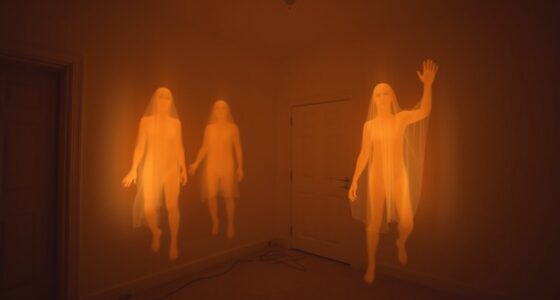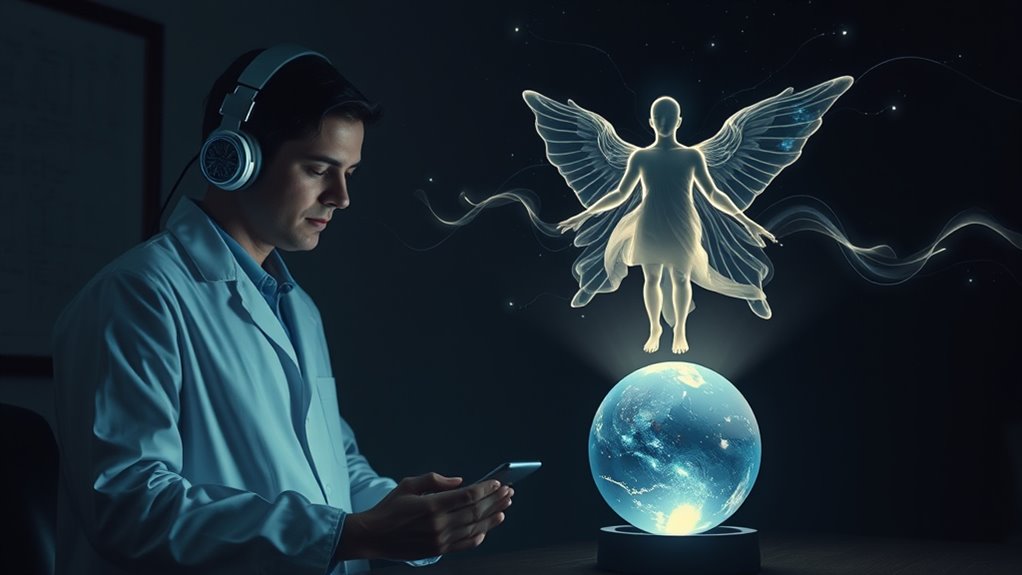

Neuroscience shows that your brain actively constructs perceptions by processing sensory data, beliefs, and past experiences, which can lead to experiences like mediumship or spiritual contact. Brain regions such as the temporal lobes and prefrontal cortex are involved in these perceptions, especially in altered states of consciousness. While some neural patterns seem to correlate with mediumistic experiences, ongoing research continues to explore how brain activity influences these phenomena, offering insights into consciousness and the possibility of channels beyond physical death.
Key Takeaways
- Neuroimaging studies reveal specific brain regions, like the temporoparietal junction, active during perceived mediumistic experiences.
- Brain processes such as perception, memory, and belief formation shape subjective experiences of spirit communication.
- Altered states of consciousness, induced by meditation or hypnosis, can facilitate perceptions associated with mediumship.
- Neural activity linked to self-awareness and social cognition underpins phenomena reported in mediumistic encounters.
- Scientific investigations explore whether neural patterns support the idea of consciousness persisting beyond brain activity, challenging traditional views.
Biomedical Sensors and Smart Sensing: A Beginner's Guide (Primers in Biomedical Imaging Devices and Systems)
As an affiliate, we earn on qualifying purchases.
As an affiliate, we earn on qualifying purchases.
Exploring the Brain’s Role in Perception and Reality
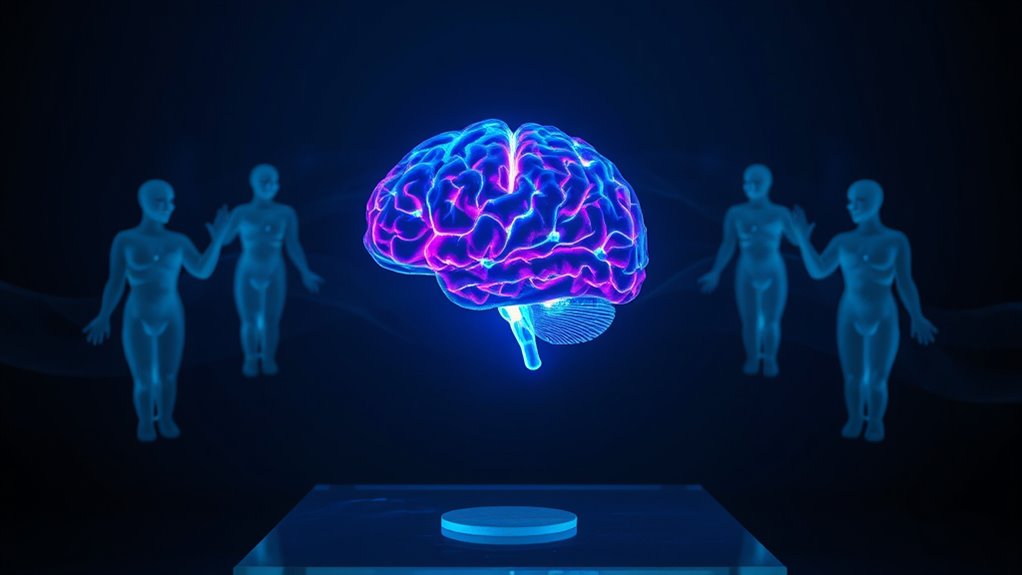
Understanding how the brain shapes your perception of reality is vital to exploring the connection between neuroscience and mediumship. Your brain processes sensory information from the environment, filtering and interpreting signals to create your experience of the world. It constructs a coherent reality based on past experiences, expectations, and current stimuli. This means what you perceive isn’t always an exact reflection of external events but a curated interpretation. Neural networks, especially in the prefrontal cortex and sensory areas, play fundamental roles in shaping perceptions, beliefs, and even hallucinations. Recognizing that your perceptions are subjective helps explain why different people can interpret the same event in vastly different ways. This understanding opens doors to exploring how altered states of consciousness might influence perceptions of spiritual or supernatural phenomena. Furthermore, high-resolution imagery provided by advanced projectors demonstrates how detailed visual input is essential for immersive experiences, which can influence perceptions of reality.

SereniBrain EEG Neurofeedback Headband for Meditation & Brainwave Monitoring, Real-Time Brain Activity Tracker with App, Train Focus, Relaxation & Sleep Preparation
Real-Time EEG Neurofeedback Headband for Brainwave Monitoring: Monitor your brain activity in real time using advanced EEG sensors….
As an affiliate, we earn on qualifying purchases.
As an affiliate, we earn on qualifying purchases.
Historical Perspectives on Mediumship and Spiritualism

Historically, mediumship and spiritualism gained prominence in the 19th century, capturing widespread public interest and shaping cultural perceptions of the supernatural. During this period, many believed that spirits of the dead could communicate with the living, leading to séances, spirit photographs, and ghost-hunting practices. These phenomena attracted both skeptics and believers, fueling debates about the nature of consciousness and the afterlife. Prominent figures, like the Fox Sisters, popularized spirit communication, making spiritualist churches common across North America and Europe. Society was eager to explore life after death, often viewing mediums as conduits to the spiritual domain. While many practices were later exposed as trickery, the era’s fascination with mediumship left a lasting impact on cultural attitudes toward the supernatural. Additionally, the interest in mediumship and related phenomena contributed to ongoing scientific and psychological investigations into consciousness and perception.

Your Brain on Art: How the Arts Transform Us
As an affiliate, we earn on qualifying purchases.
As an affiliate, we earn on qualifying purchases.
Scientific Studies Linking Brain Activity to Mediumship Experiences
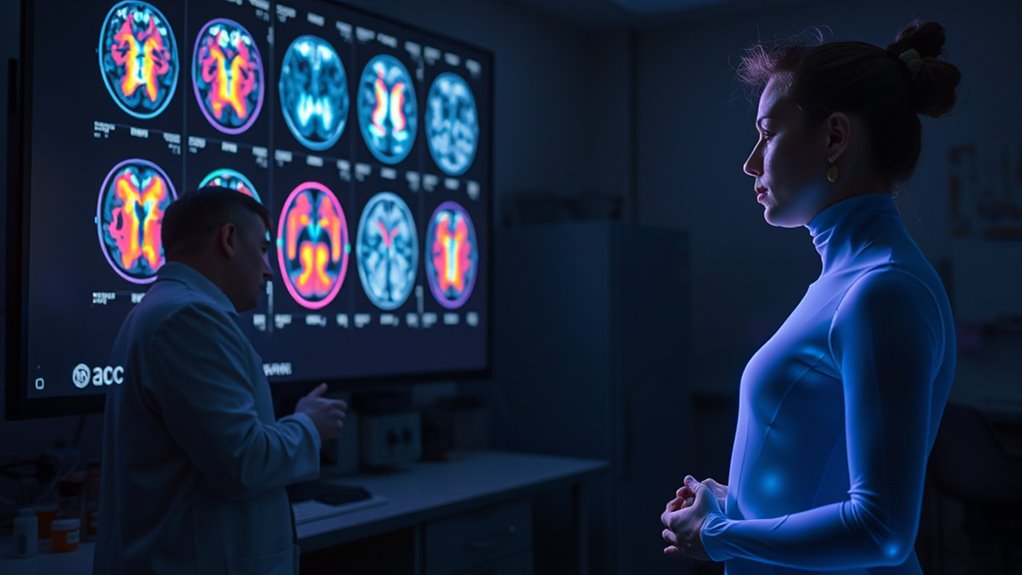
Recent advances in neuroscience have begun to explore the neural mechanisms underlying mediumship experiences, providing a scientific lens through which to examine these phenomena. Researchers use tools like fMRI and EEG to observe brain activity during reported mediumistic states. Studies reveal increased activity in areas associated with self-awareness, emotion regulation, and social cognition, such as the temporoparietal junction and prefrontal cortex. Some findings suggest that altered brain states—similar to those seen in meditation or hypnosis—may facilitate perceived communication with spirits. While these studies don’t confirm the supernatural, they highlight how specific neural patterns correlate with mediumistic experiences. Understanding brain activity patterns can help clarify how subjective experiences are constructed and how the brain may generate sensations of contact beyond ordinary perception.

Altered States of Consciousness: Experiences Out of Time and Self
As an affiliate, we earn on qualifying purchases.
As an affiliate, we earn on qualifying purchases.
The Neuroscience of Perception: How the Brain Creates Reality

The brain actively constructs your perception of reality by filtering and interpreting sensory information, even though what you experience may not always match the external world exactly. It processes signals from your senses, turning raw data into a coherent picture. This process involves several key steps:
- Sensory Input Filtering: Your brain selects relevant stimuli while ignoring others, shaping what you notice.
- Perception Formation: It combines incoming data with stored memories and expectations to create a meaningful experience.
- Reality Construction: Your brain fills in gaps, sometimes leading to illusions or altered perceptions that feel real to you.
This dynamic process demonstrates how your perception isn’t a direct window to reality but an active creation, influenced by your brain’s interpretation mechanisms.
Neurological Conditions That Mimic Mediumship Phenomena
Many neurological conditions can produce experiences that resemble mediumship phenomena, leading you to perceive communication with spirits or the supernatural. For example, temporal lobe epilepsy often causes intense, vivid hallucinations or sensations of a presence, which individuals interpret as spirits. Similarly, Charles Bonnet syndrome causes visual hallucinations in people with visual impairment, sometimes involving figures or scenes linked to the spiritual domain. Dissociative disorders can create feelings of detachment or the sense of another personality, mimicking mediumistic trance states. Additionally, migraines with aura may produce sensory distortions or hallucinations that resemble spiritual messages. These conditions alter brain activity or perception, generating experiences that seem like contact with supernatural entities without any actual external communication. Essential oils like lavender or peppermint are sometimes used to help alleviate stress and improve mental clarity, which can influence perceptual experiences.
The Potential Neural Correlates of Spirit Communication
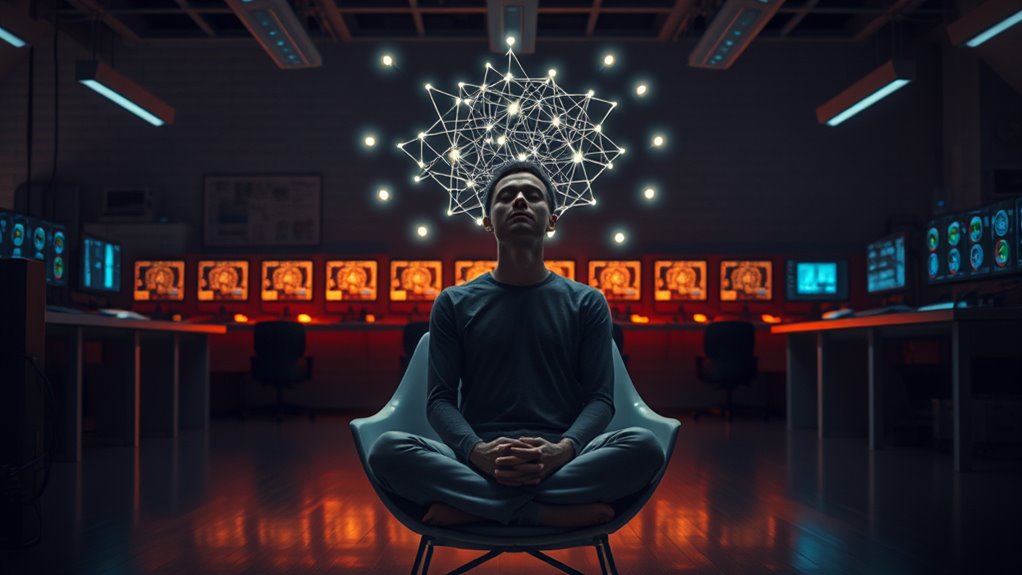
Understanding the potential neural correlates of spirit communication involves examining how specific brain regions and networks might produce experiences interpreted as contact with spirits. Research suggests that certain areas could be involved in these phenomena:
- The temporal lobes, especially the right temporal lobe, may generate auditory or visual perceptions linked to spirit contact.
- The prefrontal cortex could influence belief systems and the interpretation of anomalous experiences.
- The limbic system, including the amygdala, might modulate emotional responses during these encounters.
- The market growth in AI technology could also influence how neural data is interpreted and analyzed in future research. These regions could work together or independently to produce the sensation of communicating with spirits. Variations in activity or connectivity within these neural circuits might explain individual differences in spiritual experiences, aligning subjective perception with underlying brain processes.
Bridging Scientific Skepticism and Spiritual Beliefs
Bridging scientific skepticism and spiritual beliefs requires traversing a landscape where empirical evidence often clashes with personal and cultural experiences. You might find yourself questioning how scientific methods can validate phenomena that feel deeply meaningful. Skeptics emphasize the importance of reproducible experiments and measurable results, while spiritual beliefs often rely on subjective experiences that resist quantification. To bridge the gap, you need to recognize that both perspectives originate from different paradigms: one seeks objectivity, the other personal truth. Open dialogue is essential, where scientific inquiry respects individual experiences, and spiritual beliefs acknowledge scientific findings. This balanced approach fosters understanding, encouraging exploration without dismissing either viewpoint outright. It creates space for meaningful conversations between the worlds of neuroscience and spirituality. Additionally, advancements in AI in Education and other technological fields demonstrate how empirical data can support understanding complex phenomena, even those traditionally viewed through a spiritual lens.
Future Directions in Neuroscience and Mediumship Research
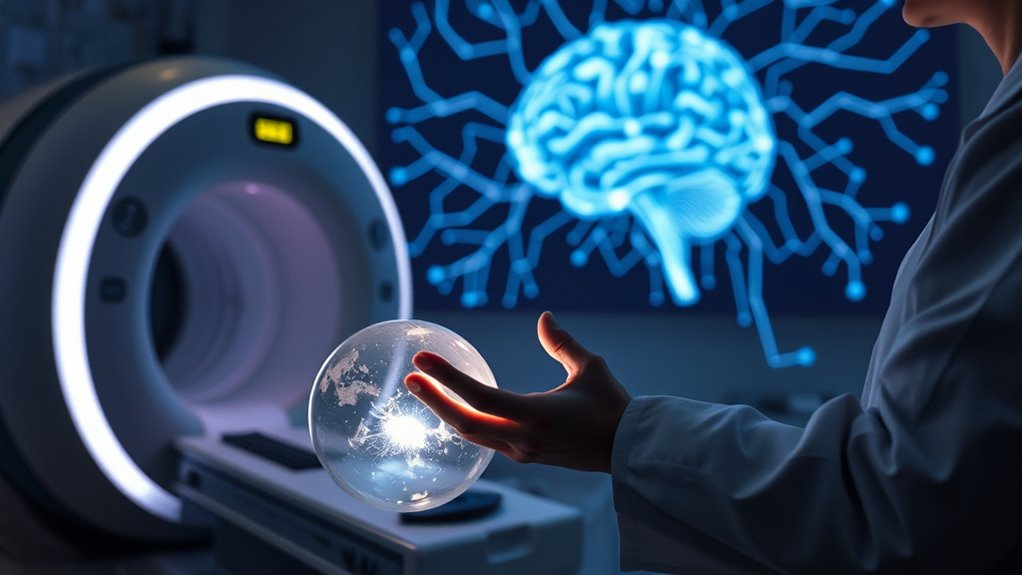
Advances in neuroscience are opening new avenues to explore the phenomena associated with mediumship, blending scientific inquiry with spiritual curiosity. As research progresses, you can expect several promising directions.
Neuroscience advances are illuminating the mysteries behind mediumship through scientific and spiritual exploration.
- Developing more refined neuroimaging techniques to identify specific brain patterns linked to mediumistic experiences.
- Conducting longitudinal studies to track neural changes over time in individuals identifying as mediums.
- Integrating interdisciplinary approaches, combining psychology, neuroscience, and anthropology, to deepen understanding of mediumship across cultures.
- Exploring the role of brain plasticity in adapting neural pathways related to spiritual and mediumistic experiences.
These strategies aim to clarify the neurobiological basis of mediumship, fostering a balanced perspective between science and spirituality. By pursuing these paths, you contribute to a future where the mysteries of mediumship are examined with rigor and open-mindedness, shaping a more holistic understanding of human consciousness.
Implications for Understanding Consciousness and the Afterlife
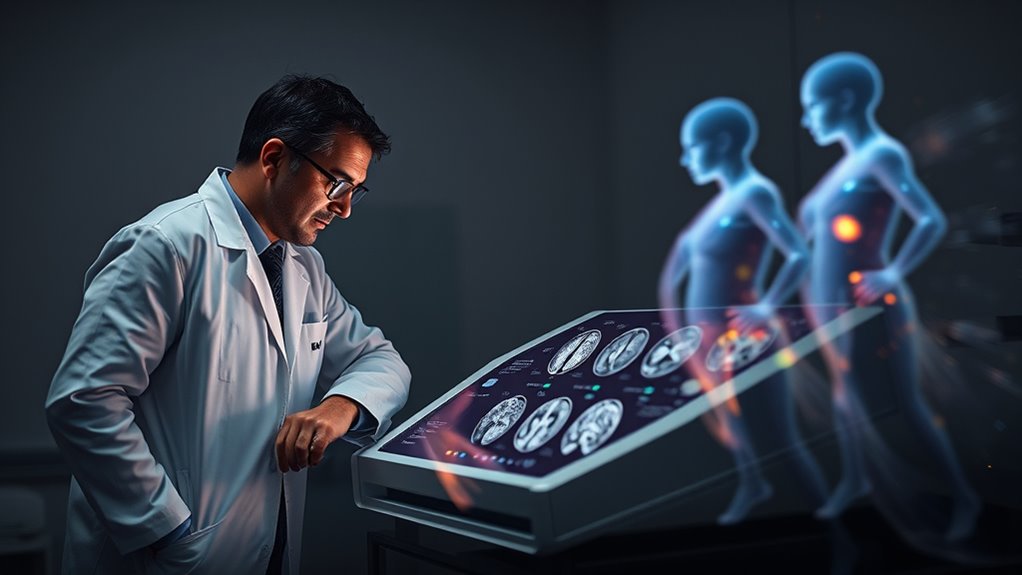
Understanding the neural basis of mediumship can shed light on how consciousness persists beyond physical death. Evidence from postmortem consciousness studies raises questions about the brain’s role in experiencing an afterlife. By examining these points, you can explore how neuroscience challenges traditional views of life and death. Additionally, advancements in battery technologies and portable power solutions can facilitate remote research and data collection in this fascinating field.
Neural Correlates of Mediumship
Have scientists identified specific brain activity linked to mediumship experiences? Research suggests they have. Studies using neuroimaging reveal distinct neural patterns during mediumistic states. These findings highlight three key areas:
- Activation of the temporoparietal junction, associated with self-other distinction and perception of external voices or entities.
- Increased activity in the prefrontal cortex, related to complex cognition and hypothesis generation about communication with spirits.
- Altered functioning in the limbic system, which influences emotion and belief, possibly underpinning the subjective experience of contact.
These neural correlates offer insights into how the brain facilitates mediumship phenomena. They suggest that specific brain regions may underpin the perception of communication beyond the physical domain, with profound implications for understanding consciousness and the afterlife. Notably, recent advances in AI-powered discoveries are opening new avenues for exploring the mysteries of the mind and consciousness.
Postmortem Consciousness Evidence
Evidence from postmortem consciousness studies challenges the traditional view that consciousness ceases entirely after death. Reports of near-death experiences, where individuals recall vivid visions or sensations despite being clinically dead, suggest consciousness might persist beyond physical demise. Some research highlights cases of accurate, detailed memories of events occurring during moments of apparent unconsciousness, raising questions about the soul’s survival. These findings imply that consciousness could operate independently of brain activity in certain circumstances. If verified, this evidence urges a reevaluation of what we grasp about death and the afterlife. It also prompts further exploration into consciousness research and its implications for understanding the mind-body connection. It opens the possibility that consciousness may continue, influencing how we perceive life’s end and the potential for ongoing existence beyond physical death.
Frequently Asked Questions
Can Neural Imaging Definitively Prove the Existence of Spirits?
Neural imaging can’t definitively prove spirits exist. While it can show brain activity linked to perceptions or experiences people interpret as spiritual, it doesn’t validate the existence of spirits themselves. These images reveal how your brain processes certain thoughts, emotions, or sensations, but they don’t provide concrete proof of an external spiritual domain. Science requires more than just brain activity patterns to confirm such metaphysical claims.
How Do Cultural Beliefs Influence Brain Responses to Mediumship Claims?
Imagine your brain as a garden, shaped by your cultural beliefs like seeds. When you hear claims of mediumship, these beliefs influence how your brain responds—watering certain ideas while pruning doubts. If you’re in a culture that reveres spirits, your brain may activate different pathways than one skeptical of such claims. Your cultural environment cultivates specific neural responses, shaping what you believe and how you perceive mediumship.
Are There Ethical Concerns in Neuroscientific Studies of Mediumship?
Yes, there are ethical concerns in neuroscientific studies of mediumship. You should consider participant consent carefully, ensuring they understand the research’s purpose and potential emotional impacts. Protect their privacy, especially when sensitive information is involved. Avoid exploiting beliefs or vulnerabilities, and be transparent about the study’s limitations. Addressing these concerns helps maintain integrity and respects the dignity of those participating in the research.
Could Brain Injuries Enhance or Diminish Mediumship Experiences?
Brain injuries can either enhance or diminish your mediumship experiences, depending on the injury’s location and severity. If the injury affects areas linked to perception or emotion, you might notice heightened sensitivity or diminished abilities. Conversely, some injuries could disrupt neural pathways, reducing your experiences. You should consult medical professionals to understand how specific injuries impact your neurological functions related to mediumship, as effects vary widely among individuals.
What Role Does Quantum Physics Play in Understanding Spirit Communication?
Quantum physics acts like a bridge, suggesting that consciousness might exist beyond our physical brains, allowing spirit communication to ripple through unseen dimensions. You can imagine it as a secret language of the universe, where particles entangle and information travels faster than light. This perspective invites you to see spirit interactions as more than just metaphors—perhaps they’re real whispers from a domain that defies our everyday understanding.
Conclusion
As you explore how neuroscience and mediumship intertwine, consider what it truly means to perceive reality. Could understanding the brain’s role help bridge science and spirituality, or does it challenge the very essence of what you believe? As research advances, you might find that the boundaries between mind and spirit blur, prompting you to question whether consciousness extends beyond physical limits. Isn’t it worth pondering how much of what you see as real is shaped by your brain?