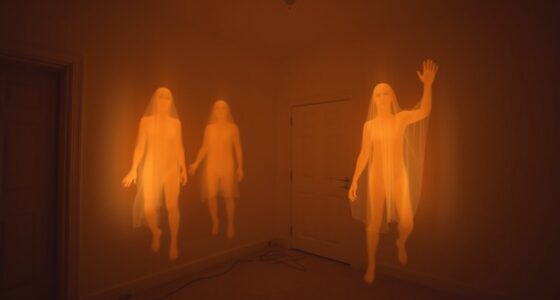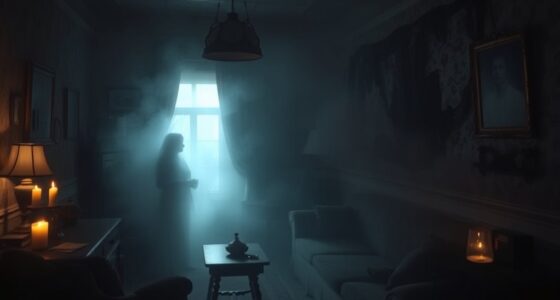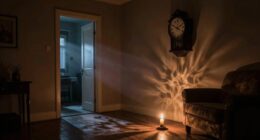

Yes, haunted feelings can be replicated in labs by using environmental cues, sensory glitches, and psychological triggers that evoke fear or eeriness. Researchers create setups with flickering lights, eerie sounds, and suggestive stimuli to mimic haunted environments. Factors like expectation, stress, and bias also play a role in shaping perceptions. If you want to learn how scientists safely simulate these sensations and what ethical questions they face, keep exploring.
Key Takeaways
- Haunted feelings can be reliably induced in labs using environmental cues like eerie sounds, lighting, and suggestive stimuli.
- Psychological factors such as expectation, stress, and prior beliefs influence the intensity of lab-induced haunted sensations.
- Sensory glitches and perceptual errors, especially under stress or sleep deprivation, can produce haunted-like experiences in controlled settings.
- Virtual reality and immersive setups have been used to simulate haunted environments, eliciting fear and presence sensations in participants.
- Ethical safeguards, including informed consent and risk mitigation, are essential when replicating intense emotional states associated with haunted feelings in labs.

Funtime Gifts 10686 Spooky Sound Machine Electronic, White
Sounds include: female scream, male scream, creaking door, howling wolf, screeching raven, thunder and lightning, hooting owl, scary…
As an affiliate, we earn on qualifying purchases.
As an affiliate, we earn on qualifying purchases.
The Science Behind Haunted Sensations
Many haunted sensations can be explained by the way our brains interpret sensory information. When you feel a sudden chill or see shadows flickering, your brain processes these signals based on past experiences and expectations. Sometimes, your senses misfire, creating illusions like a sudden gust of wind or unexplained noises. The brain’s visual and auditory systems are especially prone to errors, especially in low-light or stressful situations. These sensory glitches can produce feelings of fear or presence, mimicking paranormal experiences. Your mind fills in gaps, often interpreting ambiguous stimuli as supernatural. This interplay between sensory input and perception shows that what seems haunted often results from natural neurological processes rather than actual ghosts, grounding these sensations in science rather than the supernatural. Additionally, sleep deprivation can heighten perceptual sensitivities and increase susceptibility to hallucinations, further contributing to haunted feelings.

Hompavo 【Upgraded】 LED Flame Light Bulbs, 4 Modes Flickering Light Bulbs with Upside Down Effect, E26/E27 Flame Bulb for Halloween Christmas Party Patio Porch Home Indoor & Outdoor Decorations – 2
🔥【More Realistic Flame Effect】 After continuous experiments, our led flame effect light bulb will render as wobbly as…
As an affiliate, we earn on qualifying purchases.
As an affiliate, we earn on qualifying purchases.
Psychological Factors Influencing Paranormal Perceptions

Your expectations and biases can shape what you perceive in a lab setting, often leading you to interpret ambiguous stimuli as paranormal. Your emotional state also plays a significant role, making you more susceptible to feeling haunted or spooked. Recognizing these psychological influences helps you understand why haunted sensations might not always be rooted in the supernatural. Additionally, understanding the horsepower of electric dirt bikes and their performance capabilities can help you differentiate between real and perceived sensations of power or energy.
Sensory Expectations and Bias
Our perceptions of paranormal activity are often shaped by what we expect to see or hear, rather than by actual supernatural events. Your mind fills in gaps based on prior beliefs or suggestions, creating an illusion of something supernatural. Sensory expectations influence what you notice in ambiguous situations. For example, if you’re told a location is haunted, you might interpret creaks or shadows as evidence of spirits. Here’s a visual to illustrate this:
| Expectation | Sensory Experience |
|---|---|
| Haunted house | Cold draft feels spooky |
| Unfamiliar sound | Could be a ghost whisper |
| Flickering light | Might signal paranormal presence |
| Shadows in corner | Could hide a spirit |
| Eerie silence | Feels unnerving, not normal |
Your biases and expectations prime you to perceive paranormal cues that may not exist objectively. Additionally, factors like contrast ratio can make certain visual cues more or less noticeable, influencing your perception of eerie phenomena.
Emotional State Influence
Emotional states profoundly influence how you perceive paranormal activity, often coloring your interpretation of ambiguous stimuli. When you’re anxious, fearful, or stressed, you’re more likely to interpret normal sounds or shadows as supernatural. Negative emotions heighten your sensitivity to potential threats, making you more prone to notice oddities that might otherwise go unnoticed. Conversely, feeling calm or happy can diminish your perception of paranormal activity, leading you to dismiss strange experiences as imagination or coincidence. Your emotional state affects your attention, memory, and judgment, shaping how you interpret ambiguous cues. Researchers find that emotional priming can considerably skew paranormal perceptions, emphasizing how your psychological condition plays a vital role in haunted feelings. Additionally, emotional regulation strategies can influence susceptibility to paranormal interpretations by helping manage emotional responses. Understanding this influence helps explain why some people are more prone to experiencing or believing in paranormal phenomena.

Abacus Brands Virtual Reality ESPN Gift Box – Illustrated Interactive VR Book and STEM Learning Activity Set
EXPERIENCE SPORTS IN VIRTUAL REALITY! Dive into the world of sports like never before with immersive experiences in…
As an affiliate, we earn on qualifying purchases.
As an affiliate, we earn on qualifying purchases.
Environmental Cues and Suggestive Stimuli in Experiments

Environmental cues and suggestive stimuli play a pivotal role in shaping your perceptions and reactions during experiments. When specific sounds, lighting, or objects are introduced, they can trigger feelings of eeriness or ghostly presence, even if nothing supernatural is involved. These cues prime your mind to interpret ambiguous stimuli as haunted or unsettling. To illustrate, consider this table:
| Environmental Cue | Effect on Perception |
|---|---|
| Dim lighting | Heightens unease |
| Unexplained sounds | Promotes suspicion |
| Cold drafts | Feels ghostly |
| Old decor | Suggests history of hauntings |
Additionally, understanding how emotional support influences perception can help researchers better interpret participants’ reactions to these cues.
sensory glitch simulation kit
As an affiliate, we earn on qualifying purchases.
As an affiliate, we earn on qualifying purchases.
Notable Studies and Experiments Attempting to Reproduce Haunted Feelings

Researchers have designed various experiments to see if they can reliably evoke haunted feelings through controlled settings. One notable study involved creating a haunted house environment with flickering lights, eerie sounds, and sudden movements, aiming to trigger fear and unease. Participants reported sensations similar to feeling watched or experiencing ghostly presences, suggesting some success in replicating haunted feelings. Another experiment used virtual reality to immerse subjects in spooky scenarios, observing their reactions to different stimuli. Results showed increased heart rates and heightened alertness, aligning with natural fear responses. While these studies don’t fully capture the supernatural aspect, they demonstrate that certain environmental cues and psychological triggers can evoke haunted feelings reliably, offering insight into how context and perception influence emotional experiences. Additionally, cybersecurity vulnerabilities during simulated environments can impact the reliability of such experiments, highlighting the importance of secure systems in research settings.
The Role of the Mind and Expectation in Creating Fear

The mind plays a crucial role in shaping our experience of fear, often amplifying or even creating sensations that feel haunted or supernatural. Your expectations influence how you interpret ambiguous stimuli, turning uncertainty into something terrifying. When you believe a place is haunted, your brain becomes hyper-alert, heightening your sensitivity to sounds and shadows. This mental process can generate real physical sensations, making you feel haunted even without actual supernatural presence. To illustrate, consider this table:
| Expectation | Perception | Result |
|---|---|---|
| Belief in ghosts | Shadows seem alive | Increased fear response |
| Anxiety | Noises seem loud | Elevated heartbeat |
| Skepticism | Nothing feels strange | Calmness maintained |
| Curiosity | Unexplained lights | Fascination or fear |
| Past trauma | Unfamiliar sounds | Intense fear or panic |
Your mind’s power makes fear a deeply personal experience. Psychological processes play a significant role in how these sensations are experienced and interpreted.
Ethical Considerations in Inducing Fear and Anxiety in Labs

When conducting fear experiments, you need to prioritize participants’ consent and respect their autonomy. You also have to carefully consider the risk of psychological harm and make certain your methods align with ethical research guidelines. Balancing scientific goals with these ethical concerns is essential to conduct responsible studies.
Consent and Autonomy
Inducing fear and anxiety in laboratory settings raises important ethical questions about consent and autonomy. You must guarantee participants fully understand what they’re agreeing to and have the freedom to decline without pressure or repercussions. This means providing clear, detailed information about the procedures, potential discomfort, and risks involved. Respecting autonomy also involves verifying that participants aren’t coerced or unduly influenced, such as through financial incentives or authority figures. You need to give participants the option to withdraw at any time, without penalty. Upholding these principles safeguards their dignity and rights, ensuring that their participation is voluntary and informed. Additionally, implementing risk assessment procedures helps identify and mitigate potential harm, ensuring the safety of participants throughout the research. Balancing scientific objectives with respect for individual autonomy is vital to conducting ethical research involving induced fear or anxiety.
Risk of Psychological Harm
While laboratory studies aim to explore fear and anxiety responses, they also carry significant risks of psychological harm. You might experience intense emotions that linger beyond the experiment, such as distress or trauma. These risks include:
- Developing long-lasting anxiety or phobias from exposure to frightening stimuli.
- Triggering past traumatic memories unintentionally.
- Causing emotional exhaustion or feelings of helplessness during the study.
- Accelerating underlying mental health issues or creating new psychological problems.
- The use of self-watering plant pots as a metaphorical tool can illustrate the importance of proper safeguards and monitoring in these experiments to prevent over-saturation of emotional responses.
It’s essential to recognize these dangers and guarantee proper safeguards are in place. Researchers must monitor participants closely, provide support, and debrief thoroughly to minimize lasting harm. Ethical responsibility demands prioritizing your mental well-being over experimental goals.
Ethical Research Guidelines
Ethical research guidelines are essential to guarantee that studies involving fear and anxiety are conducted responsibly. By adhering to established principles, you ensure participant safety and respect their well-being. Informed consent is vital—participants must understand potential risks and have the right to withdraw at any time without penalty. You should also minimize discomfort by designing experiments carefully, monitoring responses closely, and providing support if needed. Ethical standards require approval from review boards that evaluate whether the study’s benefits outweigh potential harms. Transparency matters, so you must report findings honestly and avoid deception that could cause lasting harm. Ultimately, following these guidelines helps you balance scientific inquiry with your moral obligation to protect participants from undue psychological distress.
Future Possibilities and Implications of Haunted Feelings Replication
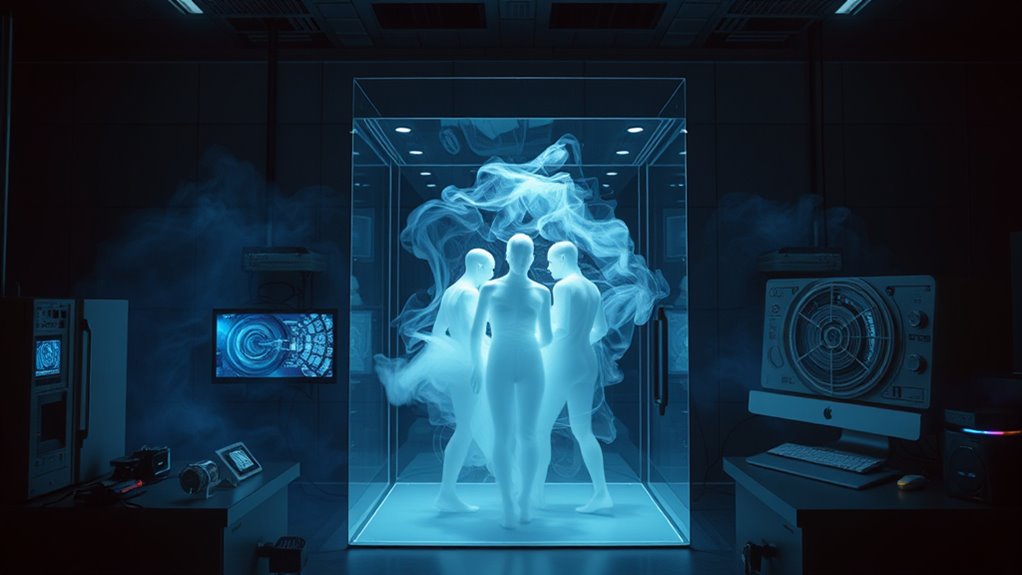
The future of haunted feelings replication holds both exciting possibilities and significant challenges. You might see enhanced therapies for trauma or anxiety, where simulated feelings help patients confront fears safely. It could also lead to new emotional research, revealing how feelings shape human experience. However, ethical concerns remain about manipulating such intense emotions and the potential for misuse. You’ll need to contemplate long-term impacts, like emotional dependency or authenticity questions. Advances in Pimple Patch technology could influence how these emotional simulations are delivered or managed, adding another layer of complexity to their development and application.
Frequently Asked Questions
Can Scientists Reliably Measure Haunted Feelings Objectively?
You can’t reliably measure haunted feelings objectively because they are deeply personal and subjective experiences. Scientists can use tools like surveys, physiological sensors, and brain scans to gather data, but these methods can’t fully capture the emotional and psychological nuances. Your feelings of fear or eeriness are influenced by individual beliefs and memories, making it hard to quantify or replicate such sensations with complete accuracy in a lab setting.
What Are the Potential Long-Term Effects of Inducing Fear in Lab Participants?
Inducing fear in lab participants can have lasting effects, like heightened anxiety or emotional distress, even after the experiment ends. You might experience lingering feelings of unease, increased stress levels, or difficulty trusting certain environments. While researchers aim to minimize these impacts, you should be aware that such experiences could influence your mental health temporarily or, in some cases, lead to longer-term emotional changes if not properly managed.
How Do Cultural Differences Influence Perceptions of Haunted or Spooky Experiences?
Cultural differences shape how you perceive haunted or spooky experiences, making what scares one person seem harmless or intriguing to another. Your background influences beliefs about spirits, folklore, and the supernatural, which heightens or diminishes your reactions. Even if science can replicate certain feelings, your cultural lens colors the intensity and meaning behind these experiences, so what feels genuinely haunted to you might differ drastically from someone else’s perspective.
Are There Any Known Natural Phenomena That Mimic Haunted Sensations?
Yes, natural phenomena can mimic haunted sensations. For example, infrasound waves, which are below the human hearing threshold, can cause feelings of unease, dizziness, and cold chills. Mold or musty odors can evoke eerie atmospheres, and optical illusions like flickering shadows or strange reflections can create ghostly images. These experiences often trigger haunted feelings, making you feel something supernatural might be happening when it’s just natural or environmental factors at play.
Could Virtual Reality Recreate Haunted Feelings More Effectively Than Traditional Methods?
Virtual reality can recreate haunted feelings more effectively than traditional methods because it immerses you fully in the experience. Imagine walking through a shadowy corridor where every flicker of light and distant sound heightens your senses, much like being truly there. Studies show VR triggers emotional responses comparable to real-world encounters. You feel the fear and anticipation, making VR a powerful tool to simulate haunted sensations authentically.
Conclusion
Imagine walking into a room and suddenly feeling an icy chill—like a ghostly whisper brushing past your ear. Researchers are trying to turn this eerie sensation into a science, knowing your mind’s expectations shape what you perceive. While labs can mimic haunted feelings, it’s like trying to catch a shadow—fleeting and elusive. Still, each experiment uncovers more about the mysterious dance between mind and environment, revealing how fear is often a product of perception rather than the supernatural.