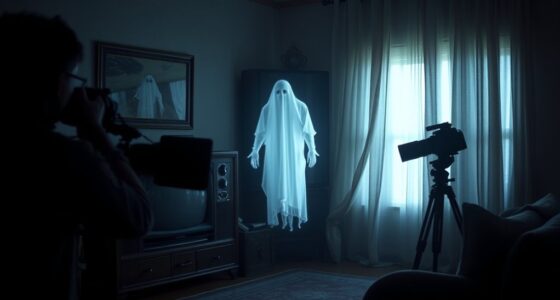

Many believe that tools like EMF meters and spirit boxes attract spirits, but this is just a myth. These devices don’t have supernatural powers; they often pick up environmental noise, electrical interference, or natural sounds, which are misinterpreted as spirits. Media portrayals and myths have fueled this misunderstanding. If you’re curious, exploring the true science behind these gadgets can help you see why they don’t actually lure spirits into your space.
Key Takeaways
- Scientific evidence shows no credible support that paranormal devices attract spirits or influence the supernatural realm.
- Many readings from tools like EMF meters or spirit boxes are caused by natural or technical factors, not spirits.
- Media portrayals and myths often exaggerate the capabilities of paranormal tools, creating misconceptions.
- Proper understanding and calibration of equipment reveal that environmental factors, not spirits, generate signals.
- The belief that devices attract spirits stems from cultural myths and psychological factors rather than scientific fact.

ERICKHILL 3 in 1 EMF Detector, Electromagnetic Field Radiation Detector for EF, RF, MF, WiFi,5G Signal,Triple Alarm Modes, Type-C Charging, EMF Meter for Home, Office, and Paranormal Investigation
All-in-One Detection: RT-100S 3-in-1 EMF Reader measures Electric (EF), Magnetic (MF), and Radio Frequency (RF) fields to monitor…
As an affiliate, we earn on qualifying purchases.
As an affiliate, we earn on qualifying purchases.
The Origins of the Belief in Spirit-Attracting Devices
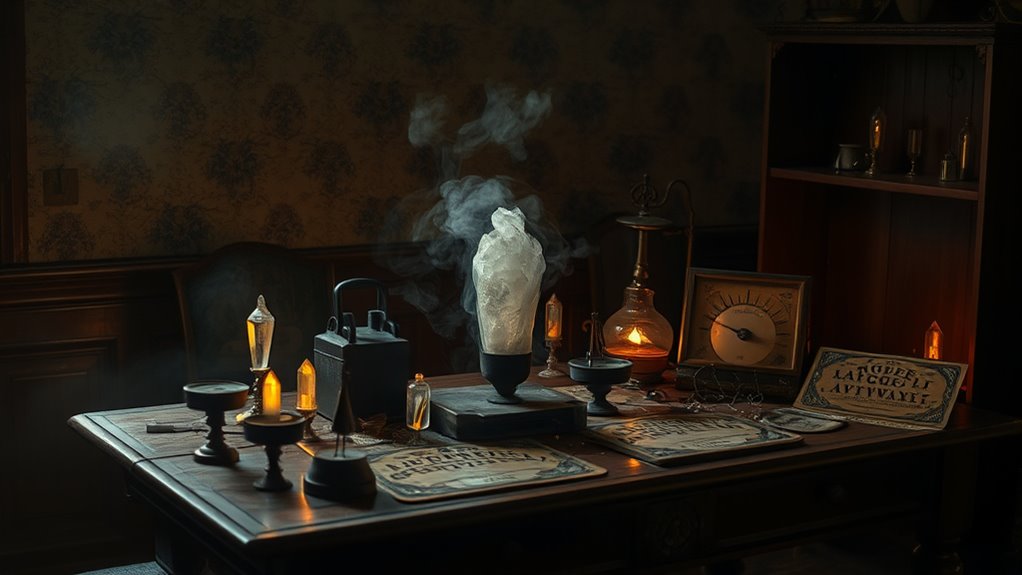
The belief that certain devices can attract spirits has roots in ancient practices and cultural myths. Early societies used objects like pendulums, mirrors, and crystals in spiritual rituals, believing they could communicate with the unseen. These tools often served as conduits, helping people feel connected to ancestors or spirits. In many cultures, tools such as Ouija boards or ritualistic objects gained significance through stories and traditions passed down generations. The idea was that these objects held spiritual power or could influence the supernatural sphere. Over time, these beliefs intertwined with folklore and religious practices, reinforcing the idea that specific devices could summon or attract spirits. Modern myths about paranormal tools may also be influenced by technology in energy distribution, which demonstrates how innovations can be misinterpreted or mythologized over time. This history laid the foundation for modern myths about paranormal tools, even though scientific evidence remains lacking.

Sam and Colby XPLR Spirit Box | Paranormal Detection Equipment; Haunted Survival; Ghost Hunter Scanner; EMF and EVP Detector; Comprehensive Tool for Spirit Communication
Designed by Viral Explorers Sam and Colby: Step up your ghost hunting game with the "Spirit Box," created…
As an affiliate, we earn on qualifying purchases.
As an affiliate, we earn on qualifying purchases.
Cultural Influences and Media Portrayals
Media portrayals have markedly shaped how people view paranormal tools and their supposed ability to attract spirits. Movies, TV shows, and books often depict gadgets like Ouija boards, EMF meters, and spirit boxes as essential tools for contacting the supernatural. These portrayals create a sense of excitement and legitimacy around such devices, leading many to believe they can directly influence spirits. Cultural narratives and popular media tend to dramatize these interactions, emphasizing the idea that specific tools are gateways or magnets for spirits. As a result, public perception is heavily influenced by entertainment rather than scientific evidence. This media-driven imagery reinforces myths and misconceptions, making it seem as if paranormal tools possess inherent powers, even though their actual effectiveness remains unproven. Additionally, the portrayal of these tools often overlooks the psychological factors that can influence paranormal experiences, further skewing public understanding of their true capabilities.
Sam and Colby XPLR Spirit Box | Paranormal Detection Equipment; Haunted Survival; Ghost Hunter Scanner; EMF and EVP Detector; Comprehensive Tool for Spirit Communication
Designed by Viral Explorers Sam and Colby: Step up your ghost hunting game with the "Spirit Box," created…
As an affiliate, we earn on qualifying purchases.
As an affiliate, we earn on qualifying purchases.
Scientific Perspectives on Paranormal Tools

Scientific research consistently finds little evidence to support the idea that paranormal tools like EMF meters or spirit boxes can attract or communicate with spirits. Studies show these devices often produce random readings or sounds, which can be explained by natural or technical factors rather than supernatural activity. Skeptics argue that electromagnetic fields, for example, are common in many environments and don’t indicate spirits’ presence. To help you better understand, here’s a quick overview:
| Tool | Common Misinterpretation | Scientific Explanation |
|---|---|---|
| EMF Meters | Detect spirits through EMF changes | EMFs are from wiring, electronics |
| Spirit Boxes | Capture spirits’ voices | White noise and radio interference |
| Thermometers | Sense cold spots for spirits | Temperature fluctuations happen naturally |
This evidence emphasizes that these tools lack scientific validity for paranormal communication. Understanding the limitations of these devices can help you approach paranormal claims more critically.

ERICKHILL EMF Meter, Detects Electric and Magnetic Fields, Handheld Digital EMF Detector with LCD Display, Sound-Light Alarm, Rechargeable Battery for Home, Office, and Appliances (Blue)
True EMF protection starts with detection. Our emf meter helps you: 1) Find dangerous radiation hotspots in your…
As an affiliate, we earn on qualifying purchases.
As an affiliate, we earn on qualifying purchases.
Common Misconceptions and Misuse of Equipment
Many people misunderstand how paranormal equipment works, leading them to misuse these tools or interpret their readings incorrectly. For example, they might assume that a sudden spike in EMF readings signals a spirit presence, when other factors like electrical wiring or appliances could cause the change. Similarly, they often rely solely on devices like spirit boxes or ghost meters without understanding their limitations or the possibility of false positives. Misinterpreting environmental factors or equipment anomalies as evidence of spirits can lead to false conclusions. It’s important to remember that these tools are not foolproof or supernatural. Proper understanding, calibration, and skepticism are essential to avoid making unwarranted claims based on equipment readings. Additionally, understanding the contrast ratio of projectors can influence how well visual evidence is perceived, emphasizing the importance of accurate equipment calibration in both paranormal investigations and home entertainment setups.
The Psychological Appeal of Paranormal Investigations
Paranormal investigations often appeal to our desire for mystery and the unknown, providing a thrill that can be both exciting and comforting. You seek answers beyond everyday reality, and the possibility of contact offers a sense of connection or purpose. This psychological pull can make you interpret ambiguous sounds or sensations as evidence of spirits, reinforcing your beliefs. The excitement of hunting for paranormal activity boosts adrenaline and creates a sense of adventure. Additionally, the social aspect—sharing experiences with others—fosters community and belonging. Sometimes, the hope of uncovering something supernatural helps you cope with fears or grief. Ultimately, the psychological rewards—curiosity, validation, and camaraderie—drive many to pursue paranormal investigations, even when there’s no scientific evidence supporting their claims. Recognizing psychological appeal can help you understand why these investigations are so compelling.
Frequently Asked Questions
Can Paranormal Tools Actually Detect or Communicate With Spirits?
Paranormal tools can’t definitively detect or communicate with spirits, but they can help you observe anomalies or sensations that might suggest supernatural activity. Devices like EMF meters or spirit boxes are often used in investigations, but their readings can be influenced by environmental factors or user interpretation. Keep in mind, scientific support for these tools is limited, so approach their use with skepticism and an open mind.
Are There Any Proven Scientific Methods to Verify Spirit Activity?
No, there aren’t any proven scientific methods to verify spirit activity. While you might think a fancy EMF meter or EVP recorder would give you clear proof, science demands rigorous, repeatable evidence—something paranormal tools can’t provide. So, if you’re hoping for undeniable proof, you’ll be disappointed. Instead, you’re left chasing shadows, armed with gadgets that tell you more about electrical interference than the afterlife.
What Are the Most Common Types of Paranormal Equipment Used?
You’ll often see ghost hunters using EMF meters, digital voice recorders, infrared cameras, and spirit boxes. EMF meters detect electromagnetic fluctuations, while voice recorders capture EVP (Electronic Voice Phenomena). Infrared cameras help spot cold spots or apparitions, and spirit boxes scan radio frequencies for voices. These tools are popular because they’re believed to help detect or communicate with spirits. However, their effectiveness remains scientifically unproven.
How Do Personal Beliefs Influence the Perceived Effectiveness of These Tools?
Your personal beliefs shape how effective you think paranormal tools are. If you trust in their power, you’re more likely to notice signs or feel confident during investigations. Conversely, skepticism may make you dismiss subtle clues or feel less convinced. Your mindset influences your perceptions, making it seem like these tools work or don’t, based on your expectations and beliefs rather than actual supernatural activity.
Are There Any Risks Associated With Using Paranormal Investigation Devices?
Using paranormal investigation devices can pose risks, much like relying on a faulty compass in uncharted territory. You might misinterpret harmless sounds or shadows as supernatural activity, leading to unnecessary fear or false alarms. Additionally, obsessively using these tools can distract you from real issues or safety concerns. Always approach equipment critically, and remember, your beliefs can influence what you perceive, so stay cautious and grounded in evidence.
Conclusion
Remember, paranormal tools are like flashlights in a dark room—they don’t summon spirits, but they might help you see what’s really there. Believing these devices attract spirits is a myth, fueled by media and imagination. Instead of chasing ghosts with gadgets, trust your own senses and skepticism. Keep your mind open, but your beliefs grounded, so you don’t fall into the trap of illusions. After all, the real mystery isn’t in the equipment, but in what you choose to believe.