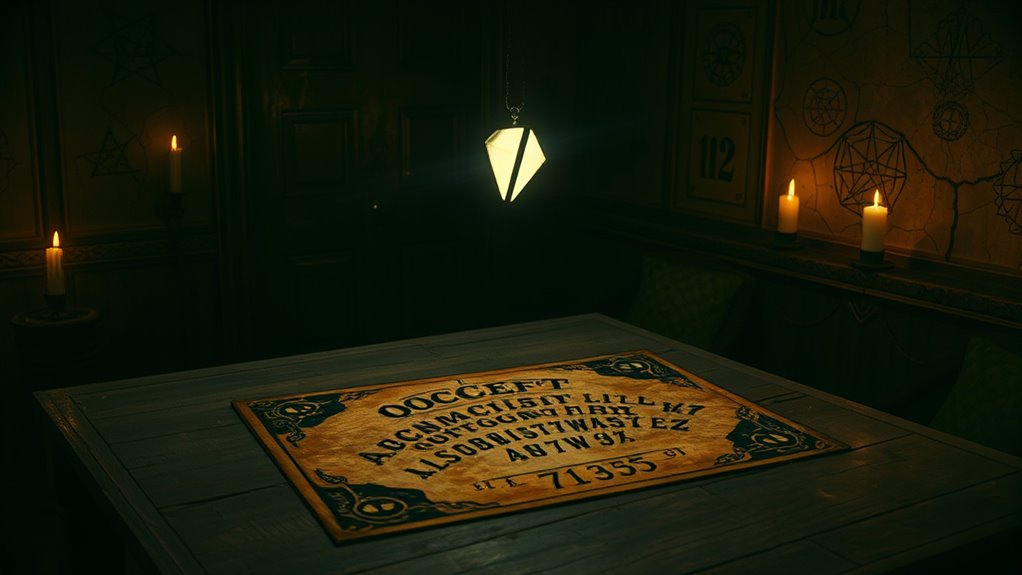

Ouija boards are often seen as paranormal tools, but science shows they mainly work through psychological effects like the ideomotor response, where subconscious movements guide the planchette. Cultural stories and media hype add to their mystique, fueling beliefs that they summon spirits. In reality, most experiences are influenced by expectations and fears. If you want to understand the truth behind these boards and how they really work, there’s more to discover.
Key Takeaways
- Scientific studies attribute movements on Ouija boards to the ideomotor effect, caused by subconscious muscle activity.
- Historically, Ouija boards originated as entertainment tools within the spiritualist movement in the late 19th century.
- Cultural beliefs and media portrayals often sensationalize the boards as gateways to spirits, fueling fear and mystique.
- Most experiences attributed to Ouija boards are explained by psychological factors like suggestion, expectation, and cognitive biases.
- While some view them as harmless entertainment, others believe they can summon malevolent entities, a claim lacking scientific evidence.

Spirit Board Game for Ghost Communication with Planchette and Detailed Instruction
Unlock the mysteries: With an Talking board, you can connect with the spirits and unlock the secrets of…
As an affiliate, we earn on qualifying purchases.
As an affiliate, we earn on qualifying purchases.
The History and Origins of Ouija Boards

The history of Ouija boards traces back to the late 19th century, when they emerged as a popular parlor game and spiritual tool. Originally, people used them to connect with spirits and seek answers from the afterlife, believing the board’s planchette moved to spell out messages. Invented in the 1890s, the game was marketed as a fun, mystical device for entertainment and spiritual communication. Its popularity grew during the spiritualist movement, which emphasized contacting spirits through various methods. Although initially seen as a harmless novelty, many considered Ouija boards to be a serious tool for engaging with the supernatural. Over time, their reputation shifted, blending entertainment with superstition, and sparking debates about their true origins and purpose. Interestingly, the idea of communicating with spirits through objects like planchettes and symbols has parallels in cultural and artistic practices involving symbols and ritual objects, reflecting a long-standing human fascination with the mystical.

YIVFOX Ouija Board Magic Skull Divination Board for Party and Decoration, Wooden Spiritual Dialogue Board for Witchy Supplies
The skull decorated alphabet and numbers divinely and visually impacting, dark gothic design with intricate illustrations of skull…
As an affiliate, we earn on qualifying purchases.
As an affiliate, we earn on qualifying purchases.
How Ouija Boards Are Used Today
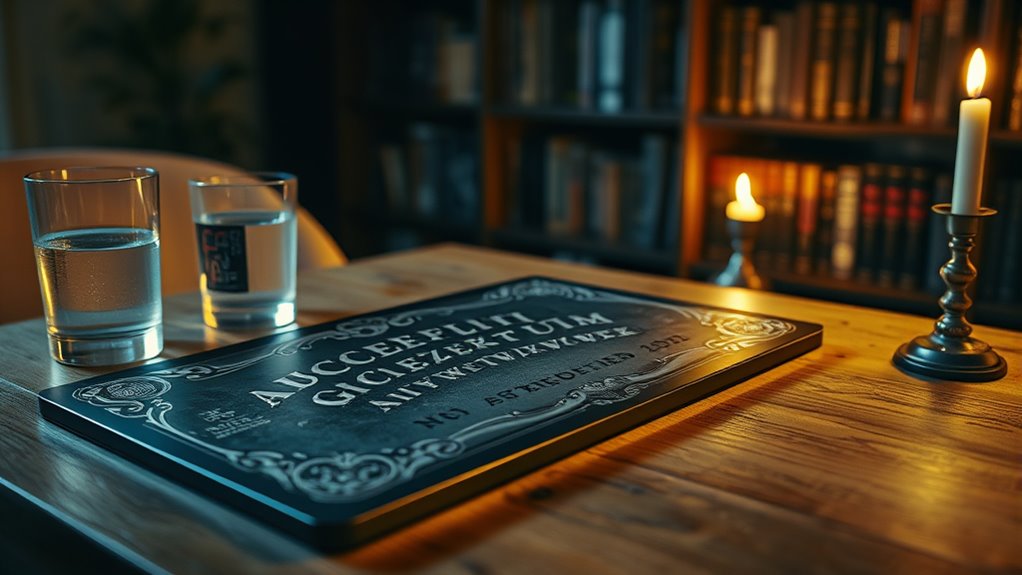
Today, many people use Ouija boards in modern spiritual practices to seek guidance or connect with spirits. Others see them as entertainment or part of games at parties. No matter the reason, understanding how they’re used now helps reveal their place in contemporary culture. Additionally, some enthusiasts incorporate spiritual tools like Ouija boards into their broader digital or social media activities to share experiences and connect with a like-minded community.
Modern Spiritual Practices
Have you ever wondered how Ouija boards are used in modern spiritual practices? Today, many turn to them for guidance, connection, or meditation. Practitioners often set up a quiet space, light candles, and focus their intent on communicating with spirits or gaining insight. Some use elaborate rituals to enhance their experience, while others simply place their hands on the planchette and ask questions. Here’s a quick look at common uses:
| Purpose | Method | Outcome |
|---|---|---|
| Spirit Communication | Silent questions, focus on spirits | Messages from beyond |
| Meditation | Using the board for mindfulness | Clarity and calmness |
| Divination | Asking specific questions | Personal guidance |
| Ritual Activation | Incorporating symbols and spells | Enhanced spiritual connection |
Additionally, understanding the history of Ouija boards can deepen practitioners’ appreciation of their role in contemporary spiritual practices.
Entertainment and Games
Ever wondered how Ouija boards are used for entertainment nowadays? Many people see them as fun party games rather than tools for spiritual communication. You might gather friends around, light some candles, and place your fingers on the planchette, hoping for a playful message. Some use Ouija boards at sleepovers or Halloween parties, treating them like a spooky challenge. Others see them as a way to break the ice or create a mysterious atmosphere. While most participants understand it’s just a game, some still believe it can connect them with spirits. Regardless, the thrill of the unknown keeps many intrigued. Additionally, AI technology has been used to analyze and understand the psychological effects of such games on participants. Just remember to approach it with caution, respecting the tradition, but also understanding it’s primarily meant for entertainment.

Ouija Salem Edition by Winning Moves Games USA, Spooky and Dark Special City Edition Ouija Board, for 2+ Players Age 8+
CUSTOM OUIJA: Everyone knows about the historical Salem Witch Trials. Here's your chance to channel your inner spirit…
As an affiliate, we earn on qualifying purchases.
As an affiliate, we earn on qualifying purchases.
The Psychology Behind the Experience
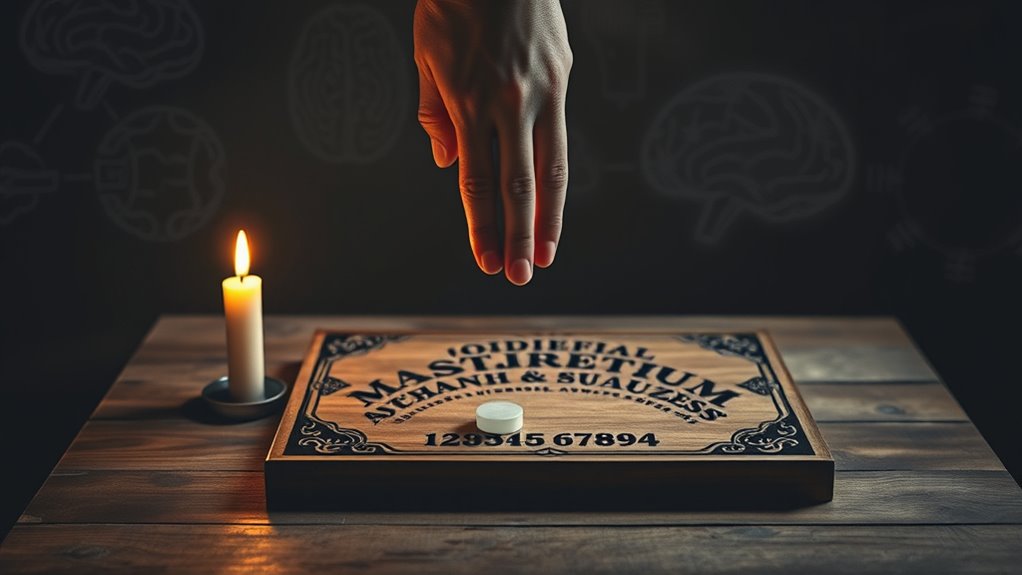
You might be surprised to learn that your movements during a Ouija session are often subconscious, driven by the ideomotor effect. When you’re in a group, collective expectations and social dynamics can influence how the planchette moves, even without realizing it. These psychological factors help explain why many experience what feels like genuine communication beyond their control. Additionally, the familiarity with yoga practices and techniques such as mindfulness and breath awareness can enhance one’s understanding of subconscious influences during such activities.
The Ideomotor Effect
The ideomotor effect explains why people often feel they are communicating with spirits through Ouija boards, even though no one is consciously controlling the planchette. Your subconscious mind subtly influences your movements, making it seem like an external force guides the pointer. To visualize this, think of:
- Your hand gently nudging the planchette without realizing it.
- Your muscles twitching or shifting slightly as your focus shifts.
- Your expectations or beliefs subtly influencing your actions.
These unconscious motions happen automatically, driven by your mental state and suggestions. The effect demonstrates how your mind can produce physical responses that feel intentional, creating the illusion of spirit communication. Recognizing this helps explain the mysterious movements during Ouija sessions, and understanding visualization techniques can further clarify how subconscious cues guide behavior.
Group Dynamics Influence
Group settings substantially shape the movements and responses during Ouija sessions. When you’re in a group, social dynamics, expectations, and shared beliefs influence how the planchette moves. People often unconsciously synchronize their movements, reinforcing the illusion of external forces. This phenomenon, known as social facilitation, can intensify the experience. To see this clearly, consider how different group sizes impact responses:
| Group Size | Effect on Responses |
|---|---|
| Small (2-3 people) | More personal, subtle movements |
| Medium (4-6 people) | Increased likelihood of collective influence |
| Large (7+ people) | Stronger group pressure, rapid movements |
Understanding these dynamics helps you realize that your subconscious and social environment heavily shape Ouija experiences. Additionally, practicing mindfulness and presence can help you become more aware of these influences and maintain a clearer perspective during such sessions.
Ouija Salem Edition by Winning Moves Games USA, Spooky and Dark Special City Edition Ouija Board, for 2+ Players Age 8+
CUSTOM OUIJA: Everyone knows about the historical Salem Witch Trials. Here's your chance to channel your inner spirit…
As an affiliate, we earn on qualifying purchases.
As an affiliate, we earn on qualifying purchases.
Scientific Perspectives and Studies
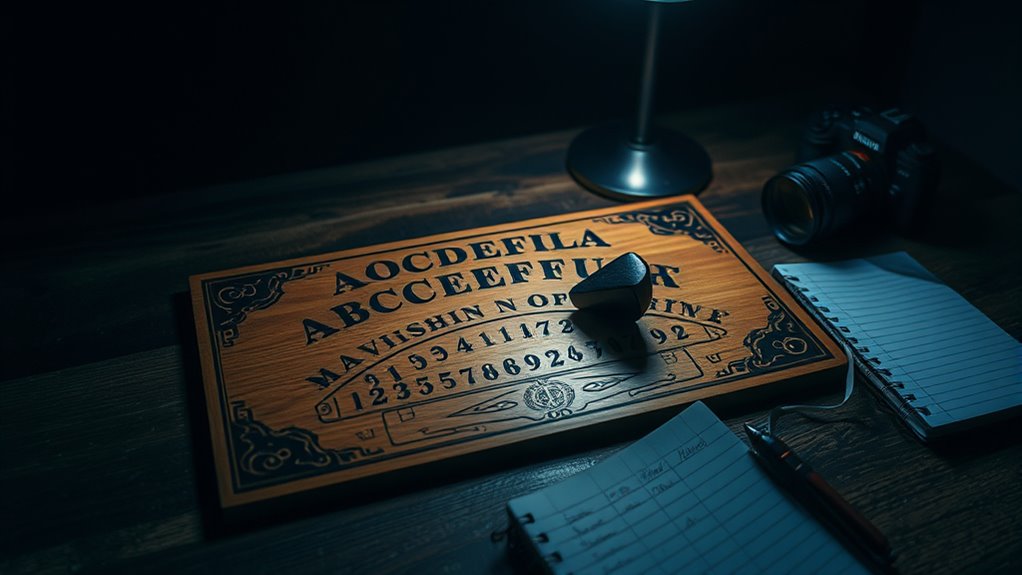
Scientific research on Ouija boards largely suggests that any perceived paranormal activity results from psychological and physiological factors rather than supernatural forces. You might experience involuntary movements, known as the ideomotor effect, where your subconscious guides the planchette. Studies show that:
Scientific studies indicate that perceived paranormal activity on Ouija boards stems from psychological and physiological factors, not supernatural forces.
- Your expectations and beliefs influence how you interpret movements.
- The brain’s tendency to find patterns leads you to see responses as meaningful.
- Fatigue, stress, or distraction can cause subtle muscle movements, affecting the game.
These factors create the illusion that spirits are communicating, but in reality, your mind and body collaborate to produce these sensations. Scientific studies emphasize that what you perceive as supernatural is often rooted in your own cognition and physiology.
Cultural Significance and Media Portrayals
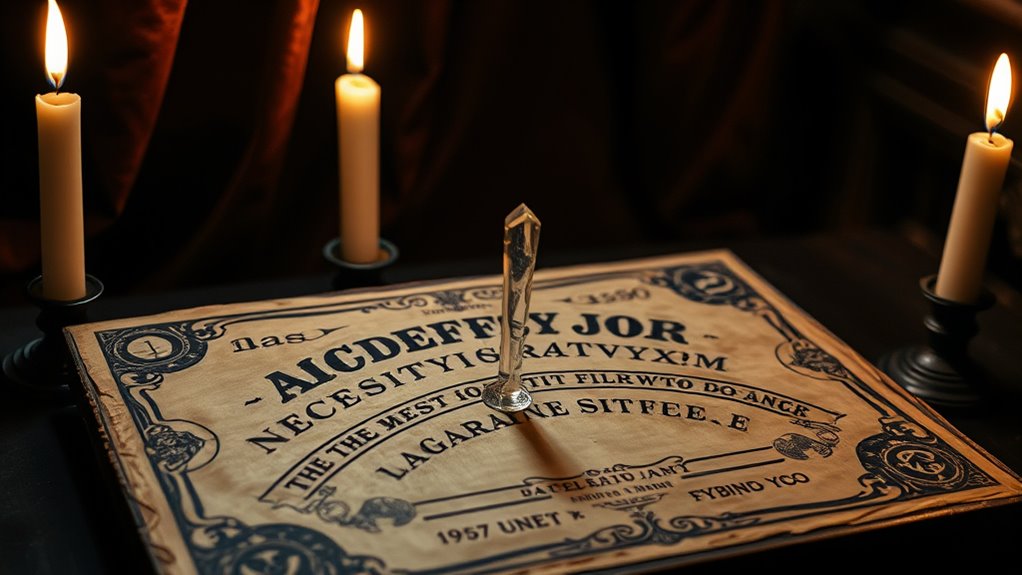
Cultural beliefs and media representations have shaped how many people perceive Ouija boards, often framing them as gateways to the supernatural. Movies, TV shows, and books frequently depict the boards as tools that summon spirits or open portals to other worlds, fueling fear and fascination. These portrayals reinforce the idea that Ouija boards are dangerous or cursed, even when many see them as simple entertainment or social activities. Popular culture also embeds symbolic meanings, associating the boards with witchcraft, ghost stories, and the occult. As a result, public perception is heavily influenced by these narratives, leading to widespread superstition and intrigue. Your exposure to these portrayals influences how you view the boards, whether as harmless fun or as something more sinister. Additionally, the use of AI analytics tools in researching public sentiment can reveal how media influences collective perceptions over time.
Common Beliefs and Superstitions
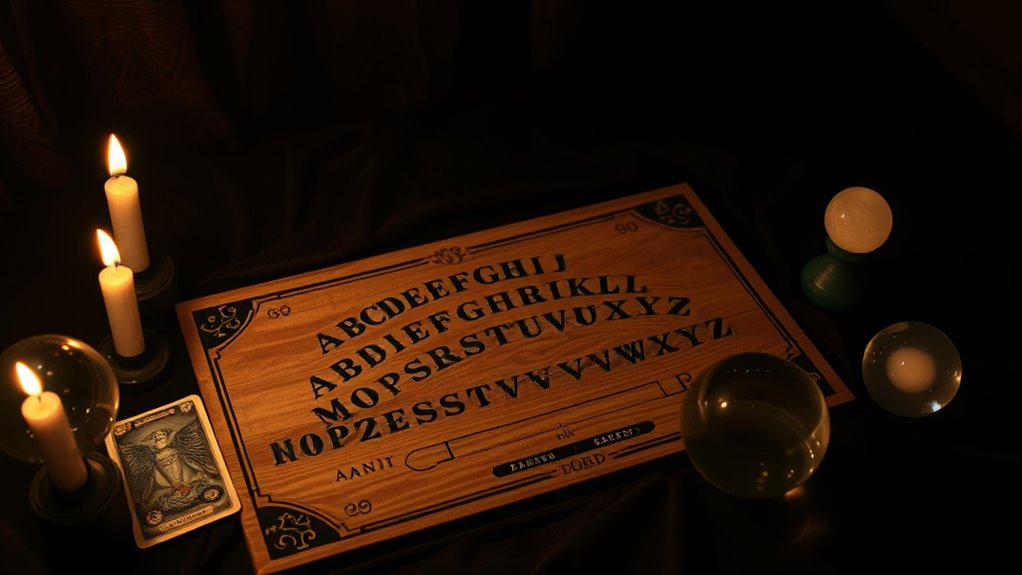
Many people approach Ouija boards with a mixture of curiosity and caution, guided by long-standing beliefs and superstitions. Some think the board is a portal to spirits, while others see it as mere entertainment. Common superstitions include:
Many approach Ouija boards with curiosity, caution, and long-standing superstitions about spirits and luck.
- Believing that the board can summon malevolent entities if used improperly or at the wrong time.
- Avoiding use during storms or on certain days, like Friday the 13th, to prevent attracting bad luck.
- Thinking that the planchette moves due to spirits or subconscious forces, and not just your own finger.
- Some believe that air purifier maintenance can influence spiritual energy, adding an extra layer of superstition to the use of such devices.
These beliefs shape how many approach the Ouija board—either with reverence or fear. Whether you believe in its supernatural power or see it as a game, these superstitions influence your feelings and behavior around it.
Notable Incidents and Alleged Encounters
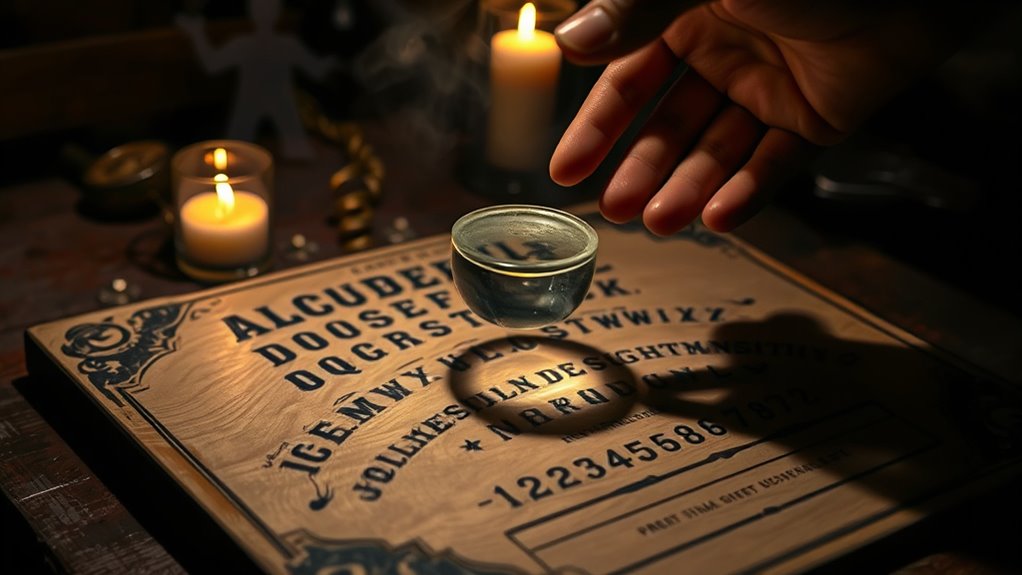
Over the years, numerous stories have emerged of people experiencing strange and unsettling events while using Ouija boards. Some report the planchette moving on its own, spelling out messages that seem impossible to control. Others claim to have encountered spirits or entities that deliver disturbing or eerie messages. There are accounts of sudden temperature drops, unexplained noises, or objects shifting unexpectedly during sessions. One well-known incident involved a group who felt an overwhelming presence, leading them to abandon the board in fear. Many of these stories circulate online and through personal testimonies, fueling the board’s reputation as a gateway to the supernatural. Additionally, some researchers highlight the role of psychological factors like suggestion and expectation in creating these experiences, which complicates the question of whether they are truly paranormal. While some dismiss these as coincidences or tricks, others believe these encounters are genuine, deepening the mystery and allure surrounding Ouija boards.
What Science Tells Us About the Phenomenon
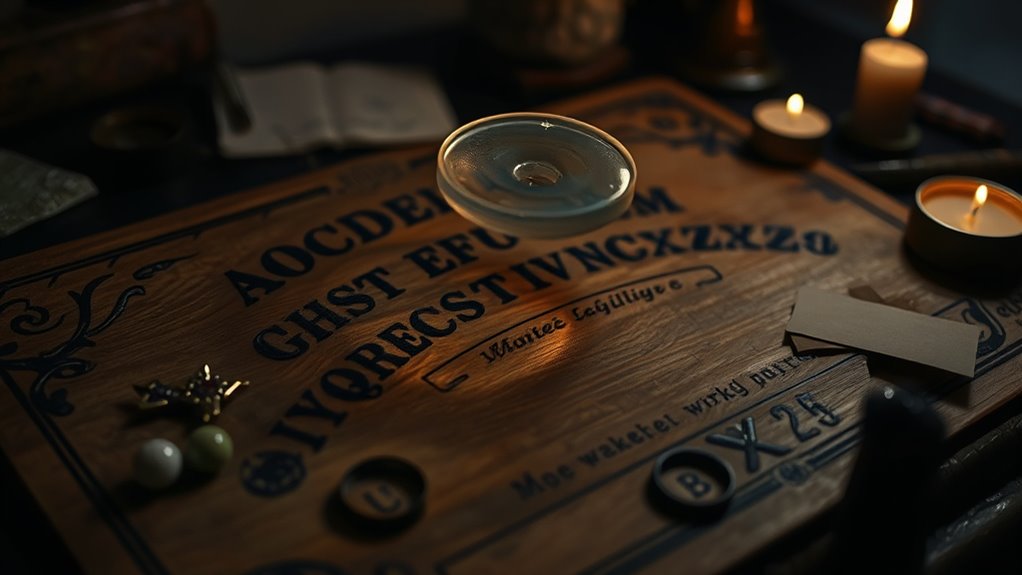
Scientists have investigated the phenomena reported during Ouija board sessions and found that most can be explained by psychological and physical factors. When you use a Ouija board, your subconscious mind often influences the movement of the planchette without you realizing it. The ideomotor effect, a well-documented psychological phenomenon, causes your muscles to subtly move in response to your expectations or beliefs. To visualize this:
- Your hand gently drifts across the board, guided by unconscious cues.
- Fingers rest lightly, making it easy for small muscle movements to steer the planchette.
- The mind fills in gaps, attributing mysterious answers to external forces rather than internal processes.
Science suggests that what feels like supernatural activity is mostly your own mind and body at work.
Frequently Asked Questions
Can Ouija Boards Connect You With Specific Spirits or Entities?
Yes, a Ouija board can connect you with specific spirits or entities, but it’s not guaranteed. The planchette moves based on your subconscious or external influences, making it hard to control or identify who or what you’re communicating with. If you get a clear message, it’s more likely a result of your expectations or the group’s collective subconscious rather than a definite connection with a particular spirit.
Are There Any Proven Methods to Control the Ouija Board’s Movements?
Studies show that about 60% of Ouija board movements are caused by the ideomotor effect, meaning your subconscious guides the planchette. To control the movements, you should focus on clear intentions and maintain steady, minimal pressure. Always remain relaxed and avoid forcing the planchette. Keep your fingers lightly on the planchette, and trust your subconscious cues. Consistent practice helps you develop better control over the board’s movements.
How Do Different Cultures Interpret the Use of Ouija Boards?
You’ll find that different cultures view Ouija boards in diverse ways. In Western traditions, many see them as tools for communication with spirits, often with caution or skepticism. In some Asian cultures, similar practices involve spiritual guidance or divination, blending with local rituals. Indigenous communities might interpret such boards as sacred objects or taboo, emphasizing respect and caution. Ultimately, cultural beliefs shape how you perceive and approach Ouija boards.
What Are the Legal Restrictions Surrounding Ouija Board Usage?
You can’t legally buy or sell ouija boards in some places like Alabama and California, where they’re considered harmful or superstitious. I once read about a haunted shop that was shut down because selling such items was illegal. Think of these laws like traffic signs—meant to keep you safe. Always check local regulations before using a ouija board, so you don’t unknowingly break the law.
Can Ouija Boards Be Safely Used by Children or Beginners?
You can use Ouija boards safely if you take proper precautions and supervise children closely. Make sure everyone understands it’s just a game, and avoid taking it too seriously. Set clear rules, like ending the session politely and not forcing it. Keep the environment positive and calm, and always oversee young or inexperienced users to ensure they don’t get overwhelmed or scared.
Conclusion
Ultimately, the mystery of Ouija boards invites you to question what’s real and what’s illusion. Like a flickering shadow on the wall, they blur the line between the known and the unknown. Whether you see them as portals to spirits or clever tricks of the mind, one thing’s certain: they ignite curiosity and wonder. So, next time you ask the board a question, remember—sometimes the truth is a whisper away from our imagination.