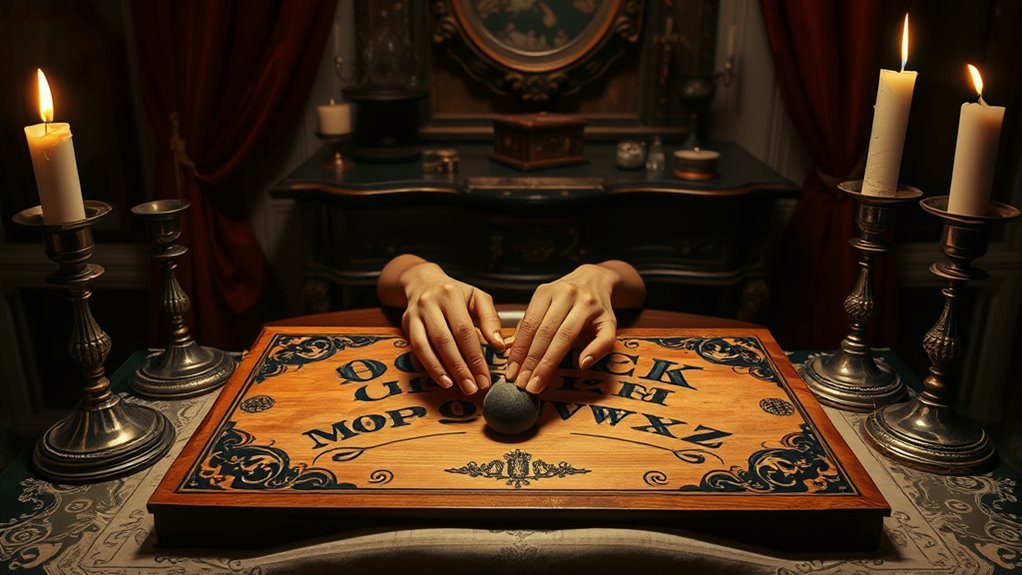

In the late 19th century, Ouija boards emerged as popular parlor games during the Victorian era, designed for entertainment, social bonding, and a touch of mystique. They combined simple boards, decorative artwork, and movable indicators to create engaging supernatural experiences. These games gained popularity across America and Europe, often blending fun with spiritual curiosity. If you want to explore how this fascinating history shaped their cultural significance, there’s much more to uncover.
Key Takeaways
- Ouija boards originated in the late 19th century during American spiritualism as simple spirit-contact tools.
- Early versions featured ornate artwork and lettered boards, combining entertainment with supernatural exploration.
- They gained popularity in Victorian parlors as social games for entertainment, bonding, and displaying social status.
- Variations added storytelling, decorative designs, and game rules, transforming them into engaging social parlor games.
- Critics and media often linked early Ouija use to supernatural phenomena, influencing public perception and cultural acceptance.
Top picks for "early ouija board"
Open Amazon search results for this keyword.
As an affiliate, we earn on qualifying purchases.
Origins and Early Designs of Ouija Boards
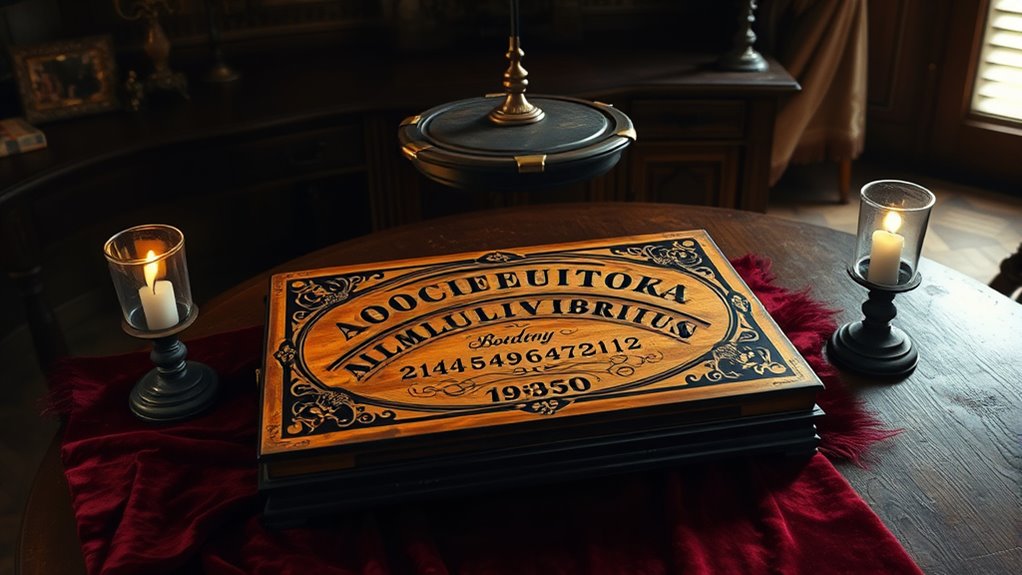
The origins of Ouija boards trace back to the late 19th century, when spiritualism gained popularity in America. During this time, people sought ways to communicate with the deceased, fueling curiosity about the supernatural. The earliest versions resembled simple cards or planchettes placed on a board with letters and numbers. These designs aimed to facilitate automatic writing or seance sessions. Charles Kennard and Elijah Bond are credited with creating the first commercial Ouija board around 1890, combining a board with a movable indicator. Early boards often featured ornate artwork and mysterious symbols, reflecting the era’s fascination with mysticism. Despite their simple appearance, these early designs laid the foundation for the modern Ouija boards, blending entertainment with a desire to contact spirits.
The Role of Parlor Games in Victorian Society

During the Victorian era, parlor games became a popular way for families and social circles to entertain themselves and demonstrate social status. These games fostered social bonding, showcased wit, and displayed wealth through elaborate setups. They also reflected societal values, emphasizing manners and decorum. Many games, like charades or card tricks, encouraged interaction and conversation. Here’s a quick look at some common Victorian parlor games:
| Game | Purpose |
|---|---|
| Charades | Showcase acting and wit |
| Card Games | Display social status and skill |
| Question Games | Promote conversation and wit |
| Tableaux Vivants | Demonstrate artistic taste |
| Ouija Boards | Explore the supernatural and curiosity |
These games shaped social life, making gatherings lively and engaging. Ouija boards gained particular popularity as a means of exploring the supernatural and curiosity.
How Ouija Became a Social Entertainment
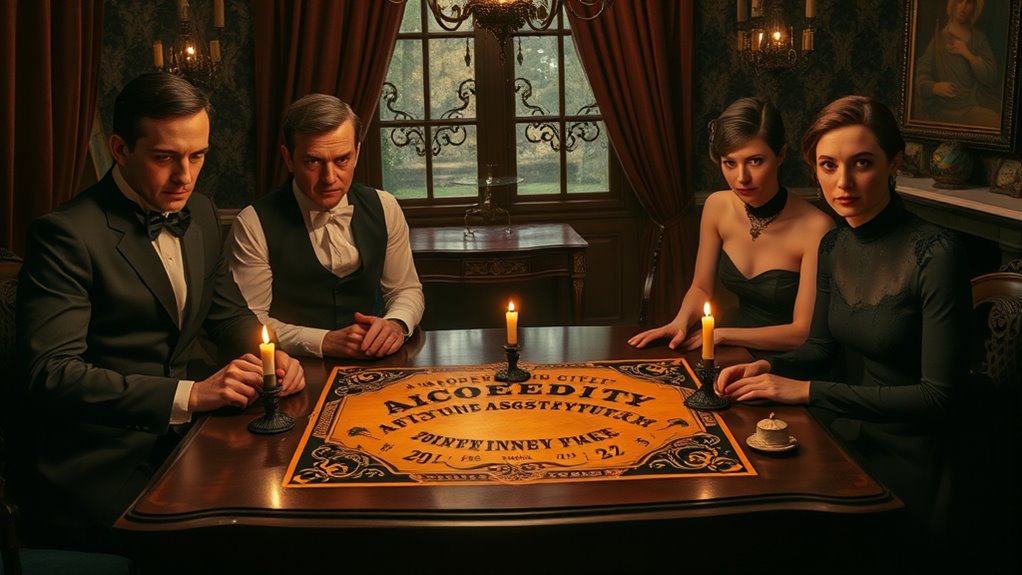
You probably noticed how Ouija boards gained popularity at social gatherings, turning into a common parlor game. Different variations of these games emerged, blending entertainment with curiosity. While many embraced them as harmless fun, others remained skeptical, reflecting the mixed cultural acceptance of the time.
Popularity in Social Gatherings
As Ouija boards gained popularity, they quickly became a staple at social gatherings, attracting groups enthusiastic to explore the mysterious and the supernatural. You’ll notice friends gathering around the board, excited to communicate with spirits or test their luck. It’s not just about the thrill; it’s about shared experiences that create a sense of mystery and camaraderie. People often used Ouija to break the ice or add excitement to parties, making it a fun, social activity. The boards became a conversation piece, sparking debates and curiosity. As more groups embraced the game, it cemented its place as a common entertainment in parlors. Its accessibility and mystique made it appealing, drawing people together to seek answers beyond the ordinary. Additionally, the social use of Ouija boards contributed to their reputation as a form of appliance-related entertainment, becoming an intriguing part of social interactions during that era.
Variations of Parlor Games
How did Ouija boards evolve into one of many popular parlor games? Initially, people used simple tools like planchettes and boards to connect with spirits, but over time, creators developed variations to enhance the experience. Manufacturers added decorative designs, personalized layouts, and even game-like rules to make the activity more engaging and accessible. Some versions incorporated storytelling elements or competitive play, turning the séance-like activity into a social game. These adaptations made Ouija boards more than just spiritual tools—they became entertainment for groups seeking mystery and fun. The modifications helped embed Ouija into social gatherings, transforming it from a serious spiritual instrument into a versatile parlor game that appealed to a broad audience. Historical popularity of Ouija boards also increased as their design and rules became more refined, making them appealing for casual entertainment.
Cultural Acceptance and Skepticism
The transformation of Ouija boards from spiritual tools into popular social entertainment sparked both fascination and skepticism. As you participate in parlor gatherings, you notice how many embrace Ouija as a fun, mysterious activity, blending entertainment with a touch of the supernatural. People are drawn to the idea of communicating with spirits, fueling curiosity and social bonding. However, skepticism runs deep, with many questioning whether the movements are deliberate or subconscious. Critics argue that Ouija is merely a game, influenced by suggestion and psychology. Despite doubts, its popularity persists, and it becomes a cultural phenomenon. The balance of belief and skepticism shapes how society accepts Ouija boards—viewed either as harmless fun or as something more mysterious. Additionally, understanding projection techniques and psychological influences helps explain why participants often experience convincing but subconscious responses.
The Mechanics and Rules of Early Play
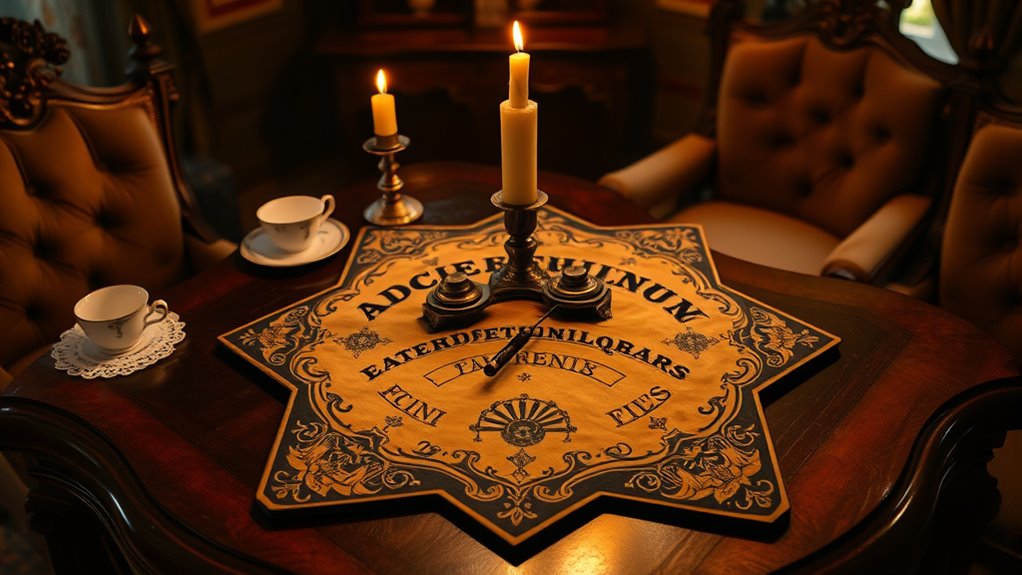
Understanding the mechanics and rules of early play is essential to grasp how Ouija boards functioned in their initial use. Typically, players gathered around a flat board with letters, numbers, and words like “Yes” and “No.” They placed their fingers lightly on a planchette, a small, movable pointer. The goal was to allow spirits or subconscious minds to guide the planchette across the board, spelling out messages. Players often took turns asking questions, keeping their fingers on the planchette without applying pressure. The movement was believed to be caused by spirits or subconscious influences. Rules varied, but the general idea was to maintain a respectful, focused environment. The game relied on collective participation and belief in supernatural guidance to produce meaningful responses. Compatibility factors and communication styles played a role in how participants interacted during sessions.
Popularity in America and Europe
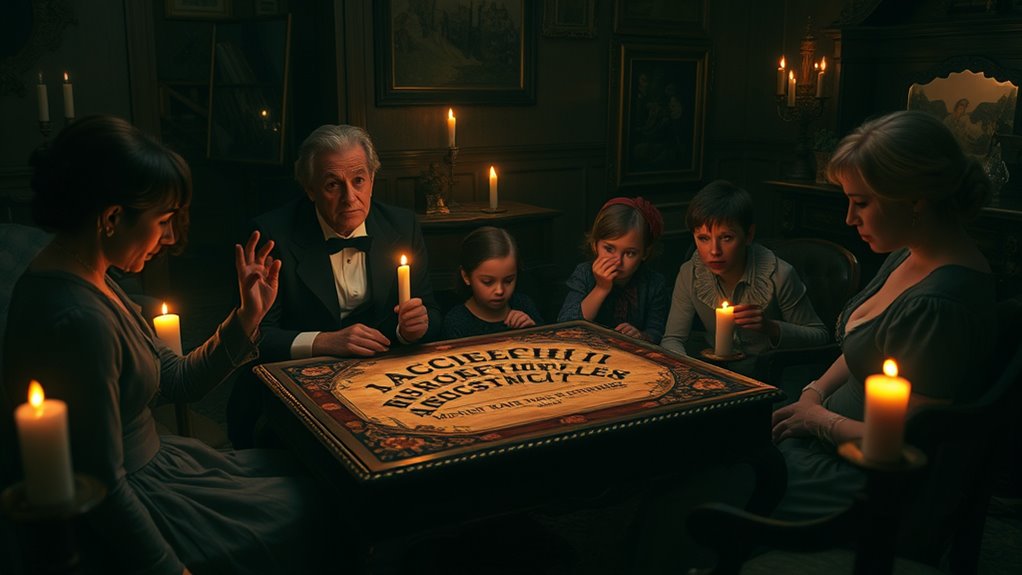
You’ll notice that Ouija boards gained popularity differently in America and Europe, reflecting unique cultural trends. Social gatherings evolved as people embraced the boards for entertainment and spiritual connection, adapting to local customs. Variations in regions show how the game’s appeal shifted based on cultural attitudes and practices.
Cultural Adoption Trends
During the early 20th century, Ouija boards gained remarkable popularity in both America and Europe, capturing the public’s fascination with communicating with spirits. This trend reflected a broader cultural interest in the supernatural and the desire to connect with the unknown. You’d see them featured in social clubs, private homes, and even in popular entertainment, becoming a common parlor fixture. The boards’ mystique appealed to a wide audience, crossing social classes and age groups. Media coverage and word-of-mouth helped propel their popularity, making Ouija boards a cultural phenomenon. People embraced them as a fun, intriguing way to explore spirituality, blending entertainment with curiosity about the afterlife. Their widespread acceptance marked a significant shift in how societies engaged with mysticism and the supernatural. Additionally, the rise of Etsy Shops specializing in vintage and spiritual items contributed to their continued cultural relevance.
Social Gatherings Evolution
The popularity of Ouija boards transformed social gatherings in America and Europe, turning them into spirited and often mysterious events. Friends would gather around, enthusiastic to connect with spirits or test their luck. The room would fill with anticipation, laughter, and nervous whispers. As the planchette moved, hands would drift closer, eyes wide with curiosity. The atmosphere grew electric, blending entertainment with a sense of the supernatural. You’d see:
- Candlelit rooms casting flickering shadows
- Curious faces leaning in, eyes fixed on the board
- Nervous giggles and hushed conversations
- The slow, deliberate movement of the planchette
- Participants taking turns, daring each other to ask questions
- These gatherings often relied on psychological suggestion to enhance the sense of supernatural influence.
Variations in Regions
As Ouija boards gained popularity in social gatherings, their appeal varied considerably across regions. In America, they quickly became a fixture in parlors, embraced for their mysterious allure and connection to spiritualism. Many Americans saw them as a fun, supernatural game, often involving friends and family. In Europe, however, opinions were more divided. Some viewed Ouija boards with suspicion and skepticism, considering them dangerous or associated with dark forces. Others approached them as entertainment or curiosity, especially in countries like France and Germany. Cultural attitudes influenced how widely they were used and accepted. Additionally, understanding and adapting to different cultural perceptions with high Cultural Intelligence can influence how such phenomena are viewed and integrated into social practices. Overall, regional differences shaped how people perceived and engaged with Ouija boards, making their history diverse and multifaceted across different parts of the world.
Media Influence and Public Perception
Media coverage has played a significant role in shaping public perceptions of Ouija boards, often amplifying fears and misconceptions. News stories link the boards to paranormal activity, accidents, and even possessions, fueling suspicion and dread. You might imagine headlines warning of evil spirits or describing ominous events tied to their use. Films and TV shows often depict Ouija boards as gateways to malevolent forces, reinforcing the idea that they’re dangerous tools. Public opinion is influenced by sensational stories, making many see the boards as sinister or taboo. Visualize images of darkened rooms, flickering candles, and tense faces as people attempt to contact the beyond. These portrayals create lasting impressions that influence how society views the boards, often overshadowing their original playful intent. Additionally, the rise of clean beauty and wellness trends has encouraged a more cautious approach to such devices, emphasizing safety and skepticism over superstition.
Notable Figures and Their Experiences
Throughout history, several notable figures have claimed to have profound experiences with Ouija boards, lending both intrigue and skepticism to their reputation. For example, educator and spiritualist Helena Blavatsky believed the board could connect her with higher beings, influencing her mystical teachings. Psychologist William James experimented with Ouija to explore consciousness and the subconscious mind, reporting intriguing results. Inventor Thomas Edison reportedly showed interest, though there’s little evidence he used one personally. Mediums and spiritualists like Pearl Curran used Ouija boards to communicate with spirits, claiming it validated their work. These figures, whether genuinely convinced or skeptical, helped popularize the board’s mystique. Their experiences fueled debates about the board’s supernatural origins and its potential as a tool for spiritual communication. Additionally, the fascination with Ouija boards has persisted in popular culture, inspiring films, books, and ongoing discussions about the nature of the supernatural and AI safety concerns.
Transition From Parlor Game to Cultural Icon

How did the Ouija board evolve from a simple parlor game into a cultural icon recognized worldwide? Its popularity soared through Hollywood movies, where spirits and supernatural forces became central themes. Media coverage amplified its mystique, sparking curiosity and fear. Manufacturers marketed it as both entertainment and a tool for spiritual communication, fueling debates about its powers. Over time, it shifted from a game to a symbol of the unknown, inspiring books, art, and popular culture.
The Ouija board evolved from a simple game into a worldwide cultural icon, inspiring movies, art, and debates about the supernatural.
Imagine:
- A dimly lit room with candles flickering around a Ouija board
- Children giggling as their fingertips lightly touch the planchette
- An eerie glow illuminating mysterious symbols
- A collector’s shelf filled with vintage boards
- A movie theater scene with the Ouija board as the centerpiece
Frequently Asked Questions
How Did Spiritualists Influence the Development of Early Ouija Boards?
Spiritualists greatly influenced the development of early Ouija boards by popularizing spirit communication as a way to connect with the afterlife. They experimented with various tools, seeking to channel spirits, which led to the creation of the planchette and the board itself. Their interest in séances and mediumship shaped Ouija’s design and purpose, turning it into a device believed to facilitate direct contact with spirits, fueling its mystique and appeal.
Were There Any Legal Restrictions on Using Ouija Boards Historically?
You might think there were strict laws against Ouija boards, but historically, restrictions were rare. In fact, some regions even saw them as harmless entertainment rather than dangerous tools. However, in certain areas, religious groups or authorities tried to ban or discourage their use, fearing spiritual harm or superstition. Overall, legal restrictions weren’t widespread, and many people enjoyed Ouija boards as fun parlor games without consequences.
Did Different Countries Have Unique Variations of Ouija or Similar Games?
Yes, different countries had unique variations of ouija or similar games. In France, they played “L’Oracle,” using different symbols and methods. In Germany, “Wunschglas” involved writing messages on glass. Japan had “Kokkuri-san,” a spiritual game resembling a spirit board but with unique cultural rituals. These variations reflect local beliefs, language, and customs, creating distinct experiences that adapted the core idea of communicating with spirits across cultures.
How Did Early Ouija Boards Influence Later Paranormal Research?
Early Ouija boards ignited a paranormal revolution, shaping modern research more than you realize. They sparked widespread fascination, convincing many that spirits communicated through them. This obsession led scientists and enthusiasts to develop new methods for studying the supernatural, pushing boundaries of what’s possible. Without these early boards, the intense curiosity and experimental spirit in paranormal research today might never have exploded into the global phenomenon it is now.
Were There Specific Cultural Fears Associated With Ouija Board Use?
Yes, there were specific cultural fears linked to Ouija board use. You might have worried about inviting spirits or negative entities into your space, fearing they could cause harm or influence your life in unsettling ways. Many believed the boards could open portals to malevolent forces or reveal secrets best left hidden. These fears reflected broader anxieties about the supernatural and the unknown, fueling suspicion and caution around their use.
Conclusion
So, next time you’re tempted to dismiss the Ouija as just a silly game, remember it once graced Victorian parlors, promising communication with the beyond. Who knew that a simple board could become a cultural icon, stirring both fascination and fear? Maybe it’s time to dust off your own spirit board—just don’t be surprised if your dinner guests start questioning your sanity or if the spirits demand a tip.