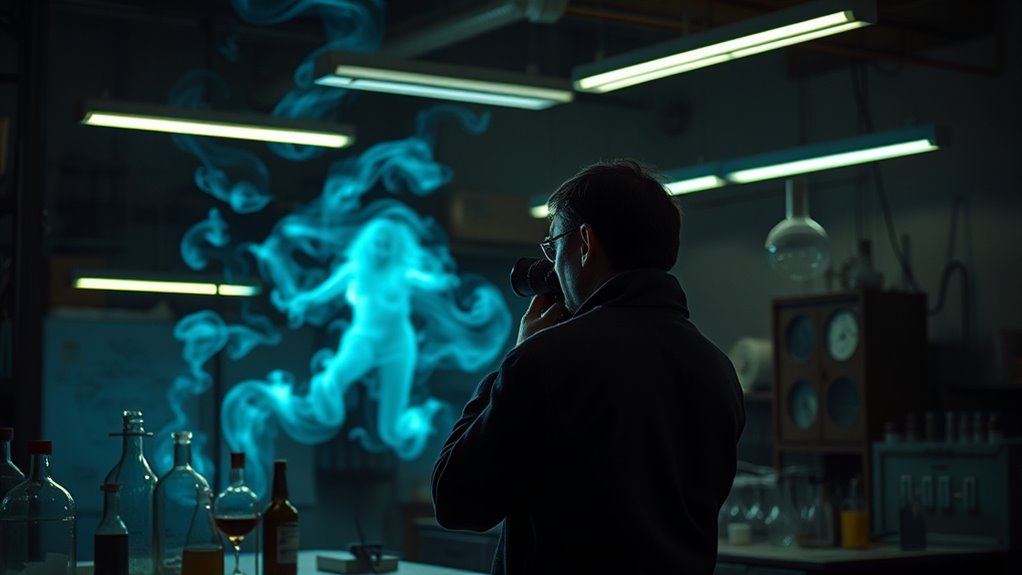

Science can help you investigate the paranormal by using tools like spectral analysis and electromagnetic testing to find unseen energies or spirits. By combining data from different methods, you can better distinguish genuine anomalies from natural interference. While science hasn’t fully proven the supernatural, it advances our understanding of mysterious phenomena. To discover how researchers are making progress and facing challenges, keep exploring the methods behind scientific ghost hunting.

Get movie nights delivered free with Prime
- Fast, free delivery on millions of items
- Prime Video, Amazon Music and more included
- Member-only deals all year
Key Takeaways
- Scientific ghost hunting combines spectral and electromagnetic analysis to seek empirical evidence of paranormal phenomena.
- Rigorous testing aims to differentiate genuine paranormal signals from environmental or electrical interference.
- Correlating spectral anomalies with electromagnetic fluctuations enhances the credibility of potential paranormal findings.
- Using controlled lab environments increases the reliability and repeatability of paranormal investigations.
- While science seeks to prove or disprove the supernatural, current methods focus on understanding energy and environmental factors.
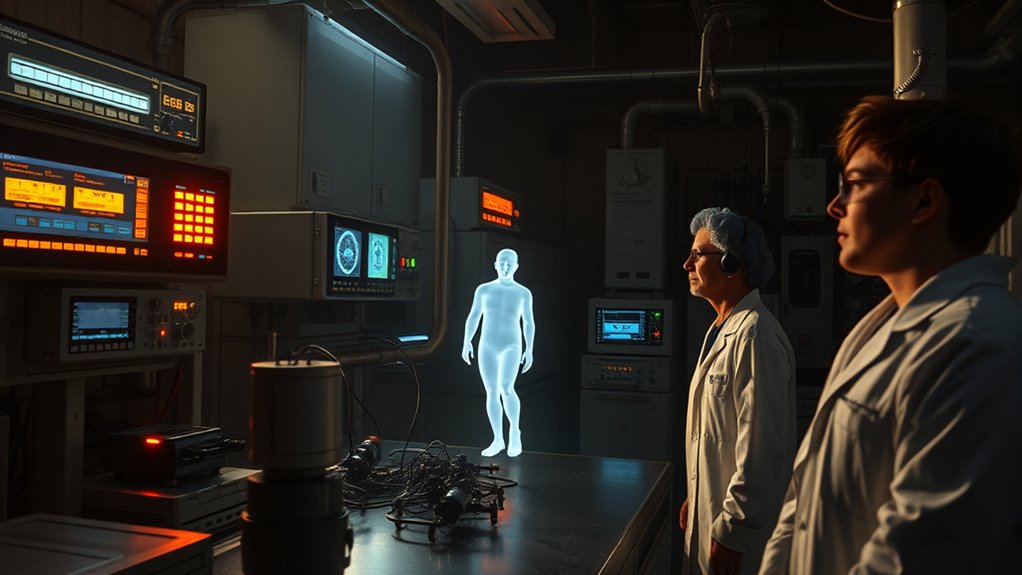
Many wonder what it would be like to hunt for ghosts in a laboratory setting, where science and the supernatural collide. It’s a fascinating idea—bringing the mystery of the paranormal into a controlled environment to test its very existence. When you step into this world, you realize that scientific methods like spectral analysis and electromagnetic testing are at the forefront of this pursuit. These tools aim to uncover unseen phenomena and determine whether spirits truly leave detectable traces behind.
Spectral analysis involves examining the energy spectrum emitted by unknown sources. In a lab, you might use sophisticated equipment to analyze unusual light patterns or energy signatures that can’t be explained by natural causes. For instance, if you detect spectral anomalies—such as specific frequencies or patterns not associated with known objects or environmental factors—you might consider them potential indicators of paranormal activity. The goal here is to differentiate between normal environmental signals and those that could be linked to spirits or other supernatural entities. The process demands precision and a keen understanding of how various energy forms behave, making spectral analysis a essential part of scientific ghost hunting. Additionally, understanding the physics of energy emissions can help distinguish genuine paranormal signals from artifacts or noise. Incorporating knowledge of environmental factors is also crucial in interpreting the data accurately.
Spectral analysis detects unusual energy signatures as potential signs of paranormal activity in a controlled environment.
Electromagnetic testing is another key method. Many ghost hunters believe that spirits can influence electromagnetic fields, causing fluctuations detectable by sensitive instruments. In a lab setting, you can use electromagnetic field (EMF) meters to monitor changes in the environment. When you notice sudden spikes or irregularities in EMF readings, it raises questions: Are these fluctuations caused by electrical devices, or could they be linked to unseen presences? By controlling variables and eliminating potential sources of interference, you aim to identify genuine anomalies. The challenge lies in ensuring that these electromagnetic disturbances aren’t just environmental noise—finding the line between natural electromagnetic interference and something more mysterious.
Integrating spectral analysis with electromagnetic testing creates a holistic approach. You analyze both the energy signatures and electromagnetic fields concurrently, seeking correlations that might point to paranormal entities. This combination helps rule out false positives caused by mundane sources, giving your investigation more credibility. Of course, skeptics argue that many anomalies can be explained through physics, environmental factors, or equipment sensitivity. Still, the pursuit remains intriguing because it pushes the boundaries of scientific understanding and challenges us to explore the unknown.
In the end, conducting ghost hunts in a laboratory isn’t about proving the supernatural outright—it’s about applying rigorous science to a phenomenon long shrouded in mystery. By leveraging spectral analysis and electromagnetic testing, you get closer to understanding whether these phenomena are genuine or simply the products of natural processes. Whether or not you find definitive proof, the process sharpens your scientific skills and fuels the ongoing quest to reconcile the paranormal with empirical evidence.
Frequently Asked Questions
What Equipment Is Most Effective for Detecting Paranormal Activity?
When you’re trying to detect paranormal activity, you’ll want equipment with high sensor accuracy to guarantee reliable readings. EMF meters are popular because they detect electromagnetic interference, which some believe indicates ghost presence. However, be cautious, as electromagnetic interference from electronic devices can cause false positives. Combining multiple tools like thermal cameras and audio recorders can improve your chances of capturing genuine activity while minimizing interference issues.
How Do Scientists Differentiate Between Real and False Paranormal Signals?
When you’re trying to tell real paranormal signals from false ones, you need to rely on scientific validation and paranormal skepticism. You compare data from different tests, look for consistent patterns, and eliminate environmental factors. Scientists differentiate by replicating findings and applying rigorous controls, ensuring that what seems paranormal isn’t just noise or interference. This process helps confirm whether a signal’s genuinely supernatural or just a false positive.
Have Any Laboratory Experiments Definitively Proven the Existence of Ghosts?
Imagine trying to catch a shadow in a dark room—exciting, but often inconclusive. You wonder if any lab experiments have definitively proven ghosts. Currently, paranormal skepticism remains high because laboratory limitations hinder clear, repeatable evidence. Scientists haven’t confirmed the existence of ghosts through controlled experiments, as many phenomena are difficult to reproduce reliably. So, despite intrigue, science still seeks concrete proof beyond anecdote or illusion.
What Are the Biggest Challenges in Ghost Hunting Within a Lab Setting?
You face major challenges in ghost hunting within a lab setting, mainly due to technological limitations that hinder accurate detection and measurement. Ethical concerns also arise, as experiments must respect privacy and avoid causing harm. These issues make it difficult to create controlled conditions, reducing the likelihood of obtaining conclusive evidence. Overcoming these hurdles requires innovative tools and strict ethical standards to guarantee credible and responsible research.
Can Psychological Factors Influence Scientific Ghost Detection Results?
You might think science can easily prove the paranormal, but psychological factors like mass hysteria and cognitive biases often influence results. These biases can lead you to see patterns or anomalies where none exist, skewing data and interpretations. While science endeavors for objectivity, your perceptions are susceptible to psychological influences, making it essential to recognize how the mind can shape ghost detection outcomes. This awareness helps you approach findings more critically.
Conclusion
As you stand at the crossroads of science and the unknown, remember that the quest to prove the paranormal is like chasing shadows in a moonlit fog—elusive yet entrancing. While labs endeavor to capture the whispers of ghosts, they often find only echoes of doubt. Perhaps the true mystery isn’t in the evidence you seek, but in the wonder that keeps you searching. After all, some secrets are best left dancing just beyond the reach of certainty.
Fall Picks
fall essentials
As an affiliate, we earn on qualifying purchases.